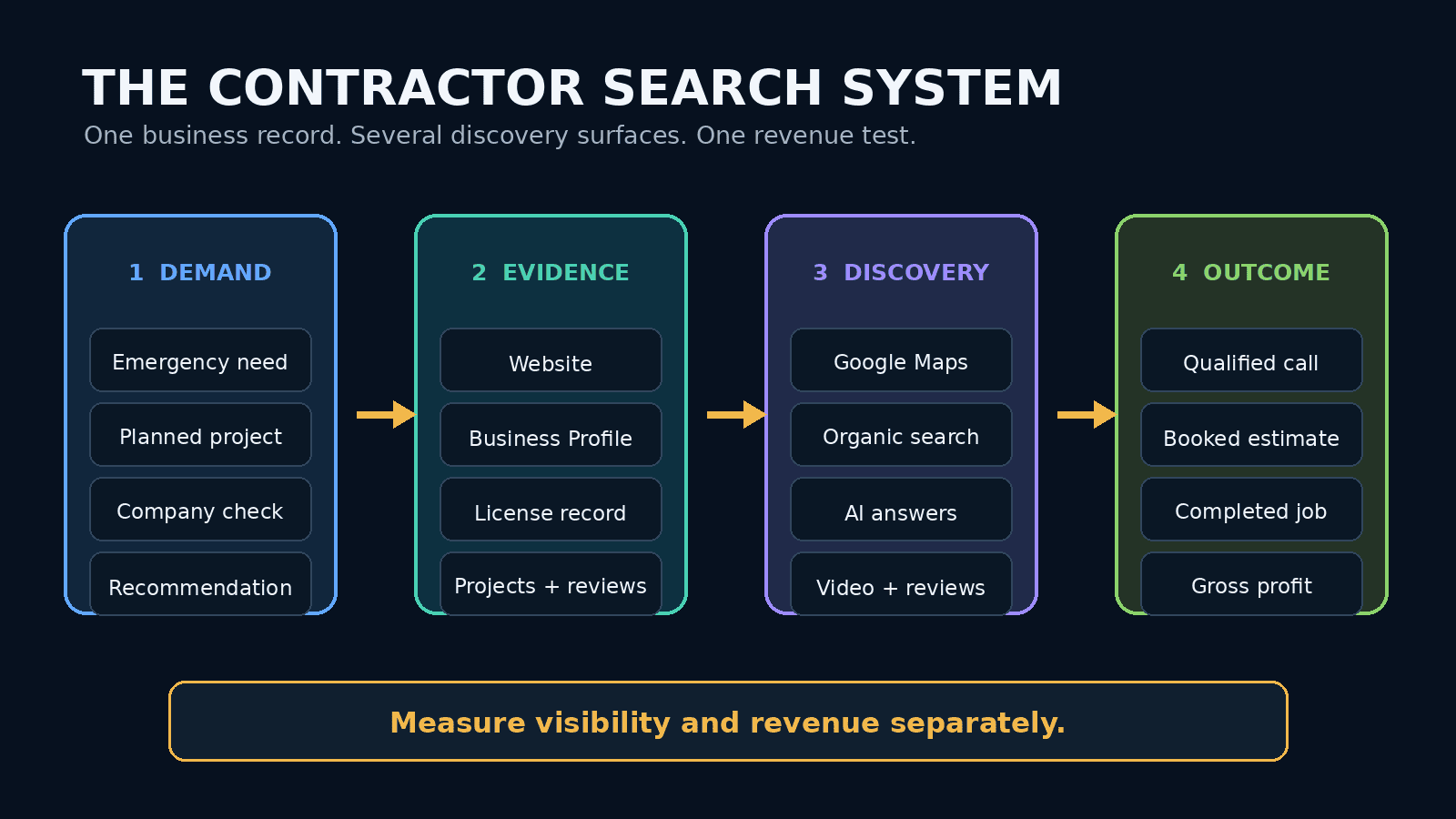
Contractors win search in 2026 by making one real business easy to find and verify across Google Maps, organic results, AI answers, reviews, licensing records, and third-party sources. You do not need separate, disconnected SEO, AEO, and GEO campaigns. You need one search operation that maps commercially useful demand, strengthens the records you control, earns outside corroboration, and tracks which visibility turns into booked work.
The operating rule: Own the facts about your business. Make those facts consistent. Publish proof that competitors cannot copy. Then measure visibility by service, city, and buying intent instead of celebrating traffic that never becomes a call.
Google still matters, but the result page is changing. Google Maps, Local Services Ads, organic listings, AI Overviews, videos, reviews, and brand results may all appear during one buying decision. Standalone AI products add another route. The homeowner may never follow the neat path your marketing report assumes.
That does not mean search is dead. It means the contractor has more places to be misunderstood.
Search changed around SEO, not instead of it
Google’s current guidance is unusually direct: its generative search features are rooted in the same core ranking and quality systems used by Search. Google says website owners should keep working on technical access, useful original content, local business details, and normal SEO rather than chasing special AI markup or a separate writing style.1
The click environment has changed. Pew Research Center analyzed browsing activity from 900 U.S. adults in March 2025. AI summaries appeared in 18% of the Google searches in that study. People clicked a traditional result during 8% of visits with an AI summary, compared with 15% when no summary appeared. Only 1% of visits with an AI summary produced a click on a cited source.2
Those figures describe one study period, not every contractor query in every market. They still establish the operational problem. A contractor can gain visibility without gaining a website visit. Traffic alone no longer captures the whole result.
For a local service company, Google Maps remains a separate contest inside the larger search market. Google’s own Business Profile guidance says local results mainly depend on relevance, distance, and prominence. Complete information can improve relevance. Reviews and links can contribute to prominence. Distance remains a physical constraint that a blog post cannot erase.3
The practical conclusion is not “move the SEO budget into AI.” It is this: protect Google Maps and organic search, make your business legible to AI systems, and stop measuring all three as if they were the same channel.
A contractor’s search market has four different jobs
A generic software company can think in national categories. A contractor has to account for service radius, crew capacity, licenses, emergency response, project value, and local proof. The search market should reflect those constraints.
| Search job | Typical behavior | Where the contractor must be credible |
|---|---|---|
| Immediate local need | “AC repair near me,” “emergency plumber,” or “electrician open now” | Google Maps, Local Services Ads where eligible, mobile organic results, phone and booking paths |
| Planned project research | Costs, options, timelines, materials, financing, and contractor comparisons | Service pages, cost guides, project pages, videos, AI Overviews, and organic results |
| Business validation | Brand search, reviews, license checks, complaint searches, team and warranty questions | Website, Business Profile, state license record, review profiles, manufacturer and association listings |
| Recommendation request | “Who installs heat pumps in this area?” or “Which remodeler handles accessible bathrooms?” | AI assistants, Maps, directories, publications, community discussions, and the sources those systems cite |
Each job can lead to the same sale, but it requires different evidence. A fast-loading emergency page does not replace a healthy Business Profile. A five-star profile does not explain whether the company installs steam boilers. A license record proves a credential, but it does not prove good intake or customer service.
Profitability sets the boundary. Visibility outside the service area, or for work the crews do not want, is waste rather than market ownership.
Humans and machines are reading the same evidence chain
Search engines and answer systems are not a second customer. They are intermediaries trying to identify the business, interpret its services, and decide whether the available evidence supports inclusion in a result.
Google explains that Business Profile information can come from a company’s official website, licensed third-party data, public web content, user contributions, reviews, photos, and business owners.4 That is why a contractor’s online presence behaves less like a collection of pages and more like an evidence chain.
| Evidence layer | Examples | What can go wrong |
|---|---|---|
| Identity | Brand, legal entity, domain, phone, address or service-area status | Old phone numbers, unexplained DBAs, duplicate profiles, former addresses |
| Authority to perform work | License holder, credential class, jurisdiction, expiration, permits where relevant | The website claims services beyond the credential or names the wrong license holder |
| Service proof | Detailed service pages, project records, original photos, equipment and process details | One generic paragraph covers ten services with no evidence |
| Geographic proof | Real service areas, local projects, dispatch limits, Business Profile settings | Mass-produced city pages claim places the company rarely serves |
| Independent corroboration | Customer reviews, state records, manufacturer listings, associations, local coverage | The company makes a claim that no outside source supports |
| Conversion proof | Working phone, form, scheduler, response process, source attribution | The company becomes visible but loses the lead after the click or call |
Schema can describe parts of this chain. It cannot repair a contradiction. A LocalBusiness block that says one phone number while the Business Profile and footer show two others gives machines a cleaner version of an unresolved problem.
Map commercial search coverage before publishing
Most keyword exports are too broad for a local contractor. They include national questions, do-it-yourself traffic, jobs outside the dispatch radius, and topics the company cannot monetize. A useful search map starts with work the company wants.
Build the map across three dimensions:
- Service: AC repair, panel upgrades, drain cleaning, roof replacement, accessible shower installation, or another real line of work.
- Geography: the cities, neighborhoods, or ZIP areas the company can serve at an acceptable drive time and margin.
- Intent: immediate need, cost research, option comparison, problem diagnosis, company validation, or recommendation.
A small HVAC company might track the following cells:
- AC repair in its home city, immediate need.
- Heat pump replacement in two expansion cities, planned purchase.
- Heat pump versus gas furnace, comparison.
- Company name plus reviews, license, financing, or warranty, validation.
- “Who installs cold-climate heat pumps near me?”, recommendation.
Do not create a page for every cell. Some belong on the same strong page. Some belong in the Business Profile. Some need a project case study, a video, a review program, or an outside listing. The map tells you what must be answered. It does not dictate one URL per phrase.
Our broader SEO guide for contractors covers local, content, technical, and authority work in detail. This search map sits above that work and decides where effort should go first.
The plan changes by trade
A contractor SEO guide becomes generic when it treats every trade like the same business with different nouns. Search intent, job urgency, proof, and capacity change the plan.
| Trade | Demand that deserves priority | Proof worth publishing | Pages and records to build first |
|---|---|---|---|
| HVAC | Emergency repair, seasonal replacement, system comparisons, rebates, and financing | Equipment models, load or sizing process, cold-weather or high-heat performance, local projects, and response coverage | Repair pages by system type, replacement pages, heat-pump guidance, Business Profile services, and project records |
| Plumbing | Urgent leaks and stoppages, water heaters, sewer work, repipes, and inspection-driven repairs | License relationship, diagnostic process, camera or testing evidence, permit handling, warranties, and completed jobs | Emergency and drain pages, water-heater options, sewer and repipe pages, service-area limits, and review requests tied to the work performed |
| Electrical | Safety problems, panel upgrades, generators, EV charging, rewires, and permitted commercial work | Credential class, permit process, load calculations, equipment, inspection outcomes, and project scope | Panel, generator, EV-charger, and troubleshooting pages; license identity; commercial capability pages where the crew can support them |
| Roofing | Leaks, storm response, replacement, material comparisons, insurance questions, and commercial systems | Inspection findings, roof system, manufacturer status, project photos, warranty terms, service radius, and storm-response boundaries | Repair and replacement pages, material pages, storm process, commercial system pages, project evidence, and accurate seasonal hours |
| Remodeling | Kitchen, bath, accessibility, additions, design-build, budget ranges, and contractor validation | Before-and-after work, design process, realistic sequencing, permit responsibility, material decisions, and portfolio depth | Project-type pages, portfolio case studies, process and budget guidance, consultation path, and brand-validation searches |
The table is a starting model, not a publishing quota. A two-person electrical shop should not build a commercial-generator campaign because the keyword tool found volume. A remodeling company should not chase emergency traffic it cannot answer. Search coverage has value only when the operation can take the work.
Win the records and pages you control
Google Maps is an operating record, not a citation project
Google says local results mainly depend on relevance, distance, and prominence.3 Contractors can improve the record Google evaluates. They cannot write their way around distance or turn a rented mailbox into a legitimate staffed location.
Google’s representation guidelines say the profile should reflect the business as it operates in the real world. The address or service area must be accurate, the company should use the fewest categories needed to describe the core business, and one business should normally have one profile.7
- Verify the correct profile and resolve duplicates before adding content.
- Choose the primary category that matches the main line of work. Add secondary categories only for substantial services the company performs.
- Use a real customer-facing address only when the location qualifies. Service-area businesses should configure the profile for how they serve customers.
- Keep hours, holiday hours, phone, website, services, booking links, and service areas current.
- Add original project photos with enough context for a customer to understand the work.
- Request reviews steadily and answer them. Do not script customers into repeating keywords or buy review bursts.
Measure Maps visibility as a local grid rather than one search from the office. Record the query, test points, date, device assumptions, and whether the company appeared in the local three-pack. A contractor that ranks near its address but disappears six miles toward the target neighborhoods has a different problem from a contractor that is absent everywhere.
The website must support the same relevance. A complete profile cannot replace a missing service page, and a city page cannot erase the distance between the searcher and the business. Google says complete and accurate information improves a business’s chance of appearing for relevant local searches.3
Build money pages before an article factory
Give each substantial service a useful page. Give a city its own page only when the company can show real service intent, operating capacity, and local proof. Explain price drivers, process, boundaries, equipment, warranties, and the next step. Add original project evidence when customer privacy allows it.
Google’s generative search guidance specifically favors non-commodity content based on real experience. It warns against recycling information that any site or language model could produce.1 For a contractor, the defensible material is already in the operation: job photos, unusual failures, permit conditions, equipment choices, dispatch realities, callbacks, and lessons from completed work.
Fix access before asking for citations
Important pages must return HTTP 200, remain indexable, use the intended canonical, appear in the sitemap, and receive internal links. Calls, forms, and scheduling must work on mobile. A page blocked by robots.txt or a security rule cannot become a dependable search asset.
The KKS contractor AEO guide provides the detailed identity, crawler, schema, and citation checklist.
Influence outside sources without faking consensus
A contractor controls its website and Business Profile contributions. It does not control the state license record, a customer’s review, a manufacturer directory, a local news story, or a community discussion. Those outside records matter because they can confirm or contradict the controlled record.
Start with sources that buyers already use:
- State and local license records.
- Google reviews and relevant trade-specific review profiles.
- Manufacturer, dealer, certification, and association directories.
- Local chambers, suppliers, project partners, and community organizations.
- Useful videos showing real work and explaining common decisions.
- Local publications that cover projects, hiring, expansion, safety, or community work.
Do not create fake Reddit accounts, buy manufactured reviews, or pay for irrelevant listicles. Google warns that inauthentic mentions are not a sound path into generative search.1 The better move is to create something worth referencing: original project evidence, local pricing methodology, a safety explanation, a verified field comparison, or useful public data.
For review operations, use the contractor Google review field manual.
Handle AI search without buying another acronym
AI visibility deserves measurement. It does not deserve magical claims.
For Google, normal SEO remains the foundation. Google says no special AI file, special schema, content “chunking,” or AI-specific rewrite is required for AI Overviews or AI Mode.1
Other systems have their own controls. OpenAI documents OAI-SearchBot for search discovery separately from GPTBot for model training. A site owner can allow one and disallow the other.5 Allowing a crawler establishes access. It does not guarantee that an answer will mention or recommend the company.
Measure AI visibility with a fixed query set rather than five favorable screenshots. Record:
- The exact question and location context.
- The platform and test date.
- Whether the business appears.
- How the business is described.
- Which competitors appear.
- Which pages and outside sources are cited.
- Whether the answer contains an error that needs correction at the source.
Bing Webmaster Tools now exposes cited pages and grounding query phrases in its AI Performance reporting, which makes at least part of this work measurable from platform data rather than manual screenshots.6
Fund the layer that matches the constraint
The right search budget depends on the business condition. Buying every channel at once hides the bottleneck.
| Business condition | Fund first | Do not fund yet |
|---|---|---|
| The company needs qualified calls now and can answer them | Accurate Business Profile, working conversion paths, call tracking, and paid demand such as Local Services Ads where the trade and market are eligible | A large informational-content calendar with no short-term call path |
| The company gets traffic but few calls | Service-page clarity, mobile speed, phone and form testing, offer fit, and intake attribution | More traffic until the conversion leak is identified |
| The company ranks near the office but not across the profitable service area | Grid measurement, profile accuracy, local service evidence, project coverage, and realistic location strategy | Fake offices, virtual addresses, or dozens of interchangeable city pages |
| The company has strong reviews but a weak website | Core service pages, project proof, technical access, internal links, and a controlled conversion path | A separate AI-search package that leaves the website weak |
| The schedule is full but the job mix is poor | High-margin service pages, qualification language, project evidence, and source-to-gross-profit reporting | Broad lead-volume campaigns that create more unprofitable demand |
| The business has several real locations or brands | Entity governance, eligible location profiles, license relationships, duplicate control, analytics separation, and location-specific proof | Copying one location page and profile across the network |
Local Services Ads are paid distribution, not SEO. They can be useful while owned visibility develops, but eligibility and screening vary by service and market. Google says screening may include business, license, insurance, and background checks.8 Treat the ad account, Business Profile, website, and organic program as connected records with separate economics.
A contractor should know what each dollar is trying to fix. If the office misses half the calls, the next dollar belongs in intake. If the company cannot prove its target service anywhere on the site, it belongs in the service record. If the operation is already full, it belongs in job-mix control before lead volume.
A 30-minute owner diagnostic
Run this before accepting an SEO or AI-search proposal. Use an incognito browser, one phone, the company records, and a stopwatch.
- Five minutes, identity: Search the brand name. Confirm the correct website, phone, profile, reviews, address or service-area status, and license relationship. Record every contradiction.
- Five minutes, immediate demand: Search the highest-value urgent service from the office and two target neighborhoods. Record the local-pack businesses, the company’s position if visible, and the landing pages competitors use.
- Five minutes, planned demand: Search one cost, comparison, or project question a customer asks before buying. Check whether the company has a useful page that deserves to appear.
- Five minutes, AI answers: Ask the same recommendation question in two systems. Save the exact prompt, location context, companies named, descriptions, and cited pages. Treat the result as a dated observation.
- Five minutes, conversion: Open the site on mobile. Tap the phone number, submit a test form, inspect the confirmation, and verify that the lead reaches the person responsible for response.
- Five minutes, economics: Pull the last 30 days of calls and forms. Mark qualified, booked, completed, lost, duplicate, spam, and outside-service-area outcomes. Add collected revenue and gross profit where the records support it.
The diagnostic should end with a short repair list, not a 100-page report: the biggest visibility gap, the biggest evidence contradiction, and the biggest conversion leak. Those three findings determine the first work order.
The 90-day contractor search operating plan
Days 1 through 30: map and repair
- List profitable services, capacity limits, and target cities.
- Build the service-by-city-by-intent search map.
- Record current Maps, organic, AI, review, and branded-search visibility.
- Reconcile business name, phone, domain, address or service-area status, and license relationships.
- Test the homepage, priority service pages, phone links, forms, scheduler, canonicals, indexing, and sitemap.
- Identify the ten search cells closest to revenue where the company is absent or weak.
Days 31 through 60: fill the highest-value gaps
- Repair or build the priority service and location pages.
- Publish one or two evidence-rich project or decision pages that competitors cannot reproduce.
- Update the Business Profile to match the website and actual operation.
- Start a compliant review request and response process.
- Connect important pages with direct internal links.
- Fix crawler, canonical, duplicate-content, and mobile conversion failures.
Days 61 through 90: earn corroboration and measure jobs
- Correct inaccurate third-party records.
- Strengthen legitimate manufacturer, certification, association, and supplier listings.
- Pitch original local evidence where a publication or partner has a real reason to use it.
- Run the same Maps, organic, and AI query sets used on Day 1.
- Return call and form outcomes to the source record.
- Keep, revise, or stop work based on qualified inquiries, booked estimates, completed jobs, and gross profit.
The schedule is a learning loop, not a guarantee that rankings move in 90 days. Technical repairs can be verified quickly. Indexing, local visibility, reviews, citations, and revenue move on different clocks.
Use two scoreboards, not one invented score
One blended “AI visibility” number hides too much. Keep visibility and business outcomes separate.
| Visibility scoreboard | Revenue scoreboard |
|---|---|
| Priority query and location pairs measured | Qualified inquiries by source |
| Local-pack appearances and grid coverage | Booked estimates by source |
| Organic top-10 and top-20 appearances | Completed jobs by source |
| AI presence, accuracy, cited pages, and competitors | Collected revenue and gross profit by source |
| Branded-result accuracy and review movement | Cost per qualified inquiry and booked job |
| Indexing, crawl, canonical, and conversion-path health | Capacity, response time, and unserviceable lead rate |
Calculate search coverage as a transparent fraction:
Priority search cells where the company appears at the chosen threshold ÷ all priority search cells measured.
Define the threshold before testing. A Maps threshold might be appearance in the local three-pack or within a fixed grid radius. An organic threshold might be the top 10 or top 20. An AI threshold should distinguish a mention from a positive recommendation and an accurate citation.
Then ask whether improved coverage produced better work. If visibility rises while booked jobs do not, inspect the offer, geography, intake, service mix, or tracking before ordering more content.
What to stop doing
- Stop treating traffic as the final outcome.
- Stop creating city pages for places the crew cannot serve profitably.
- Stop publishing generic articles when the core service pages are thin.
- Stop marking up claims that the visible page and public record do not support.
- Stop buying separate AEO or GEO retainers that cannot show the pages, queries, citations, and booked work they changed.
- Stop assuming a number-one organic ranking guarantees the click.
- Stop letting an agency own the domain, analytics history, call numbers, or other assets needed to measure the system.
The contractor that wins search in 2026 will not chase every platform. It will build one accurate operating record, publish proof tied to profitable work, earn outside confirmation, and measure the whole path from discovery to completed job.
Find the three search gaps costing you calls
Have KKS inspect your website, Google visibility, competitor coverage, and conversion path. The free contractor audit is built around your actual trade and service area, then gives you the three corrections that should come first.
Request My Free Contractor Audit
You will leave with a repair sequence, not a national keyword report.
Frequently asked questions
Is SEO dead for contractors in 2026?
No. Google says its AI search features still rely on core Search ranking and quality systems. Contractor SEO now has to account for Google Maps, organic results, AI answers, reviews, public records, and conversion tracking rather than treating a blue-link ranking as the entire result.
Do contractors need separate SEO, AEO, and GEO strategies?
Not as separate operating silos. The same accurate business identity, crawlable pages, useful service evidence, reviews, local relevance, and outside corroboration support traditional and AI-assisted discovery. Platform-specific crawler controls and measurement still need separate checks.
What should a contractor optimize first?
Start with the profitable services and cities the company can serve. Then repair the Google Business Profile, business identity, priority service pages, mobile call and form paths, indexability, and review process before expanding content.
Does schema markup make a contractor appear in AI answers?
No. Schema helps describe visible information in a standardized form, but it does not guarantee crawling, indexing, ranking, citation, or recommendation. The underlying business facts and page evidence still have to be accurate.
How should contractors measure search visibility?
Use a fixed service-by-city-by-intent query set. Track Maps appearances, organic positions, AI mentions and citations, branded-result accuracy, calls, forms, booked estimates, completed jobs, revenue, and gross profit. Keep the exact query, location, platform, and test date.
How much should a contractor spend on SEO and AI search?
There is no responsible universal number. Price depends on the market, trade, service area, website condition, location count, content and project evidence, competition, and internal capacity. Establish the baseline and name the constraint first. The proposal should state the pages, records, technical work, measurement, ownership, and reporting included.
Should a contractor use Local Services Ads or SEO first?
A contractor that needs calls now, qualifies for Local Services Ads, and can answer and sell the work may use paid demand while building organic assets. A contractor with broken intake, weak service pages, or an inaccurate Business Profile should repair those foundations before paying to send more prospects into the same leak. The two channels solve different timing problems.
Sources
- Google Search Central: Optimizing your website for generative AI features on Google Search. Accessed August 28, 2026.
- Pew Research Center: Google users are less likely to click on links when an AI summary appears. Published July 22, 2025; accessed August 28, 2026.
- Google Business Profile Help: Tips to improve your local ranking on Google. Accessed August 28, 2026.
- Google Business Profile Help: How Google sources and uses information in Business Profiles and local results. Accessed August 28, 2026.
- OpenAI: Overview of OpenAI crawlers. Accessed August 28, 2026.
- Bing Webmaster Blog: Introducing AI Performance in Bing Webmaster Tools. Published February 2026; accessed August 28, 2026.
- Google Business Profile Help: Guidelines for representing your business on Google. Accessed August 28, 2026.
- Google Local Services Help: How providers qualify for Local Services Ads. Accessed August 28, 2026.