By Mike Warner · Last Updated: January 2026 · 15 min read
Key Takeaways
- The trade is only 40% of the job. The other 60% is running the business—and that’s where most contractors struggle.
- We’re not losing to better craftsmen. We’re losing to faster responders and better communicators.
- The real cost isn’t money—it’s time. Evenings, weekends, and years spent on paperwork instead of life.
- Rose is a business management system built for contractors. Lead response, scheduling, estimates, customer communication—handled by AI.
- I’m building this in public. Follow along, give feedback, help shape what this becomes.
Rose is an AI-powered business management system built specifically for contractors. It handles lead response, scheduling, estimates, customer communication, and back-office tasks—so solo operators and small crews can focus on the work instead of paperwork. Rose is currently in development, with beta testing planned for 2026.
The Kitchen Table
For most of my career, my office was the kitchen table.
After a full day hanging drywall or installing mini-splits in an attic that felt like the surface of the sun, I’d come home, shower, eat dinner, and then sit down to do the other job.
Return phone calls from leads who’d called while I was on a roof. Write up estimates from the three bids I’d done that week. Schedule next week’s jobs. Send invoices. Chase the invoice I sent three weeks ago. Answer emails from customers asking when I’d be there. Update the calendar. Order materials.
My wife and kids were in the next room. I could hear them laughing at something on TV.
I told myself this was temporary. Once the business grew, I’d hire someone for the office stuff. Once things slowed down, I’d have more time. Once I got caught up, I’d take a weekend off.
Thirty years later, I was still at that kitchen table.

What 30 Years Actually Taught Me
I’ve done bathroom remodels, kitchen renovations, HVAC installations, mini-splits, commercial buildouts, and just about everything in between. I’ve worked in Ohio, Kentucky, Tennessee, and a few states I’d rather forget. I’ve run crews and worked solo. I’ve had years where I made great money and years where I wondered if I’d make rent.
Here’s what I learned:
Knowing the trade is maybe 40% of the job.
You can be the best craftsman in your county. You can do work that makes other contractors jealous. You can have 30 years of experience and a reputation for quality.
None of that matters if you don’t answer the phone.
The other 60% of this job is running the business: answering leads, writing estimates, scheduling jobs, communicating with customers, following up, invoicing, collecting payment, managing your calendar, and somehow finding time to do the actual work you’re supposedly in business to do.
Most of us got into the trades because we’re good with our hands. We like building things. We like solving problems. We like seeing the finished product.
Nobody told us we were signing up to be a one-person office staff.
The Real Problem Nobody Talks About
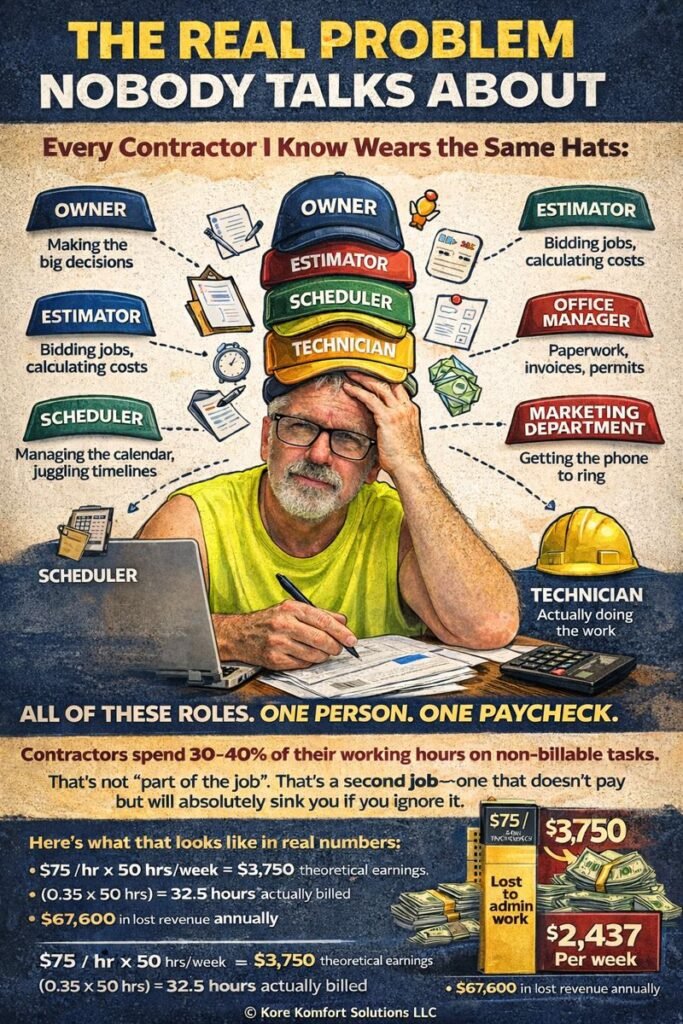
Every contractor I know wears the same hats:
- Owner — Making the big decisions
- Estimator — Bidding jobs, calculating costs
- Scheduler — Managing the calendar, juggling timelines
- Office manager — Paperwork, invoices, permits
- Marketing department — Getting the phone to ring
- Customer service — Handling questions, complaints, updates
- And the technician — Actually doing the work
All of these roles. One person. One paycheck.
The industry data backs this up. Contractors spend 30-40% of their working hours on non-billable tasks. That’s not “part of the job.” That’s a second job—one that doesn’t pay but will absolutely sink you if you ignore it.
Here’s what that looks like in real numbers:
If you bill out at $75/hour and work 50 hours a week, you’re theoretically earning $3,750 per week. But if 35% of that time is non-billable admin work, you’re only actually billing 32.5 hours. That’s $2,437 per week.
You’re losing $1,300 every single week to paperwork.
That’s $67,600 a year. Gone. Not because you’re bad at your trade—because you’re stuck doing work that doesn’t generate revenue.
And that doesn’t count the jobs you’re losing because you didn’t respond fast enough. Or the customers who went somewhere else because you forgot to follow up. Or the estimate that’s been sitting in your truck for two weeks because you haven’t had time to write it up.
The Day I Lost a $40,000 Job
A few years back, I was knee-deep in a bathroom remodel. Tile work. Couldn’t stop in the middle of it.
My phone buzzed. I glanced at it. Missed call, unknown number. Probably another spam call about my car’s extended warranty. I went back to work.
Six hours later, I listened to the voicemail.
A homeowner had called about a full kitchen remodel. Wanted someone to come out that week. Budget around $40,000. She’d found me through a referral.
I called her back the next morning.
She’d already hired someone else. “Sorry, I needed someone who could get back to me quickly. I called four contractors and you were the only one who didn’t answer or call back within a few hours.”
I lost a $40,000 job because I was too busy working to answer the phone.
That’s when I started researching. What I found made me sick.
- 78% of customers hire the first contractor who responds. Not the cheapest. Not the best. The first.
- The average contractor takes 42-47 hours to return a lead. Almost two full days.
- Only 0.1% of contractors respond within 5 minutes. Less than one in a thousand.
- 30% of leads are never contacted at all. Not even a callback.
I’d like to tell you I was better than average. I wasn’t. I was just like everyone else—too busy doing the work to run the business.
Why Contractors Fail (It’s Not What You Think)
The trades have a brutal failure rate. Depending on whose numbers you trust, somewhere between 50-80% of contractor businesses fail within the first five years.
Most people assume it’s because of:
- Bad economy
- Too much competition
- Not enough leads
- Underbidding jobs
Those things matter. But they’re not the main killer.
Most contractors fail because they’re great technicians and terrible business operators.
They can frame a wall, run electrical, or install a furnace with their eyes closed. But they can’t:
- Respond to leads fast enough to win the job
- Follow up consistently enough to close the sale
- Communicate well enough to keep customers happy
- Manage their time well enough to stay profitable
- Systematize their operations well enough to scale
The best craftsman in town loses to the contractor who answers faster, follows up more, and communicates better. I’ve watched it happen for 30 years. I’ve been on both sides of it.
Your competition isn’t the guy with better skills. It’s the guy with better systems.
What I Wish Existed
For years, I looked for a solution.
I tried hiring office help. Hard to justify the cost when you’re solo. And when I did have someone, they didn’t understand the work well enough to answer customer questions.
I tried virtual assistants. Better than nothing, but they were working from scripts. Couldn’t handle anything outside the basics.
I tried the big software platforms. ServiceTitan, Housecall Pro, Jobber. They’re good tools, but they’re built for companies with dedicated office staff. For a solo operator or small crew, they add work instead of removing it. You’re feeding the system instead of the system feeding you.
I tried automations, Zapier workflows, AI chatbots. Pieces of solutions. Nothing that actually handled the full picture.
What I wanted was simple:
Something that could answer my phone when I couldn’t. That could respond to leads instantly—not with a generic “we’ll get back to you” but with a real conversation. That could schedule estimates without me checking my calendar. That could follow up on quotes I’d sent. That could keep customers updated so they’d stop calling to ask “when will you be here?”
Something that could handle the business side so I could focus on the work.
It didn’t exist. So I started building it.
What Rose Is (And Isn’t)
Rose is an AI-powered business management system built specifically for contractors.
Not adapted from generic business software. Not a CRM with some AI features bolted on. Built from the ground up for how contractors actually work.
Here’s what Rose handles:
Lead Response
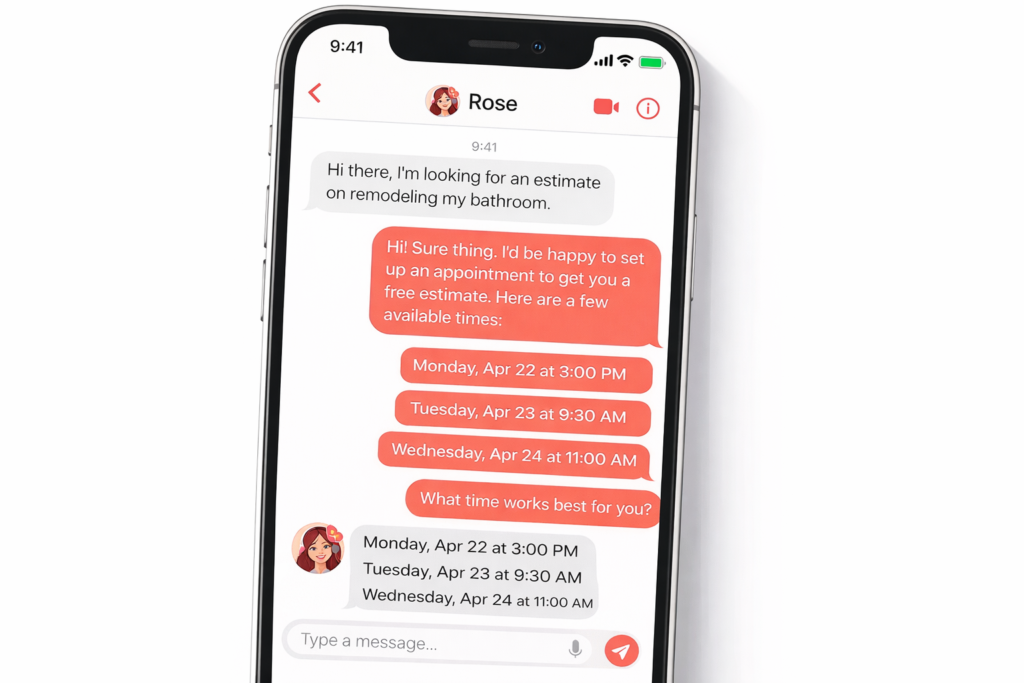
When a lead comes in—phone call, web form, email—Rose responds immediately. Not with a canned autoresponder, but with an actual conversation. Rose can answer basic questions, qualify the lead, and schedule an estimate. While you’re on a job site, Rose is making sure you never miss another opportunity.
Scheduling
Rose manages your calendar. Customers can book estimates. You can block out time for jobs. Rose handles the back-and-forth of “does Tuesday work? No, how about Thursday?” so you don’t have to.
Estimates & Follow-Up
Rose helps you send estimates faster and follows up automatically. No more quotes sitting in your truck for weeks. No more forgetting to check in on that bid you sent.
Customer Communication
Rose keeps customers updated throughout the job. “Your contractor is scheduled for Tuesday between 8-10am.” “Work is progressing, here’s a quick update.” “The job is complete, here’s your invoice.” The communication that keeps customers happy and keeps them from calling you ten times a day.
The Back Office
Invoicing. Payment collection. Appointment reminders. The administrative stuff that eats your evenings—handled.
What Rose is NOT:
Rose is not a replacement for your skills. It doesn’t do the work—you do. Rose handles the business side so you can focus on the craft you spent years mastering.
Rose is not enterprise software. It’s not built for 500-truck operations with dedicated dispatch centers. It’s built for the solo operator, the two-person crew, the small company that doesn’t have (or want) a full office staff.
Rose is not another app you have to babysit. The goal is less screen time, not more. Rose works in the background so you can work in the field.
The Roadmap
I’m building Rose in public. Here’s where we are and where we’re going:
Current Status (January 2026)
🔨 In Development
- Core AI conversation engine
- Lead response automation
- Calendar integration
- Basic scheduling
📝 In Planning
- Estimate generation assistance
- Customer communication templates
- Follow-up sequences
- Invoicing integration
What’s Next
Phase 1: Lead Response & Scheduling
The foundation. Answer leads instantly, schedule estimates automatically, never miss an opportunity.
Phase 2: Customer Communication
Automated updates, appointment reminders, the communication that keeps customers happy without keeping you on the phone.
Phase 3: Estimates & Follow-Up
Help generating estimates, automated follow-up on open quotes, tracking your pipeline.
Phase 4: Full Business Management
Invoicing, payment collection, job tracking, reporting. The complete back office.
I’ll update this section as we hit milestones. Bookmark this page and check back.
Follow the Build
I’m not building Rose in a vacuum. I’m building it with input from contractors who live this reality every day.
Here’s how to follow along and get involved:
On X (Twitter)
I post daily about contractor operations, AI for small businesses, and behind-the-scenes updates on Rose.
Newsletter
Weekly insights on running a contractor business, plus Rose development updates and early access opportunities.
Early Access
Want to be one of the first contractors to try Rose? Join the waitlist and help shape what this becomes.
A Note on How I’m Building This
I spent 30 years learning these lessons the hard way. I don’t have a venture capital fund or a team of 50 engineers. I’m building Rose the same way I built my contracting business—one step at a time, solving real problems, listening to the people doing the work.
That means I want to hear from you.
What’s the biggest headache in running your business? What would actually help? What have you tried that didn’t work?
DM me on X. Reply to the newsletter. I read everything.
This isn’t software built by tech people who’ve never held a hammer. It’s built by someone who spent 30 years at the kitchen table, wishing something like this existed.
Frequently Asked Questions
When will Rose be available?
We’re currently in development with early beta testing planned for 2026. Join the waitlist to get early access and help shape the product.
How much will Rose cost?
Pricing isn’t finalized yet. My goal is to make Rose accessible to solo operators and small crews—not priced like enterprise software. It needs to make sense for a one-person shop.
What trades is Rose built for?
Rose is designed for residential and commercial contractors across trades: remodeling, HVAC, plumbing, electrical, roofing, painting, and general construction. If you run a contracting business and struggle with the business side, Rose is for you.
Do I need to be tech-savvy to use Rose?
No. If you can use a smartphone, you can use Rose. The whole point is to reduce complexity, not add it. Rose works in the background so you can focus on the work.
Will Rose replace my current software?
Rose is designed to integrate with tools you already use, not force you to change everything. That said, for many solo operators, Rose may handle things you’re currently doing manually or with multiple disconnected tools.
What is contractor business management software?
Contractor business management software helps trades professionals handle the non-billable parts of running a business—lead response, scheduling, estimates, invoicing, and customer communication. Rose is an AI-powered version built specifically for solo operators and small crews who don’t have dedicated office staff.
How can contractors respond to leads faster?
The fastest way to respond to leads is automation. AI systems like Rose can answer calls, respond to web forms, and engage leads instantly—even while you’re on a job site. For contractors without automation, the best practice is responding within 5 minutes, which only 0.1% of contractors currently achieve.
Is Rose better than ServiceTitan or Housecall Pro?
Rose is built for a different user. ServiceTitan and Housecall Pro are full field service management platforms designed for companies with dedicated office staff. Rose is built for solo operators and small crews who need the business handled without feeding another complex system. If you have a dispatch team, those platforms may fit better. If you’re wearing every hat yourself, Rose is designed for you.
I have ideas or feedback. How do I share them?
DM me on X @_Mike_Warner or reply to any newsletter. I’m building this based on real contractor feedback, and I want to hear what would actually help your business.
Who are you, and why should I trust you?
I’m Mike Warner. Army veteran. 30+ years in construction, remodeling, and HVAC. I’ve installed mini-splits, remodeled kitchens and bathrooms, and run crews across Ohio, Kentucky, and Tennessee. I’ve lived everything I’m writing about. I’m not a tech founder who read a blog post about contractors—I am a contractor who got tired of the kitchen table.
About the Author
Mike Warner is a U.S. Army veteran with over 30 years of experience in residential and commercial construction, including bathroom remodeling, kitchen renovations, and HVAC installations. He’s the founder of Kore Komfort Solutions, an educational resource connecting homeowners with vetted contractors across Ohio, Kentucky, and Tennessee. He’s currently building Rose, an AI-powered business management system for contractors.
Follow him on X: @_Mike_Warner
Last updated: January 2026. This is a living document—I’ll update it as Rose develops. Bookmark and check back.

Author: Mike Warner
Mike Warner — Founder, Kore Komfort Solutions LLC U.S. Army veteran. 30 years in the trades — HVAC installation, kitchen and bathroom remodeling, and residential construction across Alaska, Washington, Colorado, Ohio, Kentucky, and Tennessee. I've pulled permits, managed crews, run service calls at midnight, and built a business from a single truck. Now I build the digital infrastructure that helps contractors compete and win. Kore Komfort Solutions exists for one reason: to give small and mid-size contractors ($2M–$10M) the same AI-powered tools, websites, and business systems that the big operations use — without the enterprise price tag or the learning curve. Through Kore Komfort Digital, we design and manage high-performance WordPress websites engineered to rank on Google and convert local searches into booked jobs. Through Rose — our AI-powered business management system currently in development — we're building the future of how contractors handle leads, scheduling, estimates, and customer communication. I write about what I know: the trades, the technology reshaping them, and how to build a contracting business that runs on systems instead of chaos. Every recommendation on this site comes from someone who's actually done the work — not a marketer who Googled it.