Article Navigation
- Introduction: Portsmouth’s Kitchen Evolution
- Unique Challenges in Portsmouth Kitchen Remodeling
- Historic Home Kitchen Renovations
- Mid-Century Ranch Transformations
- Flood Plain and Moisture Management
- Modern Kitchen Design Solutions
- Layout Optimization and Work Zones
- Cabinet Selection for Portsmouth Homes
- Kitchen Lighting Design
- Countertop Materials and Selection
- Flooring Options for Portsmouth Kitchens
- Kitchen Remodeling Costs in Portsmouth
- Navigating Portsmouth Permits and Inspections
- Selecting Kitchen Remodeling Contractors
- Project Timeline and Living Through Renovation
- Resale Value Considerations
- Frequently Asked Questions
FTC Disclosure: Kore Komfort Solutions connects homeowners with cabinet manufacturers and dealers. Some links in this article are affiliate links, meaning we may earn a commission if you make a purchase through our network partners. This comes at no additional cost to you and helps us continue providing honest, educational content. We only recommend products and services we believe offer genuine value.
Introduction: The Heart of Your Portsmouth Home, Reimagined
In Portsmouth, the kitchen represents far more than a cooking space. It’s where families gather for Sunday dinners in historic Hilltop homes, where morning routines unfold in ranch houses along the Scioto Trail, and where holiday traditions continue through generations. Yet many Portsmouth kitchens still function with layouts designed decades ago, featuring cramped work areas, inadequate lighting, and disconnection from the rest of the home.
The transformation of these spaces requires understanding Portsmouth’s unique architectural landscape. From century-old brick homes in Boneyfiddle to mid-century ranches that define much of the city’s residential character, each presents distinct opportunities and challenges. Our network includes contractors throughout Scioto County who specialize in addressing the specific challenges Portsmouth homeowners face.
This comprehensive guide explores every aspect of kitchen remodeling in Southern Ohio, with specific focus on Portsmouth’s distinctive requirements. Whether you’re opening up a closed 1950s floor plan, renovating a kitchen in a historic property, or updating a home near the floodwall, understanding the process helps you make informed decisions.
Portsmouth Context: As Scioto County’s largest city, Portsmouth features diverse housing stock ranging from Victorian-era homes in historic districts to post-war suburban development. This variety creates unique remodeling opportunities and challenges that require specialized knowledge of local construction methods, building codes, and architectural preservation considerations.
Unique Challenges in Portsmouth Kitchen Remodeling
Portsmouth’s architectural diversity creates specific considerations that distinguish kitchen remodeling here from projects in newer suburban developments. Understanding these challenges before beginning your project prevents costly surprises and ensures appropriate solutions.
The Closed Floor Plan Legacy
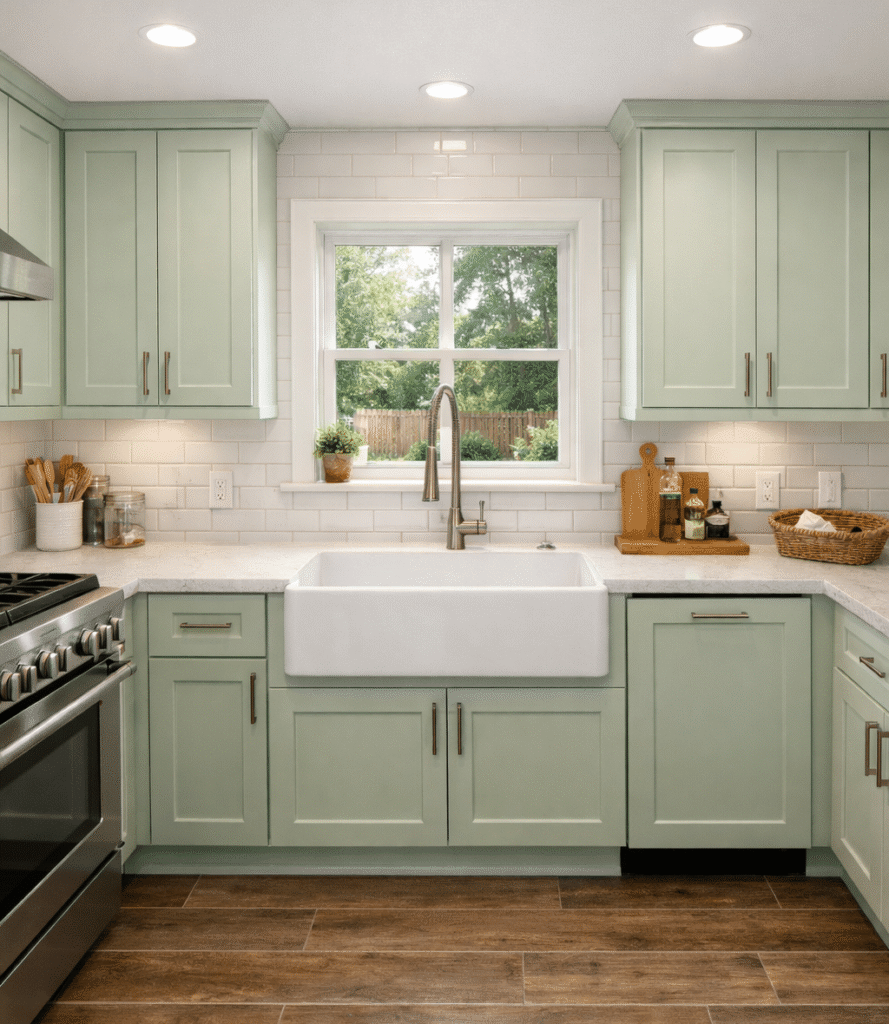
A significant portion of Portsmouth’s housing inventory consists of mid-century ranch homes built during the 1950s-1970s boom. These properties typically feature kitchens completely walled off from dining and living areas. This design philosophy prioritized formal separation of spaces over the open-concept flow modern homeowners prefer.
Opening these layouts requires careful structural evaluation. Load-bearing walls support the roof and ceiling structure. Their removal necessitates installing engineered lumber beams to redistribute loads properly. This structural work requires permits, professional engineering calculations, and inspections from the Portsmouth Engineering & Building Department.
The contractors in our network experienced in Portsmouth renovations understand local structural requirements. They can evaluate whether your specific walls carry loads or serve only as partitions. This assessment determines both feasibility and budget impact of creating your desired open layout.
Historic District Considerations
Portsmouth’s Boneyfiddle Historic District and Hilltop neighborhoods feature homes built from the 1850s through early 1900s. These beautiful properties present distinct renovation challenges that require specialized expertise.
Century-old homes typically feature plaster walls over wood lath rather than modern drywall. These walls are often uneven, and floors may have settled and sloped over decades. Installing modern cabinetry requires addressing these irregularities. Cabinets must hang level even when walls and floors aren’t. Experienced contractors use shims, careful measurement, and sometimes custom modifications to achieve professional results.
Electrical systems in historic homes may still include knob-and-tube wiring. This outdated system is potentially hazardous and inadequate for modern kitchen electrical demands. Complete kitchen renovations typically include electrical service upgrades, new circuit installations, and GFCI protection for all outlets near water sources. A quality voltage tester helps professionals verify circuits are properly installed.
Plumbing in historic Portsmouth homes often features galvanized steel pipes that may be corroded after 70-100 years of service. Kitchen renovations provide an opportunity to replace these with modern PEX or copper, improving both reliability and water pressure.
Historic Home Kitchen Renovations: Preserving Character While Modernizing Function
Renovating kitchens in Portsmouth’s historic homes requires balancing preservation of architectural character with incorporation of modern functionality and appliances.
Respecting Original Architecture
Historic Portsmouth homes often feature high ceilings, crown molding, original wood trim, and other period details that contribute to their character. Successful kitchen renovations in these properties preserve and highlight these features rather than obscuring them.
Cabinet selection plays a crucial role. While ultra-modern flat-panel cabinets may clash with Victorian-era architecture, traditional raised-panel doors complement historic character. Our Kitchen Cabinet Buying Guide for Southern Ohio explores style options that work well in period homes.
Window preservation is particularly important. Original wood windows, even if they need restoration, contribute significantly to historic character. Kitchen layouts should work around existing window locations when possible. Changing window sizes or positions in historic districts may require additional approvals.
Infrastructure Upgrades Behind the Walls
The most important work in historic home kitchen renovations often happens behind walls. Modern kitchens demand electrical capacity far exceeding what homes built before widespread appliance use provided.
Contemporary kitchen electrical requirements typically include dedicated 20-amp circuits for refrigerator, dishwasher, microwave, and disposal. Plus small appliance circuits for countertop outlets. Historic homes may have been built with 60-100 amp service total. Many projects include electrical panel upgrades to 200-amp service, providing capacity for kitchen needs plus future whole-home requirements.
Plumbing upgrades similarly transform reliability. Replacing galvanized pipes prevents future leaks and improves water pressure. Adding shutoff valves at each fixture allows future service without shutting down the entire home’s water supply.
Addressing Structural Realities
Floor leveling represents one of the most common challenges in historic home kitchen renovations. After a century of settling, floors may slope noticeably. While this doesn’t necessarily indicate structural problems, it creates challenges for installing cabinets and appliances that must sit level.
Solutions range from shimming individual cabinets to creating a level subfloor platform across the entire kitchen. The approach depends on the severity of slope and your budget. Contractors use laser levels to accurately measure floor variations and determine the most effective correction method.
Wall straightness also varies in plaster construction. Modern frameless European-style cabinets require very straight walls for proper installation. Framed American-style cabinets tolerate some irregularity better, making them often more suitable for historic Portsmouth homes.
Mid-Century Ranch Transformations: Opening Floor Plans and Modernizing Layouts
Portsmouth’s extensive inventory of 1950s-1970s ranch homes presents different challenges and opportunities than historic properties. These solid, well-built homes feature layouts that no longer match how families live and entertain.
The Open Concept Conversion
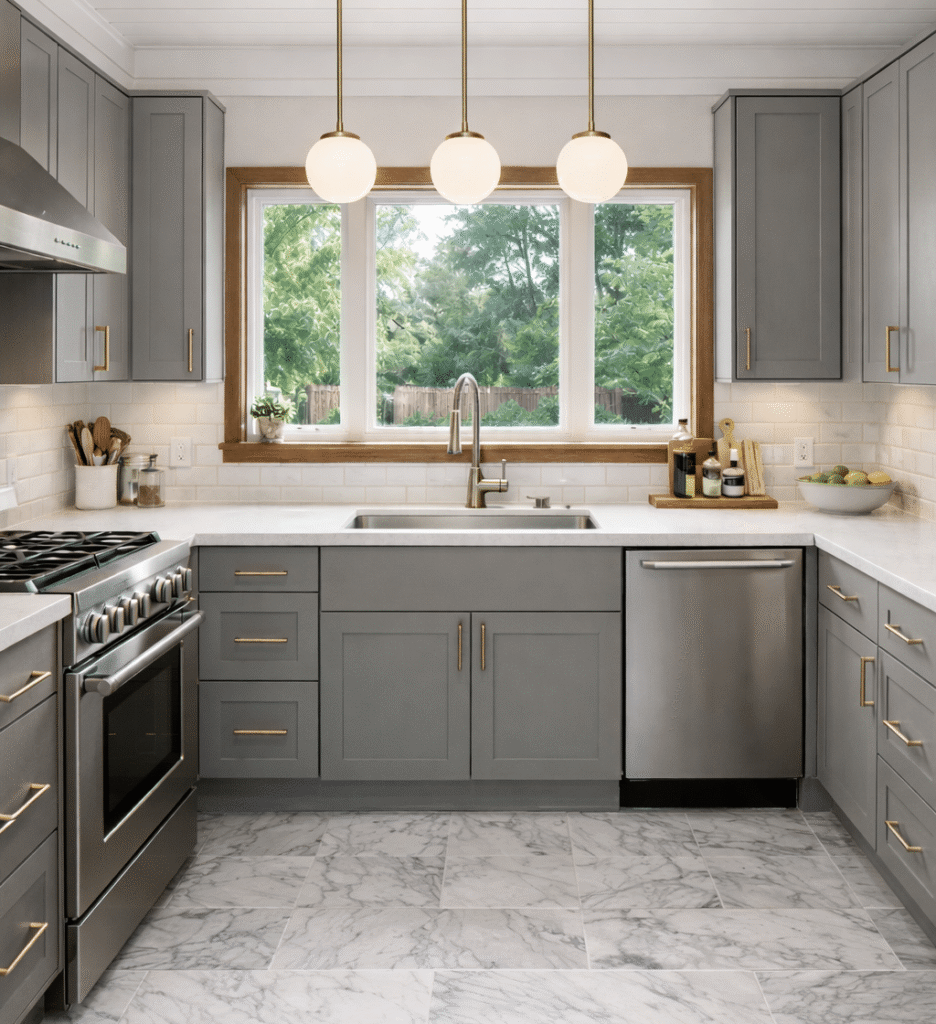
Mid-century ranch kitchens were deliberately separated from living and dining areas. This reflected the era’s entertaining style where cooking remained hidden from guests. Today’s casual entertaining style favors open sight lines allowing the cook to participate in conversations.
Creating this openness requires removing walls, but not all walls are equal. Partition walls that don’t carry structural loads can be removed relatively simply. Load-bearing walls that support roof or ceiling joists require engineered solutions.
The typical approach involves installing a laminated veneer lumber (LVL) beam sized to carry the loads previously supported by the wall. This beam spans the opening and transfers weight to posts or the home’s foundation. Beam size depends on span and load. An experienced contractor or structural engineer performs calculations to determine appropriate sizing.
This structural work requires permits from Portsmouth’s Engineering & Building Department and inspections to verify proper installation. The contractors we connect you with understand local requirements and coordinate these approvals as part of the project.
Updating the Kitchen Work Triangle
Even when maintaining existing exterior walls, ranch kitchen layouts benefit from rethinking appliance and fixture placement. The traditional work triangle positions refrigerator, sink, and range in a triangular pattern with total perimeter between 12-26 feet. This remains a useful planning principle.
However, modern kitchens often improve on this with work zones designed for specific tasks. A prep zone near the sink includes cutting boards and knife storage. A cooking zone around the range includes pot storage and spices. A baking zone with counter space and mixer storage serves occasional intense use without interfering with daily cooking.
Our Kitchen Layout Ideas for Small Spaces explores efficient configurations. Many are applicable to Portsmouth ranch kitchens even when square footage isn’t severely limited.
Maximizing Storage in Galley Kitchens
Many Portsmouth ranch homes feature galley kitchens—narrow spaces with cabinets on both sides. While this layout can be highly efficient for single cooks, it often lacks the storage capacity modern households need.
Modern cabinet innovations dramatically improve storage efficiency compared to cabinets from the 1960s-1970s. Deep drawers with full-extension glides provide better access than fixed shelves. Pull-out shelving brings items from the back of deep cabinets into easy reach. Corner cabinet solutions like lazy susans make previously wasted space functional.
Pantry cabinets consolidate food storage in one location, eliminating the need to search multiple cabinets for ingredients. When space allows, a dedicated pantry cabinet significantly improves kitchen organization.
Flood Plain and Moisture Management: Special Considerations for Portsmouth
Portsmouth’s location along the Ohio River creates unique moisture management requirements. This is particularly true for homes in lower-lying areas or near the floodwall. These conditions influence material selection and construction methods.
Understanding Portsmouth’s Flood Risk
While the floodwall protects much of Portsmouth from major flooding events, homes still experience higher humidity levels than communities further from water bodies. Additionally, some Portsmouth neighborhoods remain in designated flood plains despite floodwall protection.
For homes with flood risk, material selection becomes critical. Traditional particle board cabinet boxes absorb moisture and swell when exposed to high humidity or water contact. This expansion causes cabinet doors to stick, drawer glides to bind, and eventual structural failure.
Our network includes contractors who recommend plywood cabinet construction for Portsmouth homes. This is particularly important for those in flood-prone areas. Plywood resists moisture better than particle board, maintaining structural integrity even with humidity exposure. While plywood cabinets cost 15-30% more initially, they provide far better longevity in Portsmouth’s climate.
Moisture-Resistant Flooring Choices
Kitchen flooring in Portsmouth homes must withstand both normal kitchen moisture and potential flood events in at-risk properties. Material selection significantly affects long-term performance.
Luxury vinyl plank (LVP) flooring has become increasingly popular in Portsmouth kitchens for good reason. This waterproof material handles standing water without damage. It resists scratches and dents, provides comfortable underfoot feel, and costs substantially less than hardwood or tile. Our Kitchen Flooring Options and Costs in Southern Ohio guide provides detailed comparisons.
Porcelain tile represents another excellent choice for moisture resistance. Unlike ceramic tile, porcelain has very low water absorption. This makes it suitable even for outdoor use. In Portsmouth kitchens, this translates to flooring that will never suffer water damage regardless of exposure.
Traditional hardwood carries risk in flood-prone Portsmouth homes. Even engineered hardwood can suffer permanent damage from significant water exposure. Homeowners committed to wood’s appearance should ensure adequate insurance coverage and understand replacement may be necessary after major water events.
Waterproofing Behind Walls and Under Floors
Professional Portsmouth kitchen remodeling includes moisture barriers that protect your investment. Behind backsplash tile, a proper waterproofing membrane prevents water from reaching drywall and framing. Under flooring, vapor barriers prevent ground moisture from wicking up through concrete slabs.
In homes with basements prone to occasional dampness, contractors may recommend dehumidification systems. These maintain consistent humidity levels, protecting both your kitchen and other finished spaces. Using a moisture meter helps verify wall and floor conditions before beginning renovation work.
Modern Kitchen Design Solutions for Portsmouth Homes
Effective kitchen design balances aesthetics, functionality, and budget while accommodating your home’s existing structure and your family’s specific needs.
Kitchen Styles That Complement Portsmouth Architecture
Kitchen style should harmonize with your home’s overall architectural character. Mismatched styles can feel jarring and may hurt resale value. Ultra-modern kitchens in Victorian homes or heavily traditional kitchens in mid-century ranches exemplify this problem.
For Portsmouth’s historic homes, transitional kitchen styles work particularly well. These designs blend traditional elements like raised-panel doors with modern touches like stainless appliances. The result respects the home’s character while providing contemporary functionality.
Ranch homes accommodate a wider range of styles. Clean-lined shaker cabinets work well, as do more contemporary flat-panel designs. The key is maintaining consistency across all elements rather than mixing incompatible styles.
Color Schemes for Portsmouth Kitchens
Kitchen color selection affects both immediate appearance and long-term satisfaction. White and light neutral cabinets remain perennially popular. They make spaces feel larger, reflect light effectively, and show less dirt than dark colors. They also work with changing backsplash and wall colors and appeal to broad buyer demographics.
However, Portsmouth homeowners shouldn’t feel constrained to white. Gray cabinets in various tones have proven staying power. Natural wood finishes bring warmth, particularly in historic homes. Navy or forest green create sophisticated looks when used strategically, often on an island while perimeter cabinets remain lighter.
Two-tone kitchens add visual interest without commitment to bold color everywhere. Contrasting upper and lower cabinets or differentiating an island allows personality while maintaining broad appeal.
Appliance Selection and Integration
Appliance choices significantly impact both kitchen function and appearance. Portsmouth homeowners typically choose between freestanding ranges and separate cooktop/wall oven combinations. They also select standard-depth versus counter-depth refrigerators and various dishwasher configurations.
Freestanding ranges cost less and require less complex installation than separate units. However, cooktop/wall oven combinations provide more flexibility in layout design and often include more advanced features.
Counter-depth refrigerators create a built-in appearance by aligning with cabinet depth. They cost 20-40% more than standard-depth models and sacrifice some interior capacity. But many Portsmouth homeowners consider the streamlined appearance worth these tradeoffs.
Layout Optimization and Work Zones: Beyond the Kitchen Triangle
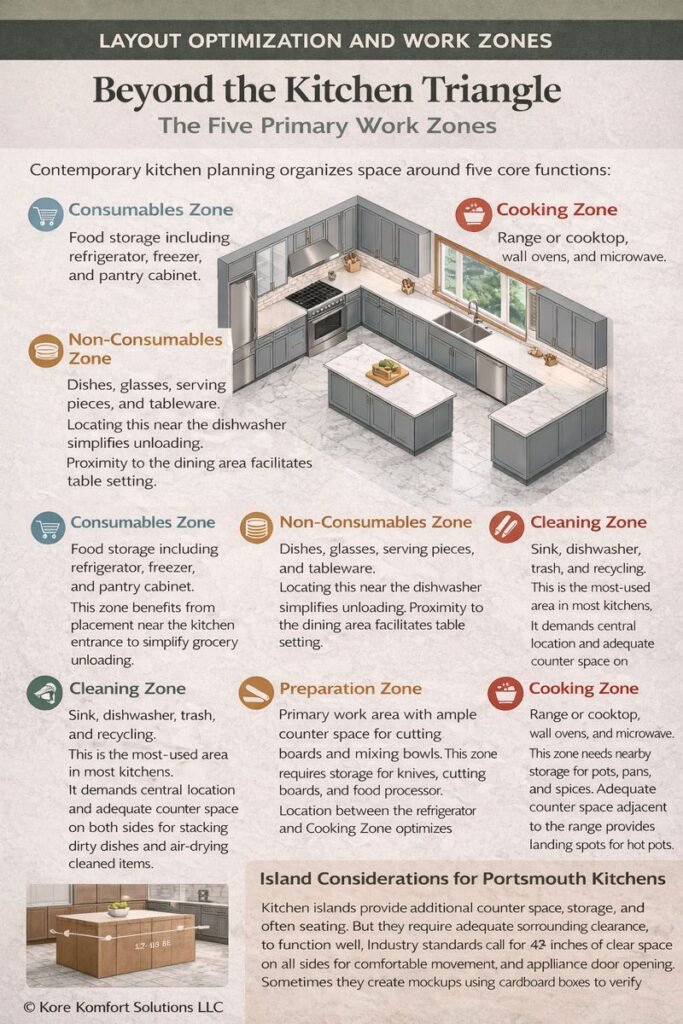
While the kitchen triangle remains a useful concept, modern design thinking has evolved to work zones. These are dedicated areas for specific tasks that allow multiple people to work simultaneously without interference.
The Five Primary Work Zones
Contemporary kitchen planning organizes space around five core functions:
Consumables Zone: Food storage including refrigerator, freezer, and pantry cabinet. This zone benefits from placement near the kitchen entrance to simplify grocery unloading.
Non-Consumables Zone: Dishes, glasses, serving pieces, and tableware. Locating this near the dishwasher simplifies unloading. Proximity to the dining area facilitates table setting.
Cleaning Zone: Sink, dishwasher, trash, and recycling. This is the most-used area in most kitchens. It demands central location and adequate counter space on both sides for stacking dirty dishes and air-drying cleaned items.
Preparation Zone: Primary work area with ample counter space for cutting boards and mixing bowls. This zone requires storage for knives, cutting boards, and food processor. Location between the refrigerator and cooking zone optimizes workflow.
Cooking Zone: Range or cooktop, wall ovens, and microwave. This zone needs nearby storage for pots, pans, and spices. Adequate counter space adjacent to the range provides landing spots for hot pots.
Successful kitchen layouts organize these zones in a logical sequence matching how you actually cook.
Island Considerations for Portsmouth Kitchens
Kitchen islands provide additional counter space, storage, and often seating. But they require adequate surrounding clearance to function well. Industry standards call for 42-48 inches of clear space on all sides for comfortable movement and appliance door opening.
Many Portsmouth ranch kitchens measure 10-12 feet wide—tight for island inclusion. Before committing to an island, contractors measure carefully. Sometimes they create mockups using cardboard boxes to verify the space will work comfortably.
Islands that include sinks or cooktops require plumbing and electrical or gas connections. This adds complexity and cost. Sinks need drain and vent lines run through the floor. These requirements don’t prohibit island cooking or cleaning, but they do impact project budgets and timelines.
Cabinet Selection for Portsmouth Homes: Quality That Lasts
Cabinetry typically consumes 30-40% of total kitchen remodeling budgets, making it the single largest expense. Understanding options helps Portsmouth homeowners select cabinets that provide the best value for their specific circumstances.
Construction Quality Indicators
Cabinet quality varies dramatically across price points. Key construction elements distinguish well-built cabinets from budget options:
Box Material: Plywood cabinet boxes outlast particle board, particularly in Portsmouth’s humid climate. Plywood resists moisture better and holds screws more securely. While plywood costs more, it typically provides better long-term value.
Drawer Construction: Dovetail joinery provides superior strength compared to stapled or glued corners. Full-extension ball-bearing drawer glides allow drawers to open completely for easy access. Budget glides stop 6-12 inches short of full extension.
Door Construction: Solid wood or wood frame with center panel construction outlasts doors made entirely from medium-density fiberboard (MDF). MDF doors can work well in painted finishes but lack durability in stained applications.
Shelf Adjustability: Cabinets with adjustable shelves provide flexibility to accommodate varying item heights. Fixed shelves waste vertical space when storing shorter items.
Our Amish Custom vs. Factory Direct Cabinets guide explores these quality differences in detail.
Stock, Semi-Custom, and Custom Cabinets
Cabinets fall into three broad categories, each with distinct characteristics:
Stock Cabinets: Pre-manufactured in standard sizes and limited finish options. Available quickly, cost least, but offer limited style choices. May not fit perfectly in your specific space. Portsmouth homeowners working with tight budgets often find good value in stock cabinets.
Semi-Custom Cabinets: Built to order with many more options for sizes, finishes, door styles, and accessories than stock. Lead times run 4-8 weeks. Pricing falls between stock and custom. This category offers the best value for most Portsmouth remodels.
Custom Cabinets: Completely customized to your exact specifications. The contractors we work with can connect you with regional cabinetmakers, including Amish craftsmen. Lead times run 8-16 weeks. Prices are highest, but custom cabinets perfectly fit odd spaces.
Hardware and Accessories
Cabinet hardware affects both appearance and long-term durability. While this represents a small portion of total cabinet cost, quality matters significantly.
Soft-close hinges prevent cabinet doors from slamming, reducing wear and noise. These mechanisms add $2-5 per hinge but dramatically improve daily experience. Quality soft-close hinges maintain smooth operation for years.
Pull-out accessories maximize cabinet utility. Options include spice racks, trash bins, cutting boards, and specialized storage. While each accessory adds cost, they dramatically improve kitchen organization and efficiency.
Kitchen Lighting Design: Layering for Function and Ambiance
Many older Portsmouth kitchens rely on a single central ceiling fixture. This is wholly inadequate for modern kitchen demands. Proper lighting design layers multiple types to create both functional illumination and pleasant atmosphere.
The Three Lighting Layers
Professional kitchen lighting includes ambient, task, and accent layers working together:
Ambient Lighting: General overall illumination typically from recessed ceiling fixtures. This provides base light level allowing you to move safely around the space. In kitchens with 8-foot ceilings, recessed fixtures should be 4-inch or smaller diameter.
Task Lighting: Focused illumination for specific work areas. Under-cabinet LED strips light countertops for food preparation. Pendant fixtures over islands provide directed light for that work zone. Good task lighting prevents eye strain.
Accent Lighting: Decorative elements like toe-kick lighting under base cabinets or lighting inside glass-front cabinets. This layer is optional but adds polish to high-end renovations.
Our comprehensive Kitchen Lighting Design Guide explores these concepts in detail with specific product recommendations.
LED Lighting Advantages
LED technology has revolutionized kitchen lighting. These fixtures offer numerous advantages over older incandescent and fluorescent options.
LED bulbs use 75-80% less electricity than incandescent bulbs for equivalent light output. In a kitchen with 10 recessed fixtures, switching from incandescent to LED saves $100-150 annually in Portsmouth.
LED bulbs last 15,000-50,000 hours compared to 1,000 hours for incandescent. This translates to 15-20 years in typical kitchen use, virtually eliminating bulb replacement hassles.
LEDs produce far less heat than incandescent bulbs. This makes kitchens more comfortable in Portsmouth’s humid summers and reduces air conditioning loads.
Quality under-cabinet LED lighting transforms kitchen functionality by eliminating shadows that overhead lighting creates.
Dimming and Control
Dimmer switches allow you to adjust lighting intensity for different times of day and activities. Bright light suits cooking and cleaning, while dimmed lighting creates pleasant atmosphere for casual dining.
Not all LED bulbs work with all dimmers. Compatibility matters. When specifying lighting, contractors ensure bulbs and dimmers are matched for proper performance. Incompatible combinations may flicker or produce annoying buzzing.
2026 Remodeling Cost Guide
Don’t get ripped off. See real pricing for bathrooms, kitchens, and HVAC.
Updated for 2026 Market Rates
Countertop Materials and Selection: Balancing Durability, Appearance, and Budget
Countertops form the kitchen’s primary work surface while contributing significantly to overall appearance. Portsmouth homeowners choose from several material categories, each with distinct characteristics and pricing.
Popular Countertop Materials
The five most common countertop materials in Portsmouth kitchen remodels offer varying balances of cost, durability, and aesthetics:
Granite: Natural stone offering unique patterns and high heat resistance. Requires periodic sealing to prevent staining. Costs $40-$100 per square foot installed in the Portsmouth area. Our Granite vs. Quartz Countertops guide provides detailed comparison.
Quartz: Engineered stone combining ground quartz with resins. Non-porous surface never requires sealing and is highly stain-resistant. Costs $50-$120 per square foot installed. Lower maintenance than granite makes it increasingly popular.
Solid Surface: Acrylic-based material like Corian offering seamless appearance and easy repair of scratches. Costs $40-$80 per square foot. Less heat-resistant than stone but works well for budget-conscious homeowners wanting seamless appearance.
Laminate: Budget-friendly option offering many color and pattern choices. Costs $20-$40 per square foot installed. Modern laminates look far better than products from decades past. Not as durable as stone but suitable for careful users.
Butcher Block: Natural wood providing warm appearance and excellent work surface for baking. Requires regular oiling to prevent drying. Costs $40-$80 per square foot. Often used for islands while stone is used for perimeter counters.
For comprehensive comparison, see our Kitchen Countertop Materials Comparison guide.
Edge Profiles and Details
Countertop edge profiles affect both appearance and price. Simple eased or beveled edges cost least and work well in contemporary designs. More elaborate edges like ogee or bullnose add decorative detail suitable for traditional kitchens but increase fabrication costs $10-20 per linear foot.
Undermount sinks create a clean, modern appearance and make countertop cleaning easier. You can wipe debris directly into the sink without a lip catching crumbs. They work with stone and solid surface counters but not laminate. This mounting style adds $150-300 to sink installation costs.
Backsplash Coordination
Backsplashes protect walls from water and food splatter while contributing to kitchen aesthetics. Material choices range from simple 4-inch granite extensions to elaborate tile designs creating focal points behind ranges.
Ceramic or porcelain tile remains the most popular backsplash material. Options range from classic subway tile at $8-15 per square foot installed to decorative mosaics at $20-40 per square foot. Portsmouth homeowners can save significantly by handling tile installation themselves if they’re comfortable with the work.
Quality tile spacers and grout sealer help DIY installers achieve professional results.
Flooring Options for Portsmouth Kitchens: Durability Meets Design
Kitchen flooring must withstand heavy traffic, dropped objects, spills, and cleaning while complementing your overall design. Portsmouth’s climate and flood considerations make material selection particularly important.
Flooring Material Comparison
Five primary flooring categories suit Portsmouth kitchen applications:
Luxury Vinyl Plank (LVP): Waterproof planks mimicking hardwood appearance. Completely waterproof, comfortable underfoot, and affordable at $3-7 per square foot installed. The best choice for Portsmouth homes with flood risk. Our Kitchen Flooring Options and Costs guide provides detailed information.
Porcelain Tile: Dense ceramic tile with very low water absorption. Extremely durable and completely waterproof. Costs $5-12 per square foot installed. Cold underfoot and hard on dropped dishes, but unmatched for water resistance.
Engineered Hardwood: Real wood veneer over plywood core. More stable than solid hardwood in Portsmouth’s humidity fluctuations. Costs $6-12 per square foot installed. Can be damaged by significant water exposure. Best for Portsmouth homes without flood risk.
Laminate: Budget-friendly option mimicking hardwood appearance. Costs $2-5 per square foot installed. Not waterproof—damaged by standing water. Suitable for Portsmouth kitchens in elevated areas without moisture concerns.
Natural Stone: Slate, limestone, or travertine offering unique, upscale appearance. Costs $8-20 per square foot installed. Requires sealing and careful maintenance. Typically reserved for high-end Portsmouth renovations.
Installation Considerations
Flooring installation in Portsmouth kitchen remodels requires addressing several practical considerations. Subfloor condition affects flooring performance significantly. Old vinyl or linoleum must be removed, and subfloor damage from past leaks repaired before new flooring installation.
Floor height changes require transition strips creating smooth, attractive boundaries. These strips accommodate different flooring heights and materials while preventing tripping hazards.
Undercutting door casings allows flooring to slide underneath for clean appearance. This attention to detail distinguishes professional installations from amateur work.
Kitchen Remodeling Costs in Portsmouth: What to Expect
Understanding typical costs for Portsmouth kitchen projects helps you budget appropriately and evaluate contractor bids. Costs vary based on project scope, material quality, and your home’s specific conditions.
Cost Breakdown by Project Type
Portsmouth kitchen remodeling projects generally fall into four categories:
Cosmetic Update ($8,000-$18,000): Painting cabinets or installing new doors, new countertops, updated backsplash, new flooring, new lighting fixtures, and appliance replacement. Timeline: 1-3 weeks.
Mid-Range Remodel ($25,000-$45,000): New semi-custom cabinets, granite or quartz countertops, tile backsplash, new flooring, updated lighting, new appliances, and new sink. This represents the most common Portsmouth kitchen project scope. Timeline: 4-6 weeks.
Full Renovation ($40,000-$70,000): Complete gut including removal of all existing materials, potential layout changes, all new cabinetry and surfaces, comprehensive electrical upgrade, plumbing relocation as needed, new appliances, and professional design services. Timeline: 6-10 weeks.
High-End Transformation ($65,000-$100,000+): Custom cabinetry from regional craftsmen, premium stone countertops, professional-grade appliances, structural modifications, high-end tile work, and exceptional lighting design. Timeline: 8-14 weeks including custom cabinet fabrication.
For detailed Portsmouth-specific cost analysis, consult our Kitchen Remodeling Costs Southern Ohio guide.
Where Portsmouth Costs Differ From National Averages
Portsmouth’s kitchen remodeling costs generally run 10-20% below national averages. Lower labor rates and cost of living contribute to this advantage. However, certain factors can increase Portsmouth-specific costs.
Historic home renovations often encounter unexpected challenges requiring additional work. Flood plain considerations may necessitate moisture-resistant materials costing more than standard options. Structural modifications in older homes may reveal issues requiring correction beyond the original scope.
These factors make contingency budgets particularly important. Setting aside 15-20% of your budget for unexpected discoveries provides cushion without derailing your project when surprises emerge.
Financing Kitchen Remodels
Portsmouth homeowners finance kitchen renovations through several methods. Home equity loans or lines of credit offer lowest interest rates for homeowners with sufficient equity. Personal loans provide faster approval without using home as collateral but carry higher rates.
Cash-out refinancing combines renovation funding with potentially lower mortgage rates if current rates are favorable. Credit cards work for smaller projects but high interest rates make them expensive for major renovations.
The contractors we work with can often suggest financing options or partnerships they’ve established with local lenders.
Navigating Portsmouth Permits and Inspections
Proper permitting protects your investment, ensures code compliance, and prevents complications during eventual home sales. Understanding Portsmouth’s requirements prevents delays and ensures your project proceeds smoothly.
When Permits Are Required
The Portsmouth Engineering & Building Department at 728 Second Street requires permits for kitchen work involving structural modifications, electrical work beyond simple fixture replacement, plumbing modifications, or any work affecting the home’s mechanical, electrical, or plumbing systems.
Simple updates like painting cabinets, replacing cabinet doors, installing new countertops without plumbing changes, or updating backsplash typically don’t require permits.
When uncertain, contacting the Building Department clarifies requirements for your specific project. This brief conversation prevents proceeding without required permits.
The Permitting Process
Portsmouth’s permit process involves several steps. The contractor submits permit applications including project plans and specifications. The Building Department reviews submissions, typically within 3-5 business days. Upon approval, permits are issued and must be posted at the job site.
Work proceeds according to approved plans. Required inspections occur at specific project milestones before project completion.
Experienced contractors coordinate this process seamlessly. The professionals we connect you with handle Portsmouth permitting routinely and understand local inspectors’ expectations.
Code Compliance Considerations
Building codes protect homeowner safety by establishing minimum standards. While codes may seem burdensome, they prevent dangerous conditions and ensure your renovation meets professional standards.
Key code requirements affecting Portsmouth kitchen remodels include GFCI outlets within 6 feet of sinks, adequate lighting levels, proper ventilation, minimum walkway widths, and structural support for removed walls.
Working with qualified contractors ensures these requirements are met without requiring you to memorize code details.
Selecting Kitchen Remodeling Contractors in Portsmouth
Contractor selection significantly impacts your project experience and final results. Portsmouth homeowners should evaluate several factors when choosing who will transform their kitchen.
Credentials and Experience
Verify contractors hold appropriate Ohio licenses and maintain insurance covering property damage and worker injuries. Request evidence of both. Legitimate contractors provide this information readily.
Experience with projects similar to yours matters significantly. A contractor who has successfully completed multiple Portsmouth historic home renovations understands challenges you’ll face. Someone primarily working on new construction may lack experience with older home complexities.
Our network includes contractors throughout Scioto County specializing in various project types. We connect Portsmouth homeowners with professionals whose experience aligns with their specific needs.
References and Portfolio Review
Request references from recent projects similar to yours. Contact these references and ask about communication quality, project timeline adherence, budget management, problem-solving when issues arose, and overall satisfaction.
Review the contractor’s portfolio of completed projects. This demonstrates their design aesthetic, quality standards, and range of capabilities. Portsmouth homeowners should see projects reflecting their desired style and quality level before committing.
Communication and Compatibility
You’ll interact extensively with your contractor throughout the project. Communication style and personality compatibility matter for smooth project flow.
During initial meetings, assess whether the contractor listens carefully, explains processes clearly, responds promptly to questions, and demonstrates respect for your home. Poor communication during bidding typically worsens during construction.
Detailed Written Estimates
Comprehensive written estimates should specify all work included, materials by brand and model, timeline expectations, payment schedule tied to project milestones, warranty terms, and procedures for handling changes.
Be wary of unusually low bids. They often indicate cutting corners, using inferior materials, or lowball bidding followed by extensive change orders. The most competitive bid isn’t always the best value.
Project Timeline and Living Through Renovation
Understanding realistic timelines and preparing for temporary disruption helps Portsmouth homeowners navigate kitchen renovation with minimal stress.
Typical Project Phases
Portsmouth kitchen remodels follow predictable phases:
Design and Planning (2-6 weeks): Finalizing layout, selecting materials, ordering custom items, and obtaining permits.
Demolition (2-5 days): Removing existing materials and preparing space for new work.
Rough-In Work (1-2 weeks): Structural modifications, electrical and plumbing rough-in. Includes required inspections.
Drywall and Paint (3-7 days): Installing or repairing drywall, taping, finishing, and painting.
Cabinet Installation (3-5 days): Installing cabinets and ensuring level installation.
Countertop Installation (1-3 days): Template creation, fabrication, and installation.
Flooring Installation (2-4 days): Subfloor preparation and new flooring installation.
Finish Work (3-7 days): Installing backsplash, trim, lighting, fixtures, and appliances.
Final Inspection and Cleanup (1-2 days): City inspection, final cleaning, and project walkthrough.
Total timeline: 4-10 weeks depending on scope.
Preparing for Temporary Disruption
Portsmouth families typically establish temporary kitchens during renovation. Practical setups include a microwave and countertop convection oven in dining room or basement, refrigerator relocated to accessible location, coffee maker for hot beverages, paper plates to minimize dishwashing, and designated washing station.
This period also offers opportunity to eat out more or embrace simpler meals. Many families find the experience less burdensome than anticipated with proper planning.
Protecting the Rest of Your Home
Quality contractors protect your home during renovation through plastic barriers sealing kitchen from adjacent rooms, floor protection along traffic routes, daily cleanup removing debris, and designated material staging areas.
Using quality plastic sheeting minimizes disruption to the rest of your Portsmouth home during construction.
Resale Value Considerations for Portsmouth Homeowners
While you should design your kitchen primarily for your own enjoyment, understanding resale implications helps make decisions that preserve or enhance your Portsmouth home’s value.
Features Portsmouth Buyers Value
Portsmouth’s real estate market shows consistent preferences for certain kitchen features. Open layouts connecting kitchen to living areas appeal strongly to buyers. Modern appliances, particularly stainless steel, meet buyer expectations. Quality countertops significantly influence buyer perception.
Adequate storage through well-designed cabinetry addresses one of most common buyer complaints. Good lighting eliminates the dark, cramped feeling buyers associate with outdated spaces. Neutral color schemes appeal to broader buyer pools than bold personal choices.
Avoiding Over-Improvement
Kitchen renovations typically return 50-70% of investment at resale in Portsmouth’s market. This means a $50,000 renovation adds roughly $25,000-$35,000 to home value. While this represents value loss in strict financial terms, the improved daily enjoyment justifies investment for most homeowners.
However, dramatically over-improving relative to neighborhood norms wastes money. Installing ultra-premium finishes in a modest Portsmouth neighborhood rarely returns sufficient value. Matching or slightly exceeding neighborhood standards provides best value balance.
The professionals we work with understand Portsmouth’s various neighborhoods. They can advise on appropriate quality levels for your specific location.
Timing Your Sale After Renovation
Newly renovated kitchens create powerful first impressions attracting buyers and supporting asking prices. However, you needn’t sell immediately after completion to benefit. Kitchen renovations provide value for the 10-15 years they remain current.
If you plan to sell within 1-2 years, focus renovation budgets on updates buyers notice. These include cabinets, countertops, appliances, and flooring. Avoid expensive structural work whose value you won’t personally enjoy long enough to justify cost.
Frequently Asked Questions About Kitchen Remodeling in Portsmouth
How long does a full kitchen remodel take in Portsmouth, OH?
A complete gut-and-rebuild kitchen remodel in Portsmouth typically requires 4-8 weeks depending on project scope. Cosmetic updates like cabinet refacing and countertop replacement may complete in 2-3 weeks. Projects involving structural modifications like load-bearing wall removal may extend to 8-10 weeks. Custom cabinet orders add 6-12 weeks to timelines, though this fabrication occurs before installation begins.
Permit approval through the Portsmouth Engineering & Building Department typically adds 1-2 weeks at the project start. The contractors in our network coordinate permits and inspections to minimize delays. Historic home renovations occasionally extend beyond estimated timelines when unexpected conditions emerge.
What does kitchen remodeling cost in Portsmouth, Ohio?
Kitchen remodeling costs in Portsmouth vary widely based on scope and materials. Cosmetic updates including cabinet refacing, new countertops, backsplash, and flooring typically run $15,000-$25,000. Mid-range complete renovations with new semi-custom cabinets, granite or quartz countertops, updated appliances, and new flooring cost $35,000-$55,000.
Full renovations involving layout changes and structural modifications reach $50,000-$75,000. Luxury transformations with custom cabinetry and premium appliances can exceed $80,000. Historic home renovations often trend toward higher ends due to challenges like uneven floors and outdated infrastructure.
Portsmouth’s costs generally run 10-20% below national averages due to lower labor rates. Our network includes contractors who provide detailed estimates breaking down all costs for your specific project.
Do I need permits for kitchen remodeling in Portsmouth?
Portsmouth requires permits for kitchen projects involving structural changes, plumbing modifications, electrical work beyond simple fixture replacement, or any work affecting mechanical, electrical, or plumbing systems.
Simple updates like painting cabinets, replacing cabinet doors without structural changes, installing new countertops without plumbing modifications, or updating backsplash typically don’t require permits. When uncertain, contact the Portsmouth Engineering & Building Department at 728 Second Street.
The contractors we work with handle permit applications, inspections, and code compliance as standard practice. This protects your investment and ensures work meets all safety standards. Skipping required permits creates complications during eventual home sales.
What are the unique challenges of kitchen remodeling in Portsmouth’s older homes?
Portsmouth’s historic homes and mid-century ranches present distinct renovation challenges. Closed floor plans in 1950s-1970s ranch homes require load-bearing wall removal to create modern open concepts. This necessitates installing engineered beams, obtaining permits, and coordinating structural inspections.
Century-old homes in Boneyfiddle and Hilltop neighborhoods feature uneven plaster walls, sloping floors from decades of settling, outdated knob-and-tube wiring, and galvanized plumbing often corroded after 70-100 years. Kitchen renovations must address these infrastructure issues.
Homes near Portsmouth’s floodwall face moisture management requirements. Particle board cabinets and some flooring materials fail in high-humidity conditions. The contractors in our network recommend moisture-resistant materials like plywood cabinets and waterproof LVP flooring for these properties.
Should I reface or replace my kitchen cabinets in Portsmouth?
For Portsmouth’s older homes, full cabinet replacement typically provides better long-term value than refacing. Cabinet refacing costs 40-50% less than full replacement, making it tempting for budget-conscious homeowners.
However, many Portsmouth cabinets from the 1950s-1980s have particle board boxes that have degraded from decades of humidity exposure. They lack modern soft-close hardware and full-extension drawer glides. They offer inefficient interior configurations wasting storage space.
New cabinets provide plywood construction better suited to Portsmouth’s humid climate, modern accessories maximizing storage, soft-close hinges improving daily experience, and warranties protecting your investment. While refacing makes sense when existing boxes are solid, full replacement often delivers better value in Portsmouth’s older housing stock.
The professionals we work with can assess your specific cabinets and provide honest guidance on whether refacing or replacement makes more sense.
Ready to Transform Your Portsmouth Kitchen?
Kitchen remodeling in Portsmouth requires understanding your home’s unique characteristics, local building requirements, and design approaches that honor architectural heritage while delivering modern functionality. Whether you’re opening up a closed ranch floor plan, renovating a historic Hilltop home, or updating a property near the floodwall, success depends on working with contractors who understand Portsmouth’s specific challenges.
Our network includes qualified professionals throughout Scioto County who specialize in Portsmouth kitchen renovations. We connect homeowners with contractors experienced in historic preservation, structural modifications, flood-resistant construction, and modern design.
For additional guidance on your Portsmouth kitchen project, explore our comprehensive resources including detailed cost analysis, material selection guides, and design inspiration. Our educational approach helps you make informed decisions that maximize both your investment and daily enjoyment of your transformed kitchen.
FTC Disclosure: This article contains affiliate links to products on Amazon. As an Amazon Associate, Kore Komfort Solutions earns from qualifying purchases at no additional cost to you. We only recommend products we believe will be helpful for your home improvement projects.

Author: Mike Warner
Mike Warner — Founder, Kore Komfort Solutions LLC U.S. Army veteran. 30 years in the trades — HVAC installation, kitchen and bathroom remodeling, and residential construction across Alaska, Washington, Colorado, Ohio, Kentucky, and Tennessee. I've pulled permits, managed crews, run service calls at midnight, and built a business from a single truck. Now I build the digital infrastructure that helps contractors compete and win. Kore Komfort Solutions exists for one reason: to give small and mid-size contractors ($2M–$10M) the same AI-powered tools, websites, and business systems that the big operations use — without the enterprise price tag or the learning curve. Through Kore Komfort Digital, we design and manage high-performance WordPress websites engineered to rank on Google and convert local searches into booked jobs. Through Rose — our AI-powered business management system currently in development — we're building the future of how contractors handle leads, scheduling, estimates, and customer communication. I write about what I know: the trades, the technology reshaping them, and how to build a contracting business that runs on systems instead of chaos. Every recommendation on this site comes from someone who's actually done the work — not a marketer who Googled it.