Article Navigation
Key Takeaways
Three-Layer Approach: Successful kitchen lighting design combines ambient (overall), task (work surface), and accent (decorative) layers working together.
LED Efficiency: Modern LED fixtures consume 75-80% less electricity than incandescent while lasting 25,000-50,000 hours (15-25 years).
FTC Disclosure: Kore Komfort Solutions connects homeowners with cabinet manufacturers and dealers. Some links in this article are affiliate links, meaning we may earn a commission if you make a purchase through our network partners. This comes at no additional cost to you and helps us continue providing honest, educational content. We only recommend products and services we believe offer genuine value.
Introduction
When doing kitchen remodeling lighting design transforms how you experience the heart of your home. This comprehensive kitchen lighting design guide covers everything Southern Ohio homeowners need when renovating Portsmouth farmhouses, updating Ashland ranches, or modernizing Marietta traditional homes. From selecting energy-efficient LED fixtures to understanding three-layer lighting systems, proper planning creates kitchens that balance beauty with functionality.
Whether you’re working with a century-old home featuring plaster ceilings and knob-and-tube wiring or a 1970s ranch with limited ceiling access, understanding regional considerations ensures your lighting upgrade meets Ohio Valley climate challenges while respecting architectural character. Our network connects homeowners with experienced contractors who specialize in these unique renovation scenarios.
Understanding the Three Layers of Kitchen Lighting
Professional lighting design relies on three distinct layers working together. Each layer serves specific purposes, and successful kitchen remodeling requires balancing all three components for your space and daily routines. According to the U.S. Department of Energy, layered lighting reduces energy consumption while improving functionality compared to single-source overhead fixtures.
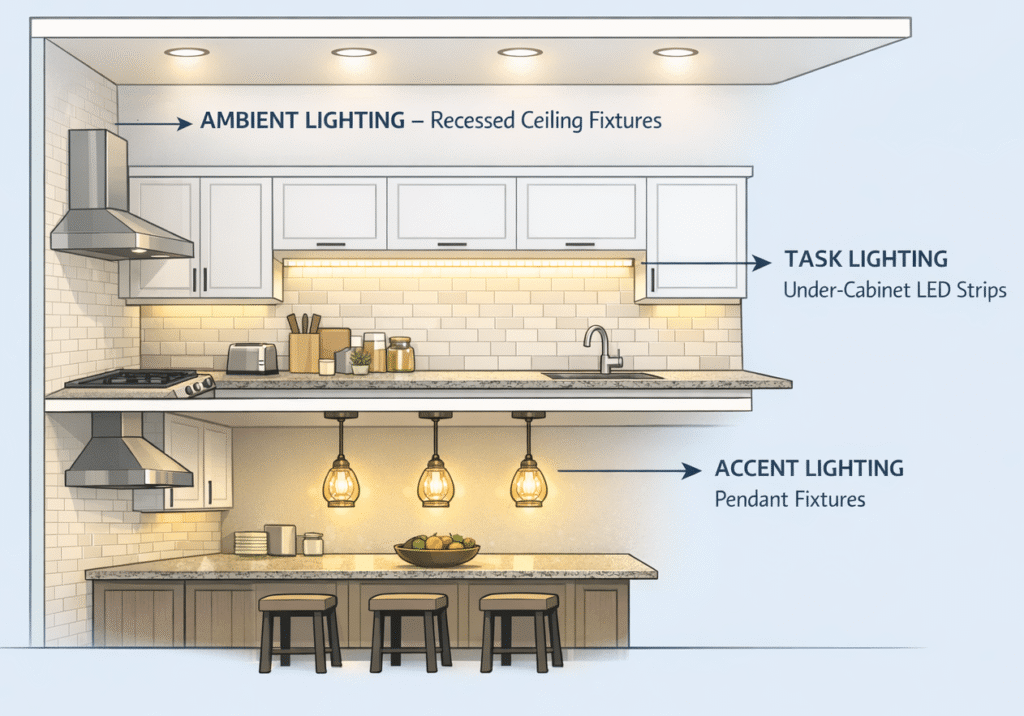
Ambient Lighting: Your Foundation Layer
Ambient lighting provides overall illumination ensuring safe navigation and establishing general brightness. In Southern Ohio’s older homes where original kitchens often featured single ceiling fixtures, modern ambient lighting represents significant upgrades from outdated designs.
Recessed Ceiling Lights
Recessed fixtures form the backbone of modern ambient lighting. These LED recessed lighting kits should be spaced approximately 4 to 6 feet apart, creating even illumination without dark corners.
For kitchens with 8-foot ceilings common in pre-1960 homes, plan for one recessed fixture per 25 to 30 square feet. Higher ceilings require more powerful fixtures or additional units to maintain adequate light levels. The National Electrical Code (NEC) establishes minimum standards for fixture spacing and circuit requirements.
Flush-Mount and Semi-Flush Options
Flush-mount or semi-flush-mount ceiling fixtures provide alternative solutions, especially in homes with limited ceiling access. These work well in Southern Ohio’s historic properties where plaster ceilings complicate extensive cutting for recessed installations.
Track Lighting Flexibility
Track lighting systems offer flexible ambient coverage for galley kitchens or spaces with unusual layouts. This adaptability proves valuable in older homes where structural limitations complicate traditional fixture placement.
Task Lighting: Focused Illumination for Work Areas
Task lighting provides concentrated illumination where you perform detailed kitchen work. Countertops, sinks, ranges, and islands all require dedicated task lighting ensuring safety during food preparation, cooking, and cleanup.
Under-Cabinet Lighting: The Critical Investment
Under-cabinet lighting represents the most critical task lighting investment. Installing LED strip lights or puck lights beneath upper cabinets eliminates shadows on countertops and provides essential illumination for food preparation.
Modern LED systems consume minimal electricity while delivering excellent light quality—ideal for Southern Ohio homeowners managing older electrical systems with limited circuit capacity. ENERGY STAR research shows LED fixtures reduce energy consumption by 75% compared to incandescent alternatives.
Color temperature matters significantly for task lighting. Lights rated between 2700K and 3000K produce warm white light similar to traditional incandescent bulbs. Meanwhile, 3500K to 4000K creates neutral white light enhancing color accuracy when preparing food.
Related Reading: Complete Kitchen Remodeling Guide
Planning a comprehensive renovation? Our Complete Guide to Kitchen Remodeling covers design decisions, material selections, and budget planning. Learn how lighting integrates with cabinetry choices, countertops, and flooring.
Pendant Lights Over Islands
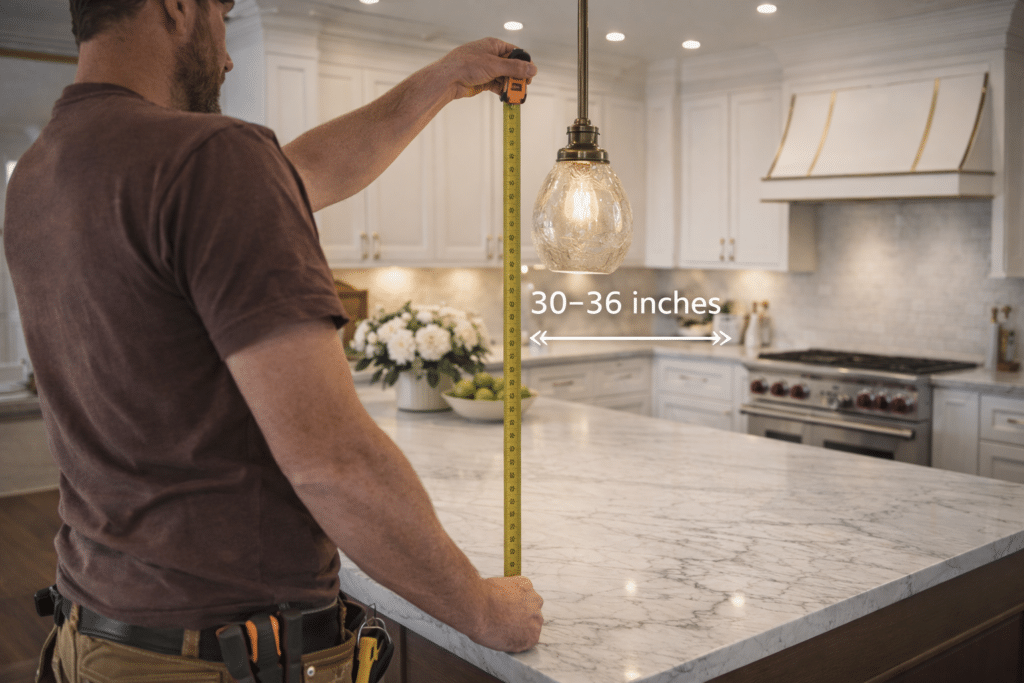
Pendant lights over islands and peninsulas provide both task lighting and visual interest. Pendant fixtures should hang 30 to 36 inches above counter surfaces, ensuring adequate illumination without obstructing sight lines.
For islands used primarily for food preparation, select pendants that direct light downward efficiently rather than decorative fixtures scattering light broadly. This distinction between task-oriented and ambient pendants affects kitchen functionality significantly.
Specialized Sink Lighting
Sink lighting requires special attention because overhead fixtures often cast shadows when you’re working. For sinks positioned under cabinets or away from windows, dedicated fixtures ensure clear visibility during dishwashing and food preparation tasks.
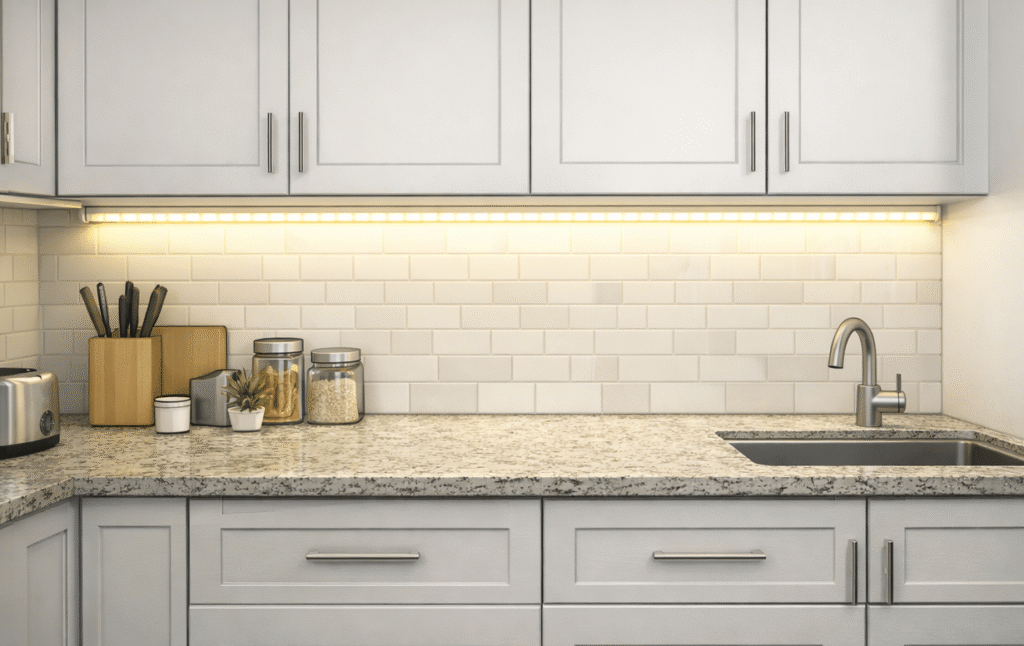
Accent Lighting: Adding Depth and Visual Interest
Accent lighting highlights architectural features, creates visual depth, and adds aesthetic appeal. While less critical than ambient and task lighting, accent fixtures transform purely functional kitchens into inviting gathering spaces.
Cabinet Display and Toe-Kick Lighting
LED strips or puck lights inside glass-front cabinets highlight china, glassware, or decorative items while adding dimension. This technique works particularly well in Southern Ohio’s traditional homes where built-in cabinetry often features glass-front upper cabinets.
Toe-kick lighting creates a floating effect beneath base cabinets while providing subtle nighttime navigation light. LED strips installed in recessed toe-kick areas consume minimal electricity and last years without replacement.
LED Technology: Energy Efficiency for Ohio Valley Kitchens
Modern LED lighting technology delivers superior performance while dramatically reducing energy consumption. Understanding LED characteristics helps you make informed investment decisions.
| Feature | LED | Incandescent | CFL |
|---|---|---|---|
| Lifespan | 25,000-50,000 hours | 1,000 hours | 8,000 hours |
| Watts (60W equivalent) | 8-12W | 60W | 13-15W |
| Annual Energy Cost* | $1.20 | $7.20 | $1.75 |
| Heat Output | Minimal | High | Moderate |
| CRI (Color Quality) | 80-95+ | 100 | 60-80 |
| Dimmable | Yes (with compatible dimmer) | Yes | Limited |
*Based on 3 hours daily use at $0.12/kWh (Ohio average)
LED Advantages for Southern Ohio
LED fixtures consume 75 to 80% less electricity than equivalent incandescent fixtures while producing identical light output. For Southern Ohio homeowners managing higher electricity costs during summer air conditioning season, LED efficiency translates directly to lower utility bills.
A kitchen using 10 recessed incandescent fixtures consuming 65 watts each draws 650 watts of power. Replacing these with equivalent LED fixtures reduces consumption to approximately 120 watts—saving over 80% of lighting energy.
Heat generation drops significantly with LED technology. Incandescent bulbs convert most electricity directly to heat rather than light, raising kitchen temperatures and increasing air conditioning costs. LED fixtures remain relatively cool during operation, improving comfort while reducing cooling demands in our region’s humid summer climate.
Exceptional Lifespan Benefits
Quality LED fixtures operate for 25,000 to 50,000 hours compared to just 1,000 hours for incandescent bulbs. In practical terms, LED fixtures installed today may not require replacement for 15 to 25 years with typical residential use patterns.
This longevity proves especially beneficial for recessed fixtures in high ceilings or under-cabinet lighting where access requires moving appliances or removing cabinet contents. According to ENERGY STAR certification standards, premium LED products must demonstrate sustained performance over their rated lifespan.
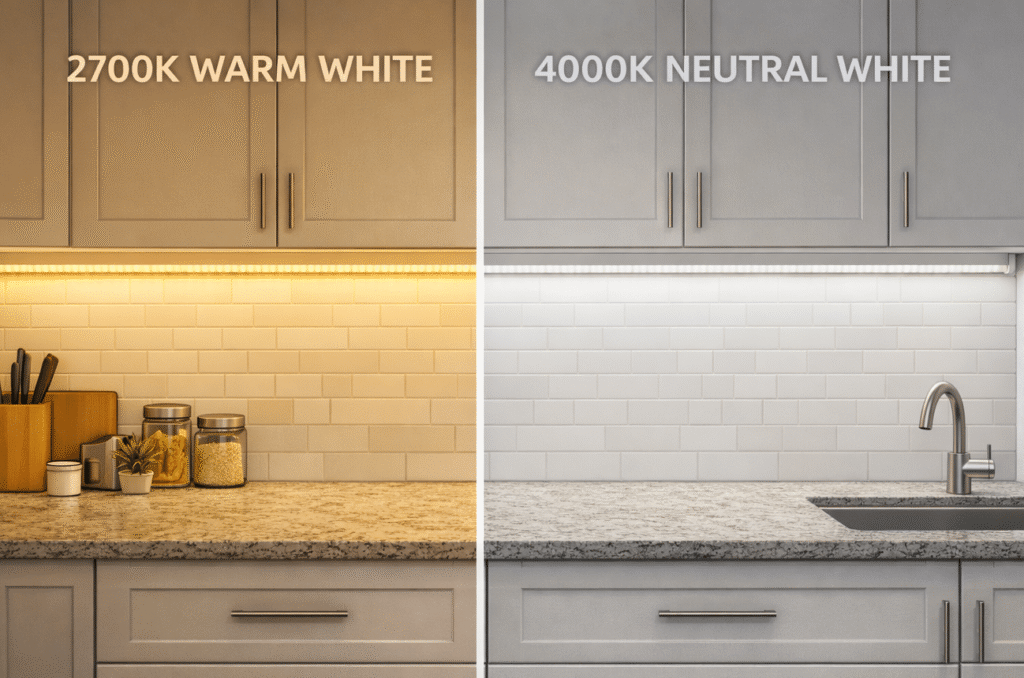
Understanding Color Temperature Selection
Color temperature, measured in Kelvin (K), describes the apparent warmth or coolness of white light. Selecting appropriate color temperature for different kitchen areas enhances both functionality and ambiance.
Warm white light (2700K-3000K) creates inviting, cozy atmospheres similar to traditional incandescent lighting. This works well for ambient and accent lighting where comfortable gathering spaces take priority over precise color accuracy. Many Southern Ohio homeowners prefer warm white lighting to maintain connection with traditional interior aesthetics.
Neutral white light (3500K-4000K) balances warmth with improved color rendering, ideal for task lighting over food preparation areas. This helps you accurately judge food appearance during cooking while maintaining relatively warm overall ambiance.
Cool white light (5000K-6500K) produces crisp, energetic illumination maximizing color accuracy and visual acuity. While less common in residential kitchens, it may benefit homeowners with specific color-matching requirements.
Quick Reference: Color Temperature Selection
- 2700K: Warm, cozy – Best for dining areas, ambient lighting
- 3000K: Warm neutral – Versatile choice for most kitchen applications
- 3500K-4000K: Neutral white – Ideal for task lighting, food prep areas
- 5000K+: Cool, bright – Professional kitchens, specialized tasks
Pro Tip: Limit color temperature variation to 500-1000K between layers to avoid jarring visual conflicts.
Fixture Selection and Dimming Systems
LED-Compatible Dimmer Requirements
LED dimming requires specialized dimmer switches designed specifically for LED loads. Traditional incandescent dimmers often cause LED fixtures to flicker, buzz, or fail to dim smoothly. Lutron’s LED dimming guide provides detailed compatibility information for matching dimmers to fixtures.
When planning LED kitchen lighting, budget for LED-compatible dimmers from reputable manufacturers like Lutron, Leviton, or Legrand. Calculate total wattage of all connected fixtures and select dimmers rated for at least 20% more than your actual load.
2026 Remodeling Cost Guide
Don’t get ripped off. See real pricing for bathrooms, kitchens, and HVAC.
Updated for 2026 Market Rates
Smart Lighting Integration
Smart lighting systems provide control through smartphone apps, voice commands, or automated schedules. Smart bulbs offer entry-level automation, while smart switches replace traditional wall switches with networked controls that operate standard LED fixtures.
Scene programming allows you to save preferred brightness levels for different activities—morning coffee, food preparation, dinner cleanup, and evening entertaining. Most smart lighting systems include scene creation tools within their control apps.
Planning Kitchen Lighting Layouts
Effective lighting layout considers your kitchen’s specific configuration, workflow patterns, and existing architectural features. Thoughtful planning prevents costly corrections after installation.
Calculating Lumens Requirements
Kitchen lighting design begins with lumens calculations—actual light output rather than outdated wattage-based planning. Modern LED technology produces far more lumens per watt than older technologies.
Lumens Calculator: Kitchen Lighting Requirements
Ambient Lighting: 70-80 lumens per square foot
Example: 150 sq ft kitchen = 10,500-12,000 total lumens
Task Lighting: 75-100 lumens per square foot over work surfaces
Example: 6-foot counter = 1,800-2,400 lumens from under-cabinet strips
Under-Cabinet LED Strips: 300-400 lumens per linear foot
Recessed Fixtures: 1,300-1,500 lumens each for 8-foot ceilings
Note: Divide total lumens requirement among multiple fixtures to prevent over-lighting specific areas while leaving others dark.
Addressing Common Layout Challenges in Older Homes
Southern Ohio’s older homes present unique lighting challenges requiring creative solutions. Low ceilings in pre-1960 homes limit recessed lighting options since standard housings require approximately 6 inches of ceiling depth.
Shallow-profile LED recessed fixtures now available require only 2 to 3 inches of depth, making them viable where traditional housings won’t fit. Surface-mount fixtures provide alternatives when even shallow recessed options prove impractical.
Plaster ceilings common in pre-1950 homes crack easily during fixture installation. Using remodel-style recessed housings that clip directly to drywall reduces stress on surrounding plaster compared to housings requiring attachment to ceiling joists. Many experienced contractors use oscillating multi-tools rather than hole saws when cutting plaster to reduce cracking risk.
Related Reading: Kitchen Layout Optimization
Maximizing functionality goes beyond lighting. Explore our Kitchen Layout Ideas for Small Spaces to learn how proper planning integrates lighting with workflow, storage, and appliance placement in older Ohio Valley homes.
Climate and Regional Considerations for Ohio Valley Kitchens
Southern Ohio’s climate patterns and housing characteristics influence kitchen lighting decisions differently from other regions. Understanding these local conditions ensures long-term performance.
Humidity Management
Southern Ohio’s humid summers create conditions where moisture accumulation affects lighting fixtures and electrical connections. Kitchens experience particularly high humidity during cooking activities—especially when boiling water or operating dishwashers.
Recessed fixtures in insulated ceiling cavities require proper sealing to prevent moisture infiltration. IC-rated (Insulation Contact) recessed housings designed for direct contact with insulation include better sealing than non-IC fixtures and future-proof installations against insulation upgrades.
Fixture ratings indicate moisture resistance capability. Damp-rated fixtures withstand occasional moisture exposure, while wet-rated fixtures tolerate direct water contact near sinks or within reach of sink spray attachments.
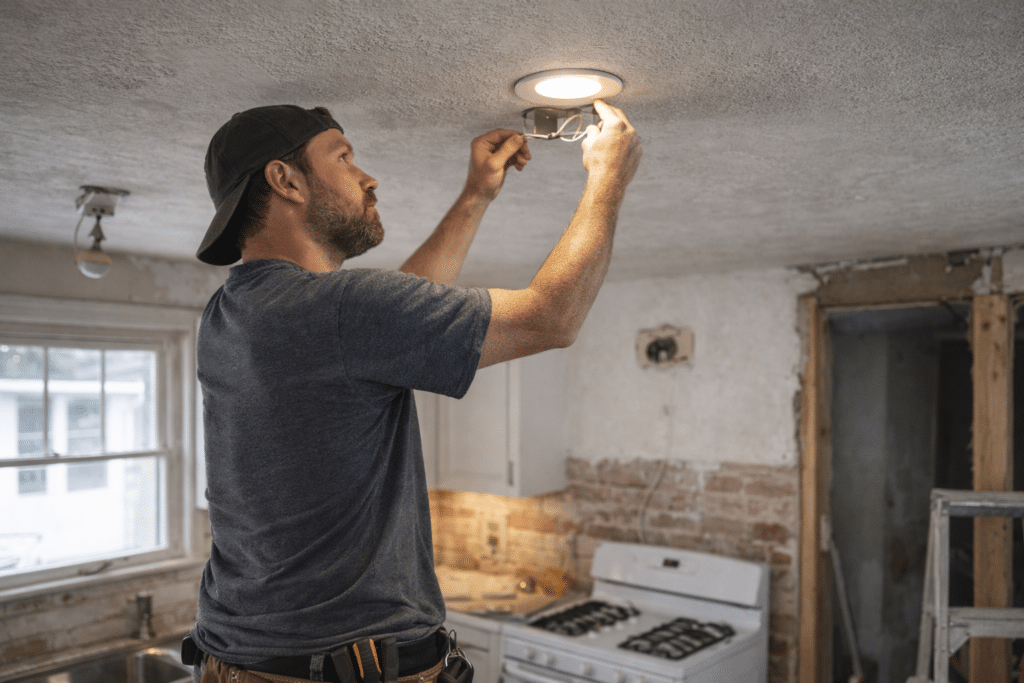
Shallow-profile LED fixtures enable recessed lighting installation in Southern Ohio’s older homes with plaster ceilings and limited attic access.
Older Home Integration Strategies
Southern Ohio’s housing stock includes substantial numbers of homes built before modern electrical codes. Ceiling joist spacing in older homes often follows 24-inch centers rather than modern 16-inch spacing, affecting recessed fixture placement options.
Wire sizing in older homes may not meet modern standards. Current NEC requirements specify 14-gauge wire for 15-amp lighting circuits and 12-gauge for 20-amp circuits. Older installations sometimes used 16-gauge or even 18-gauge wire that cannot safely support modern lighting loads.
Ungrounded circuits in pre-1960 homes create safety concerns. While many LED fixtures can operate on ungrounded circuits, proper grounding protects against shock hazards. The Electrical Safety Foundation International (ESFI) provides resources on electrical safety requirements and upgrade recommendations for older homes.
Knob-and-Tube Wiring Replacement
Knob-and-tube wiring in some older Southern Ohio homes complicates lighting upgrades. This obsolete wiring system, installed primarily before 1950, cannot safely support modern lighting loads and lacks ground conductors required by current electrical codes.
If your home contains knob-and-tube wiring, plan to rewire affected circuits as part of your lighting upgrade. While this adds initial cost, it addresses critical safety concerns and prevents future problems with modern LED fixtures requiring proper grounding.
Cost Planning and Budget Strategies
Kitchen lighting projects range from modest updates to comprehensive renovations. Understanding cost factors helps you prioritize investments and allocate budgets strategically.
| Component | Budget Range | Mid-Range | Premium |
|---|---|---|---|
| LED Recessed Fixtures | $15-30/unit | $25-50/unit | $50-100/unit |
| Under-Cabinet LED Strips | $15-25/linear ft | $30-45/linear ft | $40-60/linear ft |
| Pendant Fixtures | $50-150 each | $150-300 each | $300-500+ each |
| LED Dimmer Switches | $20-40 each | $40-75 each | $75-150 each |
| Electrical Labor (S. Ohio): $75-125/hour (8-20 hours typical) | |||
| Permits & Inspection: $100-300 | |||
Related Reading: Complete Kitchen Cost Planning
Understanding total renovation expenses? Our Kitchen Remodeling Costs Guide for Southern Ohio breaks down comprehensive budget planning including lighting, cabinetry, countertops, and flooring investments.
Strategic Project Phasing
Dividing kitchen lighting improvements into phases spreads costs over time while delivering incremental benefits. Strategic phasing prioritizes high-impact improvements enhancing safety and functionality before addressing purely aesthetic upgrades.
Phase One: Essential Task Lighting ($400-800)
Installing under-cabinet LED strips dramatically improves food preparation safety and efficiency while representing relatively modest investment.
Phase Two: Ambient Lighting ($1,500-3,000)
Adding recessed fixtures or upgraded ceiling fixtures represents the largest cost component but transforms overall kitchen usability. This includes fixtures, labor, and electrical work.
Phase Three: Accent & Controls ($500-1,500)
Incorporating accent lighting, decorative pendants, and dimming systems adds visual interest and operational flexibility after addressing fundamental lighting needs.
Panel Capacity and Electrical Upgrades
Homes built before 1970 often have 100-amp service panels that may struggle with modern electrical demands. Upgrading to 200-amp service costs $1,500 to $3,000 but provides capacity for lighting improvements plus other future electrical upgrades.
Permit requirements vary by jurisdiction but typically apply to projects involving new circuits or significant wiring modifications. Portsmouth, Ashland, Marietta, Chillicothe, and other Southern Ohio municipalities enforce NEC standards requiring permits for permanent lighting installations.
Kitchen lighting design combines technical precision with aesthetic sensibility, especially in Southern Ohio’s unique housing environment. Successful installations balance Ohio Valley’s humid climate conditions, older housing stock characteristics (plaster ceilings, knob-and-tube wiring, 24-inch joist spacing), and homeowner preferences for both function and beauty.
From energy-efficient LED technology reducing electricity costs by 75-80% to properly layered ambient, task, and accent lighting creating truly functional spaces, thoughtful planning delivers kitchens you’ll enjoy for decades. Our contractor network serves Portsmouth, Ashland, Marietta, Chillicothe, and communities throughout Southern Ohio and Northern Kentucky with specialized expertise in regional renovation challenges.
Whether you’re renovating a century-old farmhouse, updating a 1970s ranch, or modernizing a traditional home, licensed electricians familiar with local building codes and Ohio Valley architectural characteristics ensure safe, beautiful, long-lasting results. From initial design consultation through final installation, we connect homeowners with experienced professionals who understand IC-rated fixtures, moisture management strategies, and installation best practices for our region.
Ready to transform your kitchen lighting? Connect with our network today to discuss your project. We’ll match you with contractors who specialize in Southern Ohio’s older homes, understand regional electrical codes, and deliver professional installations meeting the highest standards for performance, efficiency, and aesthetic appeal.
Related Articles
Complete Kitchen Remodeling Guide
Comprehensive kitchen renovation planning including design decisions, material selections, and budget strategies for Southern Ohio homeowners.
Kitchen Cabinet Buying Guide: Custom vs. Stock vs. Semi-Custom
Understand cabinet options, quality differences, and pricing considerations when selecting cabinetry complementing your new lighting design.
Kitchen Countertop Materials Comparison
Compare granite, quartz, laminate, and other countertop materials including how different surfaces interact with various lighting designs.
Kitchen Flooring Options and Costs in Southern Ohio
Discover flooring materials working beautifully under modern LED lighting systems while meeting Ohio Valley’s humidity and durability requirements.
Granite vs. Quartz Countertops Guide
Detailed comparison of popular countertop materials showing how they reflect and interact with kitchen lighting design choices.
Final Reminder: This article contains affiliate links to products and services we recommend. Purchases made through these links may earn us a commission at no additional cost to you. We appreciate your support, which helps us continue providing comprehensive, unbiased content to help you make informed decisions about your home improvement projects.
Author: mike@korekomfortsolutions.com

Author: Mike Warner
Mike Warner — Founder, Kore Komfort Solutions LLC U.S. Army veteran. 30 years in the trades — HVAC installation, kitchen and bathroom remodeling, and residential construction across Alaska, Washington, Colorado, Ohio, Kentucky, and Tennessee. I've pulled permits, managed crews, run service calls at midnight, and built a business from a single truck. Now I build the digital infrastructure that helps contractors compete and win. Kore Komfort Solutions exists for one reason: to give small and mid-size contractors ($2M–$10M) the same AI-powered tools, websites, and business systems that the big operations use — without the enterprise price tag or the learning curve. Through Kore Komfort Digital, we design and manage high-performance WordPress websites engineered to rank on Google and convert local searches into booked jobs. Through Rose — our AI-powered business management system currently in development — we're building the future of how contractors handle leads, scheduling, estimates, and customer communication. I write about what I know: the trades, the technology reshaping them, and how to build a contracting business that runs on systems instead of chaos. Every recommendation on this site comes from someone who's actually done the work — not a marketer who Googled it.