Article Navigation
Key Takeaways
- Quartzite and quartz lead durability: Quartzite offers the highest natural hardness (7-8 Mohs scale), while engineered quartz provides superior stain resistance without sealing requirements—making both excellent long-term investments for Southern Ohio kitchens.
- Maintenance demands vary dramatically: Quartz and stainless steel require only basic cleaning, while granite needs resealing every 1-3 years, marble demands 6-month sealing, and butcher block requires monthly oiling—match maintenance to your lifestyle realistically.
- Heat handling separates materials: Granite, quartzite, soapstone, and stainless steel handle hot pans directly, while quartz, solid surface, and laminate suffer permanent damage above 300-400°F—this limitation matters significantly for active cooks.
- Regional climate impacts performance: Southern Ohio’s humidity swings between summer moisture and dry winter heating stress wood countertops and unsealed concrete more than stable materials like quartz, properly sealed granite, or stainless steel.
- Cost spans $10-$250 per square foot: Laminate starts at $10-$40, mid-range granite and quartz run $50-$150, while premium marble and specialty metals reach $100-$250—a typical 45-square-foot kitchen ranges from $450 (budget laminate) to $11,250 (premium marble) installed.
Why Countertop Material Selection Matters More Than Most People Realize
Choosing a kitchen countertop ranks among the most significant decisions you’ll make during a kitchen renovation. Your countertops affect how your kitchen looks, how it functions daily, and how much value your home retains over time. For homeowners in Southern Ohio—from Marietta to Cincinnati, Athens to Mt. Orab—understanding the full range of countertop materials helps you make a choice that fits your lifestyle, budget, and regional considerations.
Your kitchen countertops take more daily abuse than almost any other surface in your home. They endure hot pans, knife work, spilled liquids, heavy appliances, and constant cleaning. The material you choose determines whether your countertops still look great in fifteen years or show their age after five.
Beyond durability, countertop materials affect your daily routine. Some surfaces require regular sealing and careful maintenance. Others can handle neglect without consequence. Some stain permanently if you leave a coffee cup sitting too long. Others wipe clean no matter what you spill.
For Southern Ohio homeowners specifically, humidity fluctuations between our humid summers and dry winter heating seasons can affect certain materials. Understanding these regional factors helps you avoid problems that homeowners in more stable climates never encounter.
Ready to Start Your Kitchen Project?
Natural Stone Countertops
Natural stone offers timeless beauty and proven durability. Each stone type brings distinct characteristics that suit different kitchens and lifestyles.
Granite
Granite dominated the premium countertop market for decades and remains a popular choice throughout communities like Steubenville, Gallipolis, and the greater Southern Ohio region.
Composition and Characteristics
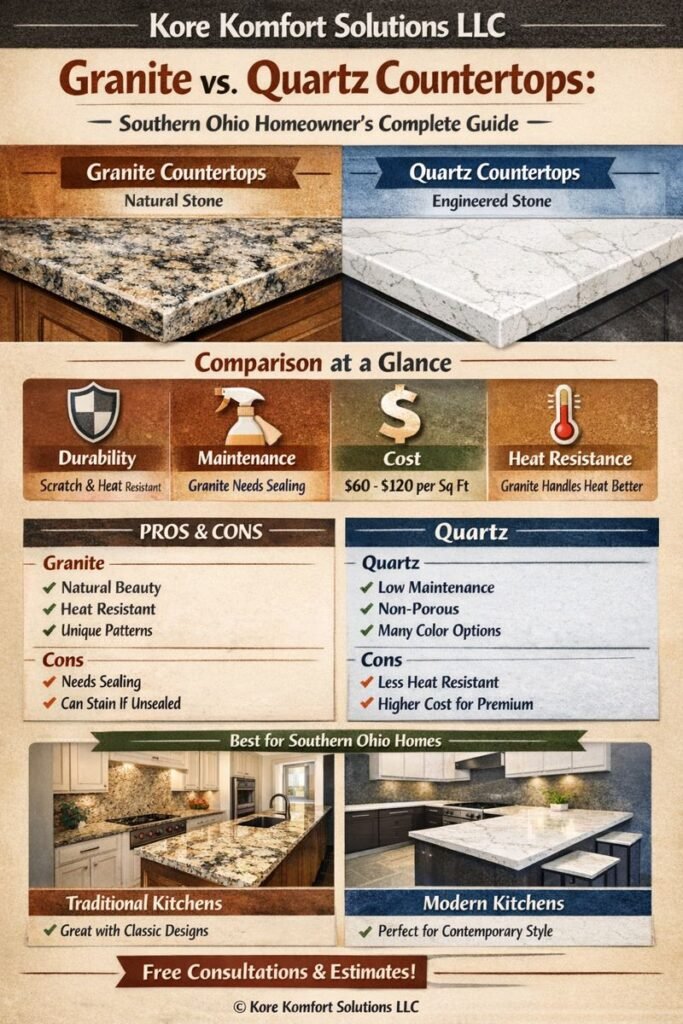
Granite forms deep within the earth under extreme heat and pressure, creating a dense, hard surface composed primarily of quartz, feldspar, and mica. Each granite slab features unique patterns and color variations, meaning no two granite countertops are identical.
Durability Assessment
Granite ranks 6-7 on the Mohs hardness scale, making it resistant to scratches from normal kitchen use. It withstands heat well—you can set hot pans directly on the surface without damage in most cases, though thermal shock from extreme temperature changes can occasionally cause issues.
The material’s primary vulnerability involves its porous nature. Unsealed granite absorbs liquids, potentially leading to staining from oils, wine, coffee, and acidic substances like lemon juice or tomato sauce.
Maintenance Requirements
Granite requires sealing upon installation and resealing every one to three years, depending on the specific stone’s porosity and how heavily you use your kitchen. Testing whether your granite needs resealing involves placing a few drops of water on the surface—if the water absorbs within a few minutes rather than beading up, it’s time to reseal.
We recommend high-quality granite sealers that provide long-lasting protection and make reapplication straightforward. Daily cleaning requires only mild soap and water. Avoid acidic cleaners, which can etch the surface and damage the sealant.
Cost Considerations
Granite countertops in Southern Ohio typically range from $50 to $200 per square foot installed, with most mid-range options falling between $60 and $100 per square foot. Exotic colors and patterns command premium prices, while more common varieties remain affordable.
A typical Southern Ohio kitchen with 40-50 square feet of countertop space runs between $2,400 and $5,000 for mid-range granite, including professional fabrication and installation.
Regional Availability
Southern Ohio homeowners benefit from reasonable access to granite suppliers and fabricators throughout the region. Our network includes experienced fabricators serving Marietta, Ashland, Athens, Mt. Orab, and surrounding communities. Larger metropolitan areas like Columbus offer extensive slab yards where you can hand-select your specific stone, while fabricators in smaller communities like Maysville, Henderson, and Owensboro can source materials from regional distributors.
Marble
Marble represents the pinnacle of natural stone elegance, though its practical limitations make it a more complicated choice for kitchen applications.
Composition and Characteristics
Marble forms when limestone undergoes metamorphosis under heat and pressure, creating the distinctive veining patterns that make marble visually striking. The classic white Carrara marble with gray veining remains the most recognizable variety, though marble comes in numerous colors including green, black, pink, and gold.
Durability Assessment
Marble rates 3-5 on the Mohs hardness scale—significantly softer than granite. This softness makes marble susceptible to scratching from knives, abrasive cleaners, and even gritty particles dragged across the surface.
More significantly, marble’s calcium carbonate composition reacts with acids. Lemon juice, vinegar, wine, tomato sauce, and many common foods etch marble surfaces, leaving dull spots that require professional refinishing to remove. This etching occurs even through sealant.
Maintenance Requirements
Marble demands the most intensive maintenance of any countertop material. Sealing every six months to a year helps reduce staining but cannot prevent etching. Spills require immediate cleanup—leaving acidic substances on marble for even a few minutes causes permanent marks.
We recommend specialized marble sealers and pH-neutral cleaners formulated specifically for calcium-based stones. Many marble countertop owners eventually embrace a “living finish” philosophy, accepting that their countertops will develop patina and character over time rather than maintaining a pristine appearance.
Cost Considerations
Marble countertops range from $75 to $250 per square foot installed in Southern Ohio markets. Carrara marble typically falls in the $75-$125 range, while premium varieties like Calacatta can exceed $200 per square foot.
Practical Recommendations
Marble works best in low-use areas or for homeowners who prioritize aesthetics over practicality. Some families install marble on islands or baking stations where they want the cool surface temperature for pastry work, while using more durable materials for primary work zones.
Quartzite
Quartzite often creates confusion because its name sounds similar to engineered quartz, though the two materials differ completely.
Composition and Characteristics
Quartzite forms when sandstone undergoes metamorphosis under extreme heat and pressure, fusing sand grains into an incredibly hard, dense stone. Natural quartzite features flowing patterns and coloring ranging from white and gray to pink, green, and blue.
Durability Assessment
Quartzite rates 7-8 on the Mohs hardness scale—harder than granite and approaching the hardness of topaz. This exceptional hardness makes quartzite extremely scratch-resistant. The material also withstands heat well, handling hot cookware without damage.
Like granite, quartzite requires sealing because it’s naturally porous. However, high-quality quartzite tends to be less porous than most granite varieties.
Maintenance Requirements
Seal quartzite every one to two years and clean with mild soap and water. Avoid acidic cleaners that can damage the sealant. We recommend penetrating stone sealers that protect without altering the stone’s natural appearance.
Cost Considerations
Quartzite typically costs more than granite, ranging from $70 to $200 per square foot installed. The material’s exceptional hardness makes fabrication more challenging, contributing to higher labor costs.
Important Purchasing Caution
Some suppliers mislabel softer marble or dolomite as quartzite. Genuine quartzite will not etch when exposed to acid and cannot be scratched with a knife blade. Before purchasing, test potential slabs or request documentation confirming the material is true quartzite.
Soapstone
Soapstone offers a distinctive alternative to more common natural stones, with characteristics that suit certain homeowners exceptionally well.
Composition and Characteristics
Soapstone consists primarily of talc, giving it a soft, smooth texture that feels warm to the touch compared to other stone surfaces. The material typically appears in gray, green, or black tones, often with subtle veining.
Durability Assessment
Soapstone rates just 1-2 on the Mohs hardness scale—the softest countertop stone available. This softness means soapstone scratches easily from knives, dropped objects, and abrasive cleaning. However, scratches sand out easily with fine-grit sandpaper, making damage repair straightforward.
Unlike marble and granite, soapstone’s density makes it completely non-porous. The material never needs sealing and resists staining absolutely—nothing penetrates the surface. Soapstone also withstands heat exceptionally well, which is why it’s traditionally used for wood stove surrounds and laboratory countertops.
Maintenance Requirements
Soapstone requires no sealing whatsoever. Many owners apply mineral oil periodically to darken the stone and enhance its appearance, though this is aesthetic rather than functional. The stone naturally darkens over time with use.
Light scratches can be removed with fine-grit sandpaper, followed by mineral oil application if desired.
Cost Considerations
Soapstone ranges from $70 to $150 per square foot installed in Southern Ohio. Its relative rarity compared to granite means fewer local suppliers carry it, potentially requiring sourcing from larger metropolitan fabricators.
Engineered Stone Countertops
Engineered materials combine natural minerals with modern manufacturing to create surfaces with enhanced performance characteristics.
Quartz (Engineered Quartz)
Engineered quartz has become the most popular countertop material in recent years, combining natural stone appearance with enhanced durability and consistency.
Composition and Characteristics
Manufacturers create engineered quartz by combining approximately 90-95% ground natural quartz crystals with polymer resins and pigments. This manufacturing process allows for consistent coloring and patterns throughout the material, unlike natural stone’s inherent variability.
Modern quartz countertops convincingly mimic marble, granite, and other natural stones while offering colors and patterns impossible in nature. The material comes in hundreds of design options from manufacturers including Caesarstone, Silestone, Cambria, and MSI.
Durability Assessment
Engineered quartz resists scratches, stains, and impact damage exceptionally well. The non-porous surface prevents liquid absorption, eliminating the staining concerns associated with natural stone.
However, quartz has one significant limitation: heat sensitivity. The polymer resins binding quartz countertops can scorch or discolor at temperatures above 300-400°F. Hot pans placed directly on quartz surfaces may leave permanent marks. Always use trivets or hot pads.
Additionally, prolonged direct sunlight can fade or discolor some quartz colors over time, though this primarily affects outdoor applications or countertops near large sunny windows.
Maintenance Requirements
Quartz requires no sealing—ever. Clean with mild soap and water or a non-abrasive household cleaner. Avoid harsh chemicals like bleach or oven cleaner, which can damage the surface.
This minimal maintenance requirement makes quartz particularly attractive for busy Southern Ohio families who want beautiful countertops without the upkeep demands of natural stone.
Cost Considerations
Quartz countertops in Southern Ohio typically range from $55 to $150 per square foot installed, with most popular options falling between $65 and $100 per square foot. Premium designer patterns command higher prices.
Regional Considerations
Quartz performs well in Southern Ohio’s variable climate. Unlike some natural stones that can be affected by humidity fluctuations, engineered quartz remains dimensionally stable regardless of seasonal moisture changes.
Solid Surface (Corian and Similar Brands)
Solid surface countertops offered the first engineered alternative to natural stone and maintain relevance for specific applications.
Composition and Characteristics
Solid surface materials consist of acrylic or polyester resins mixed with mineral fillers. Corian, manufactured by DuPont, remains the most recognized brand, though competitors include Hi-Macs, Staron, and Meganite.
The material allows seamless integration—joints between sections can be sanded invisible, and integrated sinks eliminate the seams where undermount sinks meet countertops. This seamless capability remains solid surface’s primary advantage over other materials.
Durability Assessment
Solid surface resists stains well and offers easy repair for scratches and minor damage—fine scratches buff out with gentle sanding. However, the material scratches more easily than stone or quartz and can be damaged by heat. Hot pans cause permanent scorch marks.
Maintenance Requirements
Solid surface requires no sealing. Clean with standard household cleaners, avoiding abrasive scrubbing pads that can dull the finish. Minor scratches and stains can be removed by sanding with progressively finer grits, a repair any homeowner can perform.
Cost Considerations
Solid surface countertops range from $40 to $100 per square foot installed, making them competitive with mid-range granite and budget quartz options.
Best Applications
Solid surface works particularly well for bathroom vanities, laundry rooms, and secondary prep areas where seamless integration and easy maintenance matter more than heat resistance. In kitchens, solid surface suits homeowners who want integrated sinks and are diligent about using trivets for hot items.
Laminate Countertops
Laminate countertops have evolved significantly from the dated patterns that gave the material a cheap reputation. Modern laminate offers attractive designs at the lowest price point of any countertop material.
High-Pressure Laminate (HPL)
Composition and Characteristics
High-pressure laminate consists of layers of kraft paper bonded with melamine resin under high heat and pressure, then adhered to a particleboard or MDF substrate. The decorative surface layer can replicate stone, wood, solid colors, or abstract patterns.
Modern laminate convincingly mimics granite, marble, and wood at a fraction of the cost. Manufacturers like Formica, Wilsonart, and Pionite offer thousands of patterns and colors.
Durability Assessment
Laminate resists stains well and handles daily kitchen abuse reasonably. However, the material scratches from knives, burns from hot pans, and the edges can chip from impact. Once damaged, laminate cannot be repaired—only replaced.
Water poses the greatest threat to laminate countertops. Moisture penetrating seams or edges causes the particleboard substrate to swell and delaminate. Keeping seams well-sealed and immediately wiping water around sinks prevents most damage.
Maintenance Requirements
Laminate needs no sealing. Clean with any non-abrasive household cleaner. Avoid abrasive scrubbers that can dull the surface over time.
Cost Considerations
Laminate offers the most affordable countertop option, ranging from $10 to $40 per square foot installed. Budget laminate at $10-$15 per square foot provides functional surfaces for rental properties or limited-budget renovations. Premium laminate patterns at $25-$40 per square foot rival mid-range stone appearance at a fraction of the cost.
A complete kitchen with 40-50 square feet of countertop can be surfaced in quality laminate for $600-$1,500—less than many materials cost per linear foot.
Best Applications
Laminate makes sense for budget-conscious renovations, rental properties, secondary kitchens, and situations where countertops will be replaced again within 10-15 years. The material also suits DIY installation, as cutting and fitting laminate requires only basic carpentry tools and skills.
Butcher Block and Wood Countertops
Wood countertops bring warmth and natural beauty to kitchens, though they require more maintenance than stone or engineered alternatives.
Hardwood Butcher Block
Composition and Characteristics
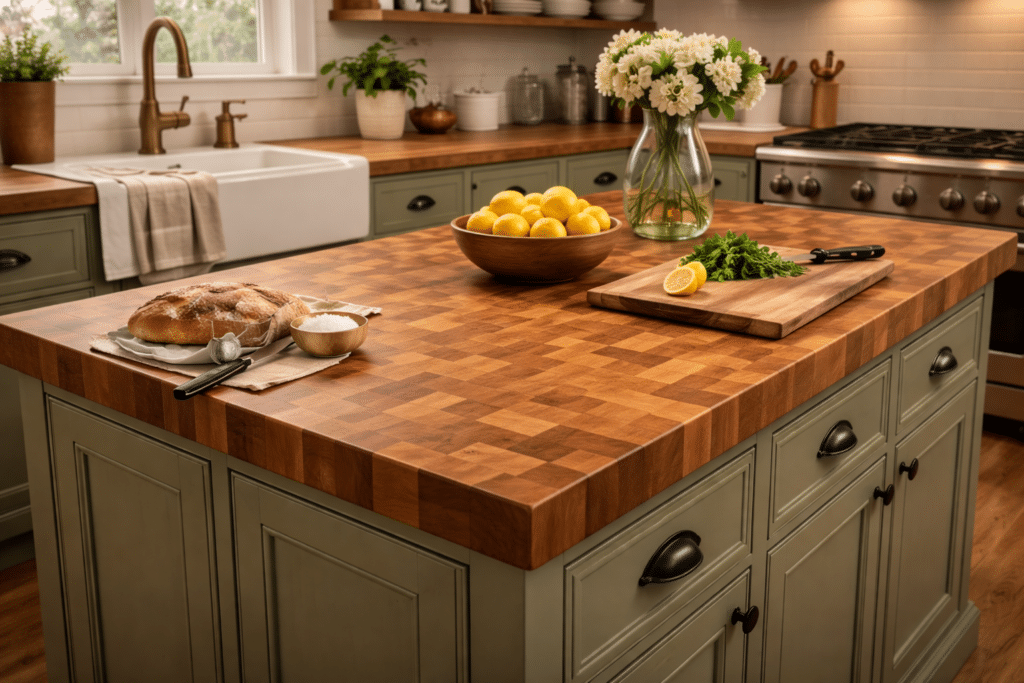
Butcher block consists of hardwood strips—typically maple, walnut, cherry, or oak—bonded together in edge-grain or end-grain configurations. Edge-grain butcher block shows the long side of wood strips and costs less. End-grain butcher block displays the cut end of each block, creating a checkerboard pattern that’s gentler on knife edges and more expensive.
Durability Assessment
Wood countertops handle kitchen tasks differently than hard surfaces. They absorb knife impacts rather than dulling blades, making them excellent cutting surfaces. However, wood scratches, dents, and stains from daily use.
Water poses the primary concern for wood countertops. Prolonged moisture causes warping, splitting, and potentially promotes bacteria growth. Southern Ohio’s humidity variations make this concern particularly relevant—the seasonal swing from humid summers to dry winter heating can stress wood surfaces.
Maintenance Requirements
Wood countertops require regular oiling with food-safe mineral oil or specialized butcher block oil. Most manufacturers recommend monthly oiling, though high-use areas may need weekly treatment. This ongoing maintenance commitment exceeds what stone or engineered surfaces demand.
Periodically sanding the surface removes accumulated scratches and stains, restoring the wood’s appearance. This refinishing capability extends the lifespan of wood countertops indefinitely with proper care.
Cost Considerations
Butcher block countertops range from $40 to $150 per square foot installed in Southern Ohio. Standard maple edge-grain falls at the lower end, while premium walnut end-grain commands top prices.
DIY installation is feasible with butcher block, potentially reducing costs significantly. Ready-made butcher block tops are available at home improvement stores, requiring only cutting to fit and proper sealing.
Best Applications
Many homeowners install butcher block on islands or dedicated prep areas while using more durable materials on perimeter countertops. This hybrid approach provides the warm aesthetic of wood where desired while ensuring durability where hot pans and water exposure occur most frequently.
Don’t get ripped off. See real pricing for bathrooms, kitchens, and HVAC.
Hire the Right Contractor the First Time
Use our free research guide and intelligence report to vet any contractor before you sign a contract.
Updated for 2026 Market Rates
Metal Countertops
Metal surfaces offer unique performance characteristics unavailable in stone or wood options.
Stainless Steel
Stainless steel dominates commercial kitchens for good reason—its durability, sanitation properties, and heat resistance exceed all other materials.
Composition and Characteristics
Stainless steel countertops typically use 16-gauge or 18-gauge steel (lower numbers indicate thicker, more substantial material) bonded to a plywood or MDF substrate for stability and sound dampening.
The material offers a sleek, modern, professional appearance that suits contemporary and industrial kitchen designs.
Durability Assessment
Stainless steel handles heat without damage—you can place any hot item directly on the surface. The non-porous surface resists staining and bacteria growth. However, stainless steel scratches easily, developing a patina of fine scratches over time. Some homeowners appreciate this lived-in appearance; others find it objectionable.
Maintenance Requirements
Clean stainless steel with mild soap and water or dedicated stainless steel cleaners. Fingerprints and water spots show readily on the reflective surface, requiring frequent wiping in high-visibility areas. Avoid abrasive cleaners and steel wool that accelerate scratching.
Cost Considerations
Stainless steel countertops range from $80 to $200 per square foot in Southern Ohio, depending on gauge thickness and customization complexity. Integrated sinks and backsplashes increase costs but eliminate seams where bacteria can accumulate.
Regional Considerations
Stainless steel’s excellent heat handling suits Southern Ohio kitchens where hot cookware transfers directly from stove to counter. The material’s complete imperviousness to water also eliminates any humidity-related concerns during our variable seasons.
Copper and Zinc
These specialty metals appeal to homeowners seeking distinctive character rather than pristine appearance.
Characteristics and Appearance
Copper and zinc countertops develop living finishes—the metals oxidize and patina over time, changing color and character with use. Copper starts bright and develops brown tones, while zinc transitions from silver to darker gray-blue shades.
Practical Considerations
Both metals are soft, scratching and denting readily. They require homeowners who appreciate evolving appearance rather than consistent aesthetics. Acidic foods accelerate patina development, creating lighter spots where lemons or tomatoes contact the surface.
Cost Considerations
Copper and zinc countertops range from $100 to $200 per square foot, placing them among the most expensive options available.
Concrete Countertops
Concrete countertops offer complete customization in color, shape, and finish, appealing to homeowners seeking truly unique surfaces.
Cast Concrete
Composition and Characteristics
Fabricators cast concrete countertops in custom molds, allowing integral sinks, unusual shapes, and embedded decorative elements. Pigments create virtually any color, from natural gray to bold blues, greens, or earth tones.
Durability Assessment
Properly sealed concrete resists staining and handles heat well. However, concrete is inherently porous and requires regular sealing—typically annually—to maintain protection. The material can develop hairline cracks over time, particularly if the underlying substrate shifts or settles.
Southern Ohio’s seasonal temperature and humidity variations can stress concrete countertops more than stone alternatives. Proper sealing helps mitigate these effects, but concrete requires more climate-related maintenance attention in our region than it might in more stable environments.
Maintenance Requirements
Concrete demands regular sealing—most manufacturers recommend annual resealing, with high-use areas potentially needing more frequent attention. We recommend food-safe concrete sealers designed specifically for countertop applications. Daily cleaning uses mild soap and water, avoiding acidic cleaners that can damage the sealant.
Cost Considerations
Custom concrete countertops range from $70 to $150 per square foot installed in Southern Ohio. The labor-intensive casting and curing process contributes significantly to costs.
Best Applications
Concrete suits homeowners who want unique, handcrafted surfaces and don’t mind maintenance demands. The material works particularly well for creating unusual shapes, integrated drainboards, or surfaces with embedded decorative elements like recycled glass or stone fragments.
Tile Countertops
Tile countertops offer unlimited design possibilities at various price points, though their practical limitations have reduced their popularity for primary kitchen work surfaces.
Ceramic and Porcelain Tile
Composition and Characteristics
Ceramic tiles consist of clay fired at moderate temperatures, while porcelain uses finer clay fired at higher temperatures, creating a denser, more durable product. Both come in thousands of colors, patterns, sizes, and textures.
Durability Assessment
Individual tiles resist heat, staining, and scratching well. However, tile countertops’ weak point lies in the grout lines. Grout stains easily, requires regular sealing, and creates uneven surfaces that complicate food preparation and cleaning.
Tiles can crack from impact—dropping heavy objects like cast iron pans often breaks tiles, requiring replacement. This vulnerability makes tile less forgiving than solid surface materials.
Maintenance Requirements
Grout demands regular sealing—every six months to a year—and frequent cleaning to prevent staining. We recommend quality grout sealers and specialized cleaning tools. Tiles themselves need only standard household cleaners.
Cost Considerations
Tile countertops range from $10 to $80 per square foot installed, depending on tile quality and complexity. Budget ceramic tile offers the most affordable countertop option, while artisan handmade tiles can rival stone prices.
Best Applications
Tile works well for backsplashes, low-use areas, or homeowners who enjoy the aesthetic and don’t mind grout maintenance. Larger-format tiles with thinner grout lines reduce maintenance concerns while retaining design flexibility.
Comparing Countertop Materials for Southern Ohio Conditions
The following comparison tables help you quickly evaluate materials based on key performance factors relevant to Southern Ohio homeowners.
Heat Resistance Comparison
| Rating | Materials | Notes |
|---|---|---|
| Excellent | Soapstone, Stainless Steel, Granite, Quartzite | Handle any temperature without damage |
| Good | Marble | Handles heat but susceptible to thermal shock |
| Moderate | Concrete, Ceramic Tile | Perform well with normal use |
| Use Trivets | Quartz, Solid Surface, Laminate, Butcher Block | Heat causes permanent damage |
Humidity and Climate Performance
| Rating | Materials | Notes |
|---|---|---|
| Most Stable | Quartz, Stainless Steel, Solid Surface, Ceramic Tile | Unaffected by seasonal changes |
| Minimal Concern | Granite, Quartzite, Soapstone, Marble | Stable with proper sealing |
| Requires Attention | Butcher Block, Concrete | Need proper sealing and climate monitoring |
| Water Sensitive | Laminate | Moisture at seams causes swelling and damage |
Maintenance Burden Comparison
| Level | Materials | Typical Requirements |
|---|---|---|
| Lowest | Quartz, Stainless Steel, Solid Surface | Wipe clean; no sealing ever |
| Moderate | Granite, Quartzite | Seal every 1-3 years |
| Higher | Marble, Soapstone, Concrete | Seal every 6-12 months or regular oiling |
| Highest | Butcher Block | Monthly oiling; periodic refinishing |
Value and Resale Impact
| Impact | Materials | Market Reception |
|---|---|---|
| Highest Value | Quartz, Granite, Quartzite | Broadly appealing to buyers |
| Strong Value | Marble, Butcher Block | Appeals to design-conscious buyers |
| Neutral | Solid Surface, Stainless Steel | Neither helps nor hurts sale |
| May Reduce Value | Outdated Laminate, Damaged Tile | Suggests deferred maintenance |
Cost Comparison Summary
| Material | Cost Range (per sq ft installed) | 45 sq ft Kitchen Estimate |
|---|---|---|
| Laminate | $10 – $40 | $450 – $1,800 |
| Solid Surface | $40 – $100 | $1,800 – $4,500 |
| Butcher Block | $40 – $150 | $1,800 – $6,750 |
| Granite | $50 – $200 | $2,250 – $9,000 |
| Quartz | $55 – $150 | $2,475 – $6,750 |
| Soapstone | $70 – $150 | $3,150 – $6,750 |
| Quartzite | $70 – $200 | $3,150 – $9,000 |
| Concrete | $70 – $150 | $3,150 – $6,750 |
| Marble | $75 – $250 | $3,375 – $11,250 |
| Stainless Steel | $80 – $200 | $3,600 – $9,000 |
| Copper/Zinc | $100 – $200 | $4,500 – $9,000 |
Making Your Countertop Decision
Questions to Guide Your Selection
How do you actually use your kitchen?
Heavy home cooks who slide hot pans and chop directly on surfaces need heat-resistant, scratch-forgiving materials. Families who primarily use their kitchens for reheating and light meal prep have more material flexibility.
What’s your maintenance tolerance?
Be honest about whether you’ll actually perform regular sealing, oiling, or special cleaning. If the answer is probably not, choose materials that forgive neglect—quartz, solid surface, or stainless steel.
What’s your timeline?
Planning to stay in your home for decades? Invest in durable, timeless materials like quartz, granite, or quartzite. Selling within five years? The additional investment in premium materials may not return at sale.
What matters most—appearance or performance?
Marble offers unmatched elegance but demands careful use. Quartz provides worry-free durability but some designers consider it less characterful than natural stone. Your priorities should guide the compromise.
Budget Allocation Guidance
For most Southern Ohio kitchens, countertop materials represent 10-15% of a complete renovation budget. Within that allocation:
- Budget-Focused Projects: Laminate or entry-level solid surface provides functional, attractive surfaces at minimal cost
- Mid-Range Projects: Granite, popular quartz patterns, or butcher block balance quality and value
- Premium Projects: Quartzite, designer quartz, or marble deliver high-end appearance and performance
Remember that fabrication and installation costs often equal or exceed material costs. A less expensive material professionally installed typically outperforms premium materials with substandard installation.
Working with Fabricators
Southern Ohio homeowners should visit fabricator showrooms to see and touch actual material samples. Online images and small samples rarely convey how materials look at countertop scale in real lighting conditions.
Our network includes experienced countertop fabricators throughout Marietta, Ashland, Athens, Mt. Orab, Steubenville, Gallipolis, Maysville, Henderson, and Owensboro who can help you evaluate materials and plan your installation.
When meeting with fabricators:
- Ask to see finished installations of your preferred materials
- Inquire about seam placement for your specific kitchen layout
- Understand warranty coverage for materials and installation
- Get detailed written quotes breaking out material, fabrication, and installation costs separately
Frequently Asked Questions About Kitchen Countertop Materials
What is the most durable kitchen countertop material available?
Quartzite offers the highest natural durability, rating 7-8 on the Mohs hardness scale—harder than granite and resistant to scratching, heat, and staining when properly sealed. Among engineered materials, quartz provides exceptional durability with superior stain resistance and no sealing requirements, though it cannot withstand high heat directly. For homeowners prioritizing longevity with minimal maintenance, quartz typically provides the best combination of durability factors. For those who want natural stone that handles everything including hot pans, quartzite or granite are the strongest choices.
How often do granite countertops need to be sealed?
Most granite countertops require sealing every one to three years, though the specific frequency depends on your granite’s porosity, how heavily you use your kitchen, and the quality of sealant applied. Testing your granite helps determine when resealing is needed—place a few drops of water on the surface and wait 10-15 minutes. If the water beads up and doesn’t absorb, your seal is intact. If the water absorbs into the stone, creating a dark spot, it’s time to reseal. Some dense granites may go longer between sealings, while more porous varieties need annual attention.
Can I put hot pans directly on quartz countertops?
No—quartz countertops can be damaged by hot pans placed directly on the surface. The polymer resins binding engineered quartz can scorch, discolor, or crack at temperatures above 300-400°F, and most cookware coming off a stovetop or out of an oven exceeds these temperatures. Always use trivets, hot pads, or cooling racks between hot cookware and quartz surfaces. This heat sensitivity represents quartz’s primary limitation compared to natural stones like granite or quartzite, which handle any temperature without concern.
What is the least expensive countertop option that still looks good?
High-pressure laminate offers the most affordable countertop option with attractive appearance, ranging from $10-$40 per square foot installed. Modern laminate patterns convincingly replicate granite, marble, and other premium materials at a fraction of the cost. Premium laminate at $25-$40 per square foot rivals mid-range stone appearance while keeping a 40-square-foot kitchen counter project under $1,600. Laminate’s limitations—vulnerability to scratches, burns, and water damage at seams—make it less durable than stone alternatives, but for budget-conscious renovations or shorter-term living situations, quality laminate provides excellent value.
Which countertop material adds the most value to a home sale?
Quartz and granite consistently add the most resale value in Southern Ohio markets because they appeal broadly to buyers without polarizing tastes. Real estate professionals report that updated kitchens with quality stone or quartz countertops recoup 70-80% of their cost at sale and help homes sell faster than comparable properties with dated surfaces. Marble adds value for buyers who appreciate its aesthetic, but its maintenance demands limit its appeal. Unique materials like concrete or copper appeal strongly to specific buyers but may narrow your potential buyer pool. For pure resale optimization, mid-range quartz or granite in neutral tones provides the safest investment.
Related Resources
Explore more guides to help plan your Southern Ohio kitchen renovation:
- Kitchen Remodeling in Southern Ohio and Northern Kentucky
- Complete Kitchen Remodeling Cost Guide for Southern Ohio
- Kitchen Remodeling Calculator
- Kitchen Cabinet Options and Costs
- Kitchen Remodeling: Complete Guide to Planning, Design and Costs
- Kitchen Layout Ideas for Small Spaces: Maximizing Every Square Foot
Hire the Right Contractor the First Time
Use our free research guide and intelligence report to vet any contractor before you sign a contract.

Author: Mike Warner
Mike Warner — Founder, Kore Komfort Solutions LLC U.S. Army veteran. 30 years in the trades — HVAC installation, kitchen and bathroom remodeling, and residential construction across Alaska, Washington, Colorado, Ohio, Kentucky, and Tennessee. I've pulled permits, managed crews, run service calls at midnight, and built a business from a single truck. Now I build the digital infrastructure that helps contractors compete and win. Kore Komfort Solutions exists for one reason: to give small and mid-size contractors ($2M–$10M) the same AI-powered tools, websites, and business systems that the big operations use — without the enterprise price tag or the learning curve. Through Kore Komfort Digital, we design and manage high-performance WordPress websites engineered to rank on Google and convert local searches into booked jobs. Through Rose — our AI-powered business management system currently in development — we're building the future of how contractors handle leads, scheduling, estimates, and customer communication. I write about what I know: the trades, the technology reshaping them, and how to build a contracting business that runs on systems instead of chaos. Every recommendation on this site comes from someone who's actually done the work — not a marketer who Googled it.