Quick Answer: What Are Mini-Splits?
Ductless mini-splits are highly efficient heating and cooling systems that eliminate traditional ductwork. They consist of an outdoor compressor connected to one or more indoor air handlers via small refrigerant lines. With SEER2 ratings of 20-30+, they reduce energy costs by 25-40% compared to central HVAC while providing independent temperature control for each room.
Key Takeaways
- Efficiency gains: Mini-splits deliver 25-40% better efficiency than central HVAC (SEER2 ratings of 20-30+)
- Cost range: $3,000-$12,000 installed depending on zones and brand tier
- Sizing formula: Use 20-25 BTU per square foot, adjusted for climate, insulation, and sun exposure
- Brand tiers matter: Premium brands (Mitsubishi, Daikin) offer 10-12 year warranties vs. 5-7 years for value brands
- DIY is possible: MrCool’s pre-charged linesets eliminate professional refrigerant work
- Cold climate capability: Standard units fail below 5°F; Hyper-Heat models work to -15°F
- 2026 incentives: Federal tax credits up to $2,000 + state rebates available
📋 Article Navigation
What Is a Ductless Mini-Split System?
A ductless mini-split system delivers heating and cooling without traditional ductwork by connecting an outdoor compressor unit to one or more indoor air handlers via refrigerant lines and electrical wiring. Unlike central HVAC systems that lose 20-30% of energy pushing air through extensive duct networks, mini-splits deliver conditioned air directly into individual rooms.
The installation requires only a small 3-inch hole through your exterior wall for the “lineset” containing refrigerant lines, drain line, and electrical wiring. Modern mini-splits achieve SEER2 ratings of 20-30+ compared to 14-16 for conventional central systems, translating to 25-40% lower heating and cooling costs. The secret is inverter-driven compressors that modulate output precisely rather than cycling on and off wastefully.
Affiliate Disclosure: This article contains affiliate links to products we recommend. If you purchase through these links, we may earn a commission at no additional cost to you. We only recommend products we believe provide genuine value for bathroom remodeling projects.
Ductless Mini-Splits: Complete Pros and Cons
The Advantages
Exceptional Energy Efficiency: Mini-splits achieve SEER2 ratings above 20, with premium models reaching 30+. Because they avoid duct losses and use inverter technology, most homeowners see 25-40% reductions in heating and cooling costs compared to traditional systems.
Zone Control: Each indoor unit operates independently with its own thermostat. Multi-zone systems can connect up to 8 indoor units to a single outdoor compressor, solving the age-old problem of one room being too hot while another is too cold.
Whisper-Quiet Operation: Quality mini-splits operate at 19-26 decibels indoors—quieter than a whisper. The noisy compressor stays outside while indoor units use advanced fan designs to move air silently.
Flexible Installation: No ductwork means installation in hours rather than days. Linesets can run up to 50 feet, allowing outdoor units to be placed in optimal locations.
Dual Functionality: Nearly all mini-splits provide both heating and cooling through heat pump technology. Modern cold-climate models work effectively down to -15°F.
The Disadvantages
Visible Linesets and Indoor Units: The lineset typically runs along the exterior wall in a plastic or metal cover. While installers can route these discreetly, they’re never invisible. Indoor units protrude 10-12 inches from the wall—they’re not flush-mounted like central air registers.
Higher Upfront Costs: Single-zone systems start around $3,000 installed, while whole-home multi-zone installations can reach $12,000-$15,000. The payback period through energy savings typically runs 7-12 years.
Regular Maintenance Required: Indoor filters need cleaning every 2-4 weeks during heavy use. Annual professional maintenance costs $150-$250 and is essential for longevity.
Uneven Room Coverage: Wall-mounted units create temperature gradients. Strategic placement and professional load calculations are worth the investment.
Limited Cold Weather Effectiveness: Standard mini-splits lose capacity below 20°F. Cold-climate models with Hyper-Heat technology maintain performance but cost 15-25% more.
Mini-Split Heat Pump vs. Air Conditioner Only
Nearly all mini-splits sold today are heat pumps—providing both heating and cooling through a reversible refrigeration cycle. Some older or budget models are cooling-only.
Heat Pump Mini-Splits: Extract heat from outdoor air and move it inside (winter heating) or extract indoor heat and move it outside (summer cooling). Year-round climate control from one system.
Cooling-Only Mini-Splits: Only operate in one direction. Less common and typically only in commercial applications.
How to tell: Look for an HSPF rating (Heating Seasonal Performance Factor). If a unit lists HSPF, it’s a heat pump. If it only lists SEER/SEER2, it’s cooling-only.
Unless you have a specific reason, always choose heat pump models for maximum flexibility and value.
Understanding SEER2 and HSPF Ratings
SEER2: Cooling Efficiency
SEER2 (Seasonal Energy Efficiency Ratio 2) measures cooling efficiency. Higher numbers mean better efficiency and lower costs.
Federal minimum: 14.3 SEER2
Value mini-splits: 18-22 SEER2
Premium mini-splits: 22-30+ SEER2
A 20 SEER2 unit uses 40% less electricity than a 14.3 SEER2 unit. Over a cooling season, that’s $150-$300 in savings.
HSPF2: Heating Efficiency
HSPF2 (Heating Seasonal Performance Factor 2) measures heating efficiency.
Federal minimum: 7.5 HSPF2
Value mini-splits: 9-10 HSPF2
Premium mini-splits: 10-13 HSPF2
A 10 HSPF2 heat pump uses 33% less electricity than a 7.5 HSPF2 unit, translating to $200-$400 in annual heating savings in cold climates.
Single-Zone vs. Multi-Zone Systems
Single-Zone: One Room, Maximum Efficiency
One outdoor unit connected to one indoor unit. Most cost-effective for conditioning a single room.
Best for: Garages, sunrooms, home offices, master bedrooms, workshops
Cost: $2,200-$6,500 installed
Advantages: Lowest cost, simplest installation, easiest DIY, system independence
Multi-Zone: Whole-Home Solution
One outdoor unit connected to 2-8 indoor units. Each zone operates independently but shares the outdoor compressor.
Best for: Whole-home HVAC replacement, conditioning 2+ rooms, homes without ductwork
Cost: $4,800-$17,000 installed
Advantages: Single outdoor unit, lower total cost for 3+ zones, unified control
Critical Sizing Principle
The outdoor unit capacity must equal or exceed combined indoor capacity. Most systems allow 10-30% “oversizing” where total indoor BTUs exceed outdoor BTUs, but all zones can’t run at maximum simultaneously.
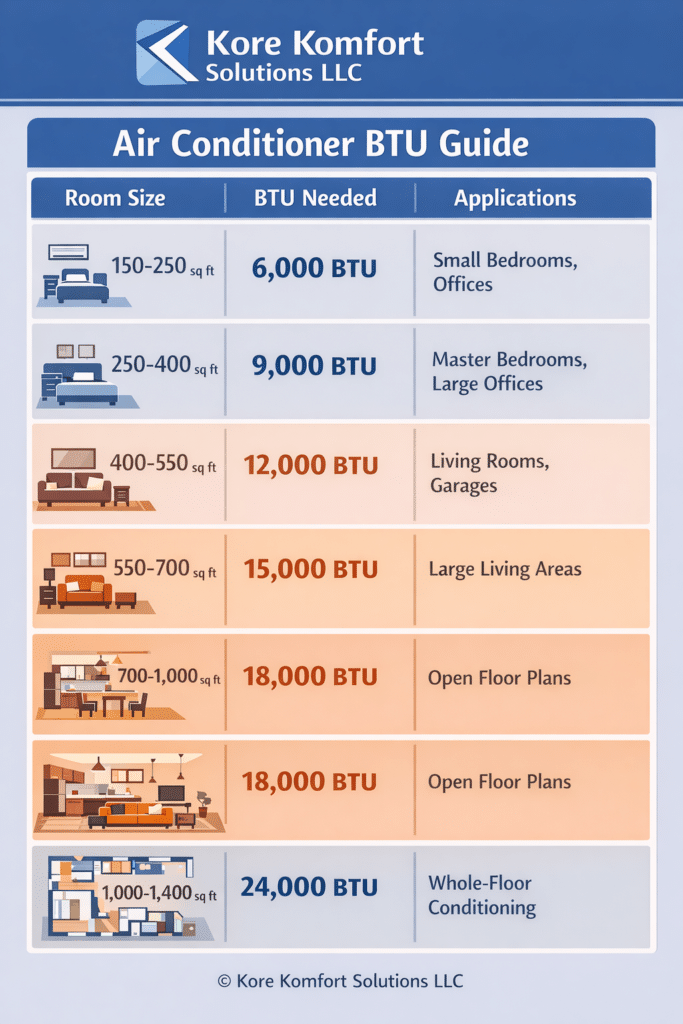
Mini-Split Sizing: Getting BTU Capacity Right
| Room Size | BTU Needed | Applications |
|---|---|---|
| 150-250 sq ft | 6,000 BTU | Small bedrooms, offices |
| 250-400 sq ft | 9,000 BTU | Master bedrooms, large offices |
| 400-550 sq ft | 12,000 BTU | Living rooms, garages |
| 550-700 sq ft | 15,000 BTU | Large living areas |
| 700-1,000 sq ft | 18,000 BTU | Open floor plans |
| 1,000-1,400 sq ft | 24,000 BTU | Whole-floor conditioning |
This assumes: 8-foot ceilings, moderate insulation, normal windows, moderate climate.
Critical Sizing Adjustments
Climate Zone (±15-30%):
- Hot, humid climates: Add 10-15% for dehumidification
- Very cold climates: Add 20-30% (heat pumps lose efficiency as temps drop)
- Moderate climates: Use baseline
Insulation Quality (±30-50%):
- Poor insulation (pre-1980 homes): Add 30-50%
- Average insulation: Use baseline
- Excellent insulation: Reduce 10-15%
Window Exposure (±10-20%):
- South/west-facing large windows: Add 15-20%
- North-facing or limited windows: Use baseline or reduce 5-10%
Ceiling Height: Add 12.5% per foot above 8 feet. Ten-foot ceilings need 25% more capacity.
Kitchen: Add 4,000 BTU if serving kitchen with standard appliances.
Occupancy: Add 500 BTU per person beyond two for rooms hosting crowds.
[Regional Link: For Ohio Valley homeowners, see our regional sizing guide with specific climate data and heating degree days.]
Brand Tier Breakdown: Premium, Value, and DIY Options
Tier 1: Premium Brands
Mitsubishi Electric
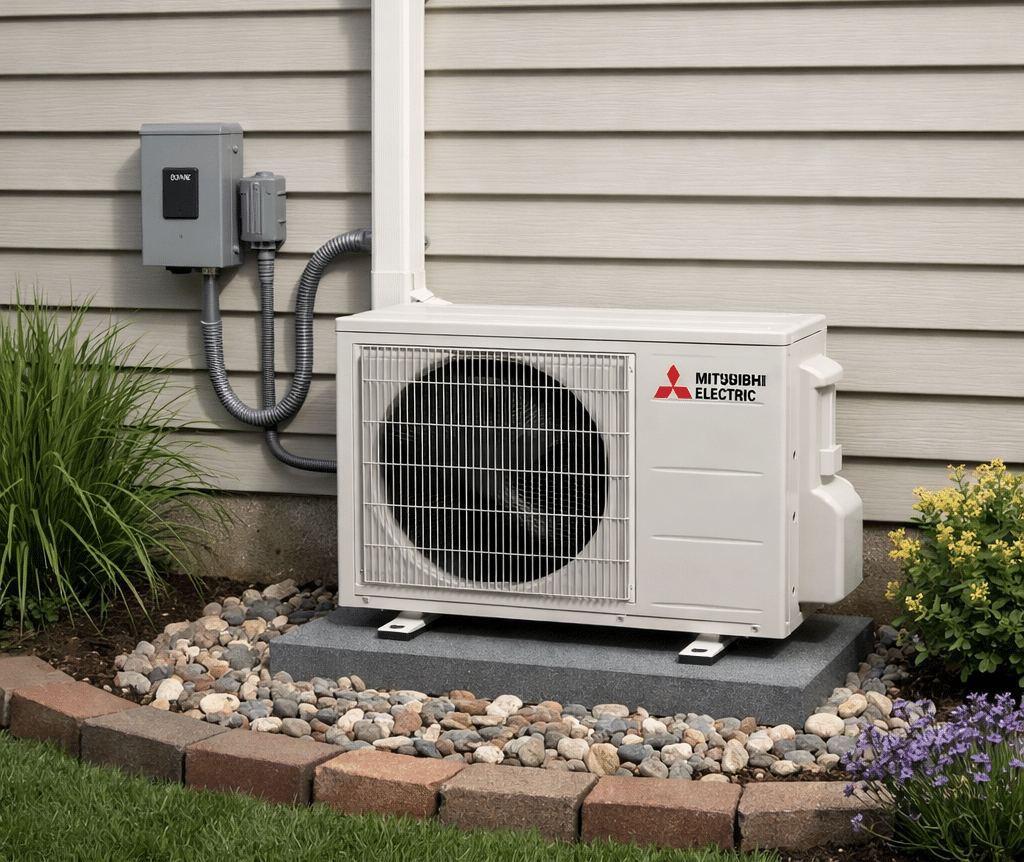
Why premium: Invented mini-splits in 1954. Compressors last 15-20+ years. Hyper-Heat works to -13°F at rated capacity.
Warranty: 12-year parts on compressors (10 years other components)
Technology: i-see sensor, 19 dB operation, kumo cloud app
Price: $2,500-$3,500 equipment / $4,500-$6,500 installed
Best for: Cold climates, longevity priority, primary heating
Where to buy: Mitsubishi Mini-Split Units on Amazon
Daikin
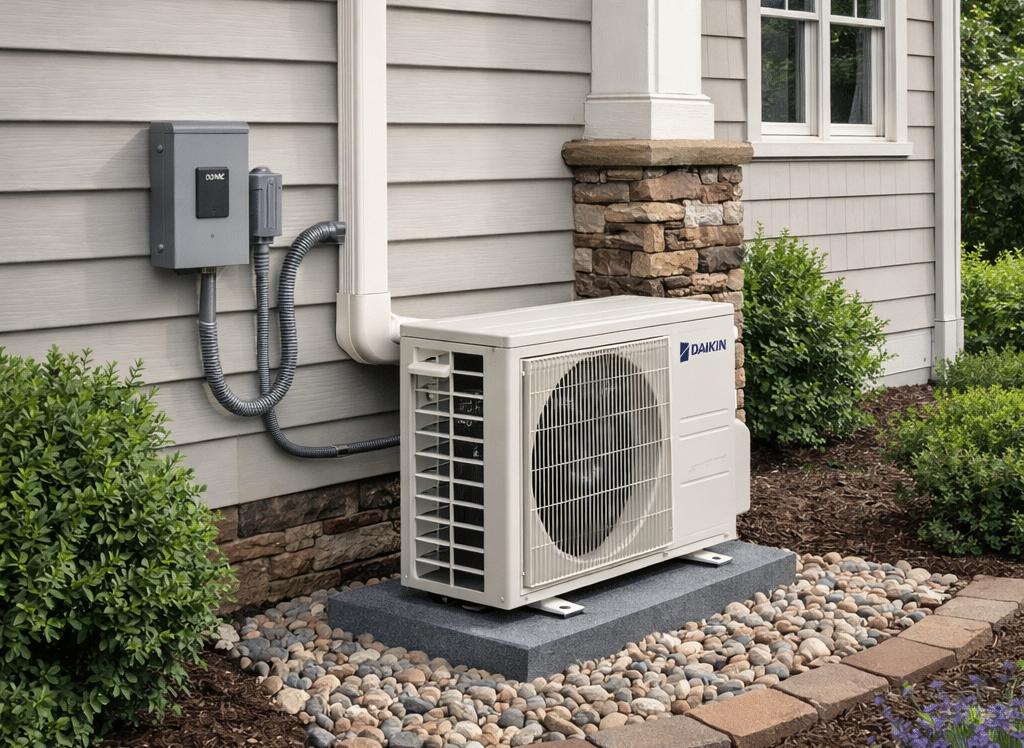
Why premium: World’s largest HVAC manufacturer. Matches Mitsubishi quality at 10-15% lower cost.
Warranty: 12-year compressor, 6-year other components
Technology: Comfort Control sensors, Daikin One app, Aurora cold-climate series
Price: $2,200-$3,200 equipment / $4,000-$5,500 installed
Best for: Premium reliability at slight discount, excellent dealer network
Where to buy: Daikin Mini-Splits on Amazon
Tier 2: Value Brands
Gree

Why value: World’s largest specialized AC manufacturer. 35-45% less than premium, 85-90% of performance.
Warranty: 7-year compressor, 5-year other components
Technology: SEER2 20-25, WiFi standard, cold-climate models to -22°F
Price: $1,200-$1,800 equipment / $2,800-$4,200 installed
Best for: Budget-conscious buyers, moderate climates, rental properties
Where to buy: Shop Gree Mini-Splits
Cooper&Hunter
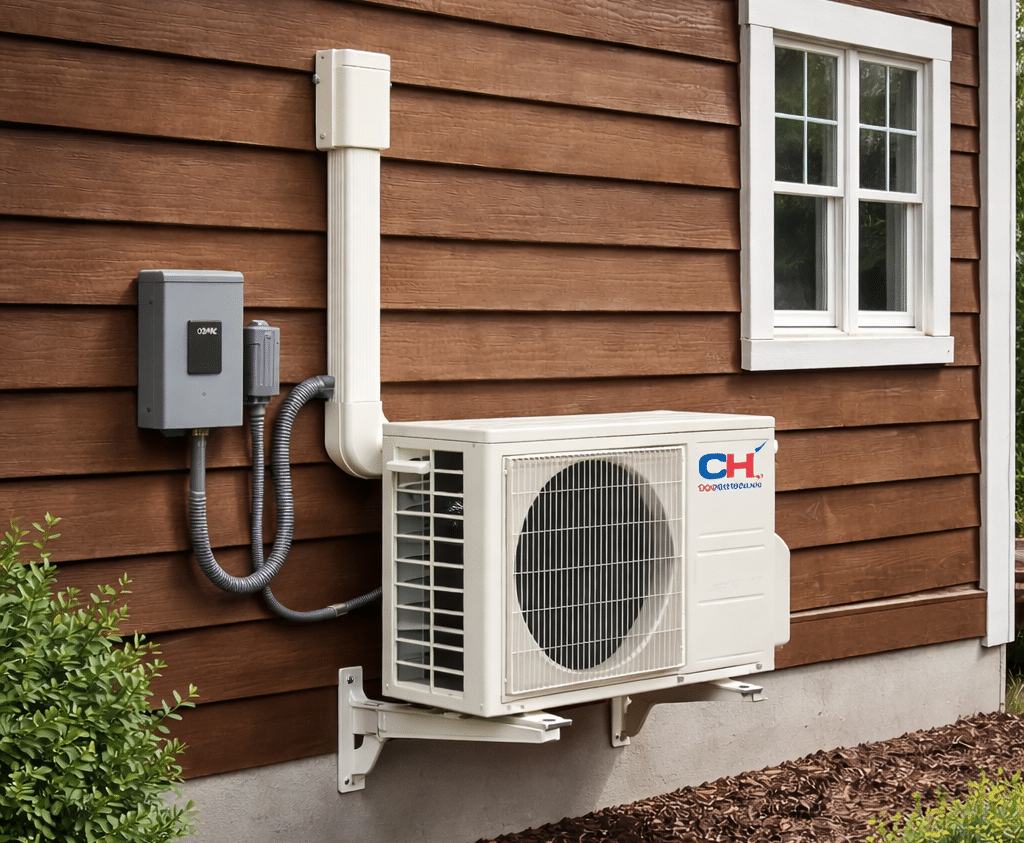
Why value: Best mid-tier smart home integration. Better quality than budget, 20-30% less than premium.
Warranty: 7-year compressor, 5-year other components
Technology: WiFi standard, works with Alexa/Google Home/SmartThings, SEER2 22-23
Price: $1,100-$1,600 equipment / $2,600-$3,900 installed
Best for: Tech-savvy homeowners prioritizing smart features
Where to buy: Shop Cooper & Hunter Systems
Tier 3: DIY and Budget
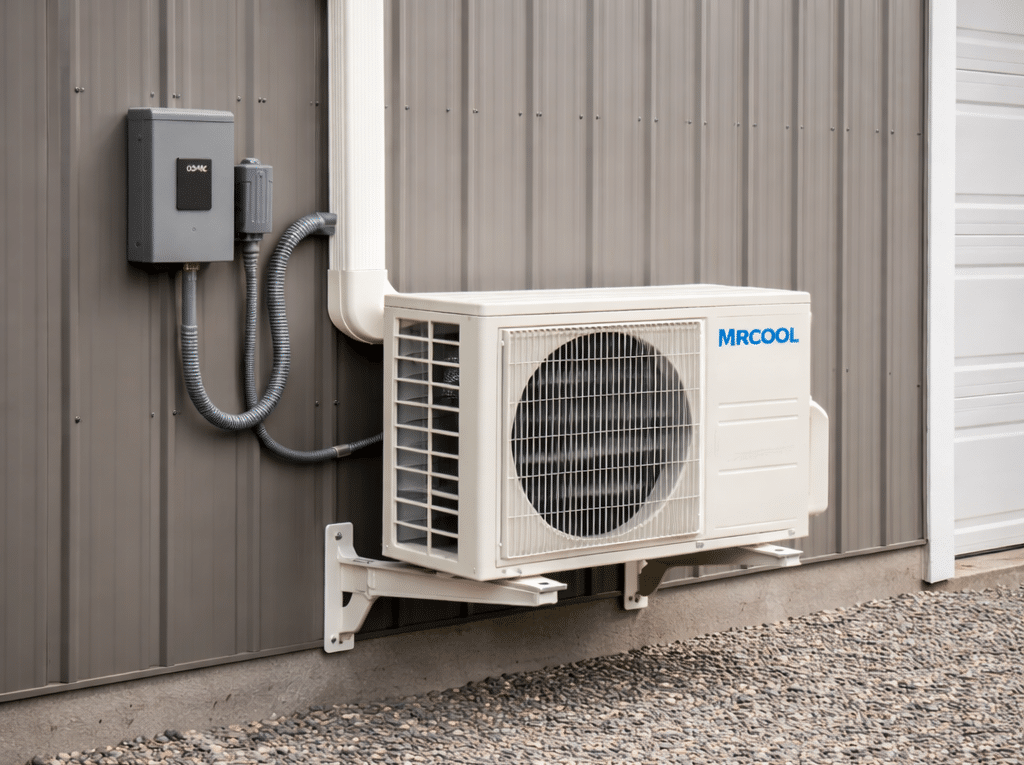
MrCool (The DIY Game-Changer)
Why revolutionary: Pre-charged linesets with quick-connect fittings. Only true DIY option. No vacuum pump or EPA certification needed.
Warranty: 5-year DIY install, 7-year professional install
Technology: WiFi standard, SEER2 16-19, cold-climate models to -5°F
Price: $1,100-$1,500 DIY kit complete
Best for: Handy homeowners, garages, workshops, rental properties
Where to buy: Mr Cool DIY on Amazon
Della (Popular Budget Choice)
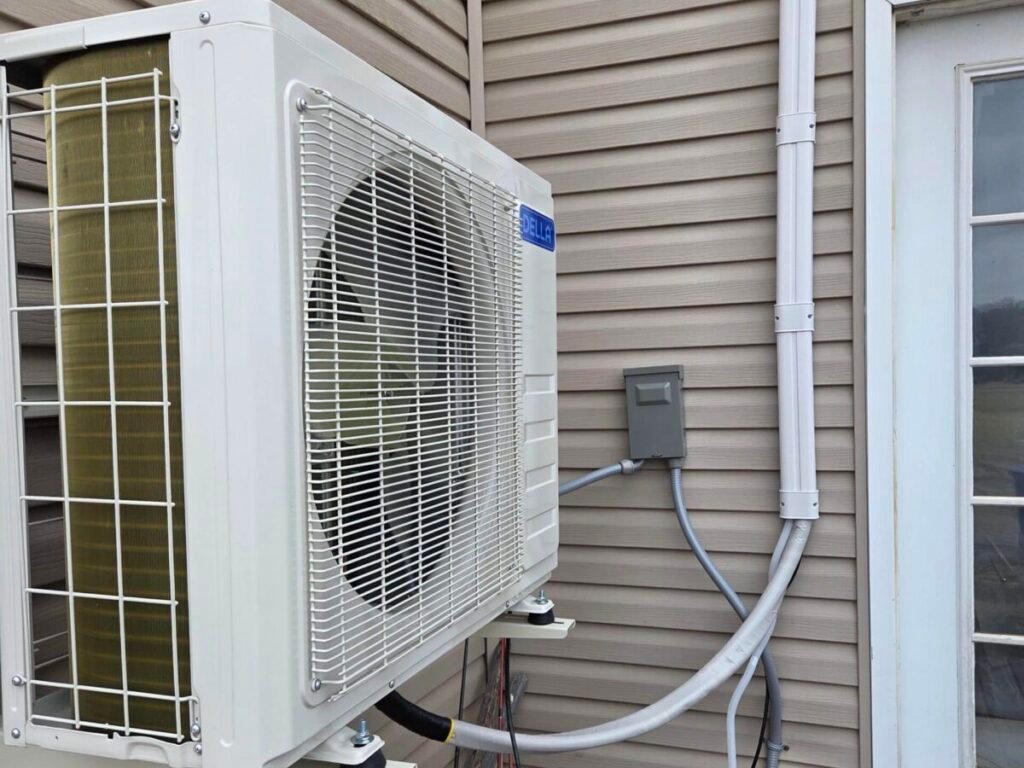
Why they’re popular: Della has gained significant traction in the budget market by offering surprisingly decent quality at rock-bottom prices. While they don’t match premium brands for longevity, they deliver reliable cooling and heating for homeowners prioritizing upfront cost savings. Popular on Amazon with thousands of verified purchase reviews.
Warranty coverage: 5-year limited warranty on compressor, 2-year warranty on parts. Customer service is handled primarily through Amazon, which provides buyer protection but limited technical support compared to established HVAC brands.
Technology highlights: Basic inverter technology on mid-tier models, SEER ratings of 16-19 (adequate but not exceptional). Many models include WiFi control and smartphone app compatibility. Remote control standard. Operates in heating mode down to approximately 5-10°F before significant capacity loss. No advanced features like occupancy sensors or AI optimization.
Price range: Single-zone 12,000 BTU systems run $700-$1,100 for equipment, $1,900-$3,200 installed. This positions Della as one of the most affordable options while maintaining acceptable quality standards. Dual-zone systems: $1,800-$2,600 equipment only.
Best for: Budget-conscious homeowners who need basic climate control without premium features. Excellent for rental properties where longevity beyond 8-10 years isn’t critical. Good option for garages, workshops, or seasonal spaces where occasional failure is acceptable. Also suitable for homeowners wanting to condition spaces affordably while planning future upgrades to premium systems.
Realistic expectations: Della systems deliver on their core promise—cooling and heating at minimal cost. However, expect shorter lifespan (6-10 years typical), louder operation than premium brands (32-38 dB vs. 19-26 dB), and potential quality control inconsistencies. Some units perform flawlessly for years; others experience early failures. The trade-off is price—you’re paying 40-50% less than value brands and 60-70% less than premium brands.
Installation considerations: Della systems ship unpressurized (not DIY-friendly like MrCool). Professional installation required for vacuum pumping and refrigerant charging. Some installers are reluctant to work with lesser-known brands due to warranty concerns and lack of technical support—verify your installer’s willingness before purchasing.
Where to buy: Shop Della Mini-Splits on Amazon
[Related: Planning renovations? See our kitchen and bathroom renovation guides for mini-split integration tips.]
Cost Breakdown: Equipment, Installation, and Operating Expenses
Quick Answer: How Much Do Mini-Splits Cost?
Single-zone systems cost $3,000-$6,500 installed. Budget: $2,200-$3,800, Value: $2,800-$4,500, Premium: $4,500-$6,500. Multi-zone systems: $4,800-$17,000 for 2-4 zones. Factor in federal tax credits up to $2,000 plus state rebates of $500-$2,500.
| System Type | Equipment Only | Installed |
|---|---|---|
| Single-Zone (Budget) | $800-$1,500 | $2,200-$3,800 |
| Single-Zone (Value) | $1,100-$1,800 | $2,800-$4,500 |
| Single-Zone (Premium) | $2,200-$3,500 | $4,500-$6,500 |
| Dual-Zone (Value) | $2,500-$3,800 | $4,800-$7,200 |
| Tri-Zone (Premium) | $5,500-$8,000 | $9,500-$13,500 |
Installation Labor
Professional installation: $1,500-$2,500 for single-zone, $2,500-$4,000 for multi-zone.
Included: Mounting units, drilling core hole, running linesets (up to 25 feet), vacuum and refrigerant charging, electrical connection, testing.
Additional costs:
- New 220V circuit: $300-$800
- Lineset concealment: $500-$1,500
- Extended lineset runs: $8-$15 per foot beyond 25 feet
- Difficult mounting: $200-$600
Operating Costs
Mini-splits: $200-$600 annually for 1,500 sq ft vs. $400-$900 for traditional systems.
Example (1,500 sq ft, moderate climate, $0.13/kWh):
- Premium mini-split (26 SEER2, 11 HSPF2): $770/year
- Value mini-split (20 SEER2, 9 HSPF2): $900/year
- Central AC + gas furnace: $1,280/year
- Annual savings: $380 (30% reduction)
At $380 savings, a $9,000 system pays for itself in 10-12 years while delivering superior comfort.
[Regional pricing: See our Ohio Valley cost guide for Portsmouth, Ashland, and Maysville market pricing with local contractor recommendations.]
Cold Climate Performance: Hyper-Heat Technology
Quick Answer: Do Mini-Splits Work in Extreme Cold?
Standard mini-splits lose capacity below 20°F and stop working below 5°F. However, cold-climate models with Hyper-Heat maintain 70-80% capacity down to -13°F and operate to -20°F. These cost 15-25% more but eliminate backup heat needs in most applications.
Standard heat pumps struggle because there’s less heat energy available in cold air. Cold-climate models overcome this through enhanced vapor injection compressors, advanced refrigerants, and enlarged heat exchangers.
Performance Comparison
| Temperature | Standard | Hyper-Heat |
|---|---|---|
| 20°F | 70-80% | 95-100% |
| 5°F | 40-50% | 85-90% |
| -5°F | Shutdown | 70-80% |
| -13°F | Shutdown | 70-75% |
Top Cold-Climate Models
Mitsubishi Hyper-Heat: 100% capacity at 5°F, 87% at -13°F, operates to -25°F. 12-year warranty. HSPF2 10-12. Cost: $2,800-$4,000 equipment.
Daikin Aurora: 95% capacity at 5°F, 80% at -15°F. 12-year warranty. HSPF2 10-11. Cost: $2,400-$3,400 (10-15% less than Mitsubishi).
MrCool Cold-Climate DIY: 80% capacity at 5°F, 70% at -5°F. 5-year warranty. HSPF2 9-10. Cost: $1,400-$1,900 DIY kit.
Ohio Valley & Midwest Buyers
Living where winters reach 0°F to -10°F? Standard units won’t cut it for primary heating. Hyper-Heat models cost $600-$1,200 more but eliminate backup heat needs. See our Ohio Valley HVAC Guide for regional climate data, model recommendations by budget, and calculations showing when premium cold-climate models pay for themselves.
Smart Home Integration: WiFi Control and Automation
Modern mini-splits integrate with smart home ecosystems, offering convenience and 15-25% additional energy savings through automated control.
Available Smart Features
Basic WiFi (standard on 2024+ models): Temperature control from smartphone, on/off from anywhere, scheduling, energy monitoring, filter reminders.
Advanced Features (premium models): Geofencing (adjusts when you leave/return), occupancy detection (infrared sensors), voice control (Alexa, Google Home, HomeKit), IFTTT automation, AI optimization.
Brand Smart Capabilities
Mitsubishi (kumo cloud): Excellent app, geofencing, works with Alexa/Google/SmartThings. $100 adapter on older models, included 2023+.
Daikin (Daikin One): Comparable to Mitsubishi. Alexa and Google voice control. WiFi included most models.
Cooper&Hunter: WiFi standard all models. Best smart home integration in value tier. Works with Alexa/Google/SmartThings natively.
Gree: WiFi on mid-tier+ models. Basic scheduling and control. Works with Alexa and Google.
MrCool: WiFi standard on 4th gen DIY. Surprisingly good app for budget brand.
Third-Party Options
Cielo Breez: Works with virtually all mini-splits. Adds smart capability to older non-WiFi systems. $99-$139 per zone.
Mysa: Purpose-built for mini-splits. Excellent app, Alexa/Google/HomeKit. $139-$169 per zone.
Sensibo: Similar to Cielo with advanced automation. $119-$149 per zone.
Energy Savings
Smart features drive real savings:
- Geofencing: 10-15% HVAC cost reduction
- Schedule optimization: 8-12% savings
- Occupancy detection: 5-10% in multi-zone systems
- Combined: 15-25% reduction = $100-$200 annual savings
2026 Federal Tax Credits, State Rebates, and Utility Incentives
Quick Answer: Available Incentives
Federal tax credits up to $2,000 through 2032 under the Inflation Reduction Act. Many states offer additional rebates of $500-$2,500. Utilities provide $200-$800 incentives. Combined savings can reduce costs by $1,000-$4,500 depending on location.
Federal Tax Credits
Standard Credit: 30% of equipment and installation costs, maximum $2,000. Requirements: ENERGY STAR Most Efficient OR SEER2 ≥16 and HSPF2 ≥8.5. Applies to existing homes. Claim via IRS Form 5695.
Example: $8,000 total × 30% = $2,400, capped at $2,000 credit.
Enhanced Rebates (HOMES): Up to $8,000 for households earning <80% area median income. Requires 20%+ energy savings via whole-home audit. Varies by state.
State and Utility Rebates
High-incentive states:
- California: $500-$3,000 (TECH Clean CA, BAAQMD). Income-qualified: up to $6,000
- Massachusetts: $500-$1,500 (Mass Save)
- New York: $500-$1,000 (NYSERDA)
- Vermont: $500-$2,500 (Efficiency Vermont, higher for cold-climate)
- Connecticut: $300-$2,000 (Energize CT, tiered by efficiency)
Utility incentives: $200-$800 per system. Check DSIRE database or contact your utility.
Combined Example
Massachusetts homeowner, $8,000 system:
- Federal credit: $2,000
- Mass Save: $1,000
- Utility: $500
- Total incentives: $3,500
- Net cost: $4,500
Maximizing Incentives
- Research before purchasing (some require pre-approval)
- Choose ENERGY STAR Most Efficient models
- Buy cold-climate models in cold states (enhanced incentives)
- Apply early in calendar year (annual budgets deplete)
- Stack federal + state + utility (all combine)
- Save all documentation
Resources: DSIRE | ENERGY STAR | Rewiring America Calculator
DIY vs. Professional Installation
The DIY Path: MrCool Systems
MrCool’s pre-charged linesets with quick-connect fittings eliminate vacuum pumps and EPA certification. Installation takes 3-4 hours.
Process:
- Mount outdoor unit (70-90 lbs, two-person job)
- Install indoor mounting bracket (must be level for drainage)
- Drill 3-inch core hole (slight downward angle)
- Run lineset through hole
- Connect quick-connect fittings (hand-tighten)
- Mount indoor unit
- Connect electrical (indoor: 110V, outdoor: 220V)
- Test and seal penetration
Tools needed: Drill with 3-inch core bit, level, wrenches, screwdrivers, measuring tape, caulking gun.
Electrical challenge: Indoor plugs into standard outlet. Outdoor needs dedicated 220V circuit. If you don’t have existing 220V nearby, hire electrician ($300-$800). Don’t DIY 220V work unless experienced—it’s dangerous.
Ready for DIY? Shop MrCool DIY systems on Amazon with free shipping.
Professional Installation
Required for non-DIY systems (Mitsubishi, Daikin, Gree, Cooper&Hunter). These ship unpressurized and need vacuum pumping, refrigerant charging, and EPA 608 certification.
Choosing installers:
- Verify EPA 608 certification
- Ask: “How many mini-splits annually?” (Look for 20+)
- “Do you perform Manual J calculations?” (Proper method)
- “What’s your lineset concealment process?”
- Check manufacturer certifications (Diamond Contractor, Comfort Pro)
Red flags: Sizing by square footage only, no certifications, won’t provide references, pressure to sign same-day, significantly cheaper than competitors.
[Need help vetting contractors? See our Contractor Selection Guide with interview questions and verification steps.]
Maintenance Requirements
Monthly Tasks (Peak Seasons)
Clean indoor filters (every 2-4 weeks): Most important owner task. Takes 5 minutes. Open front panel, remove mesh filters, vacuum or wash with soap and water, dry completely, reinstall.
Why it matters: Dirty filters reduce efficiency 10-25%, force harder operation, can cause coil freezing or overheating. Set phone reminder—this free task prevents expensive problems.
Seasonal Tasks
Clean outdoor unit (spring and fall): Remove debris, gently spray coils with water (inside-out, never high pressure), trim vegetation to 2 feet clearance, clear snow in winter.
Check drainage: Verify water drips from outdoor drain during cooling. If indoor unit leaks or has musty odors, drain line is clogged—needs professional cleaning.
Annual Professional Maintenance
Schedule annually ($150-$250 per system). Technicians deep-clean coils, verify refrigerant charge, test electrical, clean drains, lubricate motors, test controls, verify temperature differential.
Why it matters: Systems with regular maintenance last 15-20 years. Without maintenance: 8-12 years. The $150-$250 annual cost prevents $1,500-$3,000 premature replacement.
Maintenance Schedule
| Frequency | Task | Who |
|---|---|---|
| Every 2-4 weeks (peak) | Clean indoor filters | Owner |
| Twice yearly | Clean outdoor unit | Owner |
| Annually | Professional service | Technician |
Frequently Asked Questions
Do mini-splits really work in below-zero temperatures?
Standard mini-splits lose significant capacity below 20°F and stop working below 5°F. However, cold-climate models with Hyper-Heat technology maintain 70-80% of rated capacity down to -13°F and continue operating to -20°F. These cost 15-25% more but eliminate backup heat needs in most cold regions. If you regularly see temperatures below 10°F, cold-climate models are essential.
How often do I need to clean the filters?
Clean washable filters every 2-4 weeks during peak use seasons (summer cooling, winter heating). During mild spring and fall, monthly is sufficient. Takes 5 minutes per unit. Dirty filters reduce efficiency 10-25% and can cause system failures. Set a recurring phone reminder—this is the most important owner maintenance task.
Can I heat and cool my entire house with mini-splits?
Yes. Multi-zone mini-splits successfully serve as whole-home HVAC systems. Success requires proper sizing (Manual J load calculation), strategic indoor unit placement for effective airflow, and climate-appropriate models (cold-climate models for regions below 20°F). Open floor plans work naturally. Homes with many closed doors may need more zones. If your existing ductwork is in good condition, keeping traditional system as backup provides redundancy, but if near end-of-life or you lack ductwork, whole-home mini-splits cost less and deliver 25-40% lower operating costs.
Check out the recent MIT research (February 2025) on heat pump efficiency, residential heating electrification, and cost-effectiveness
What are my aesthetic options if I hate wall-mounted units?
Alternatives include ceiling cassette units (mount flush in ceiling, $400-$800 more), floor console units (sit against walls like baseboards), ducted mini-split air handlers (install in attics/closets with only registers visible, $600-$1,200 more), and suspended units (commercial spaces). For wall units, installers can conceal linesets by routing through walls/attics ($500-$1,500 additional) for cleaner appearance. Many homeowners use standard wall units for main areas (most efficient, cost-effective) and upgrade to alternatives for bedrooms or formal spaces where aesthetics matter most.
How do I know if contractors are pricing fairly?
Verify equipment prices online by searching specific model numbers—should be within 40% of retail. Professional installation should add $1,500-$2,500 for single-zone, $2,500-$4,000 for multi-zone with standard complexity. Request itemized quotes separating equipment from labor. Get quotes from 3+ contractors, verify similar specifications. Red flags: bundled pricing without itemization, no Manual J calculation, pressure tactics, won’t provide model numbers before signing. Fair pricing reflects quality equipment, skilled installation, proper sizing, and warranty support—not just cheapest bottom line.
Are mini-splits energy efficient enough to justify the cost?
Yes, for most applications. Mini-splits achieve SEER2 20-30+ vs. 14-16 for traditional systems, translating to 25-40% lower costs. Payback typically runs 7-12 years through savings. Federal tax credits ($2,000 maximum) plus state/utility rebates ($500-$2,500) can reduce net cost by $1,000-$4,500. Best case: new construction or no existing ducts—mini-splits often cost less initially. Moderate case: replacing functional HVAC—$9,000 system vs. $6,000 replacement costs $3,000 more but saves $380 annually, payback in 8 years. Over 15-year lifespan, you come out $2,700 ahead. Challenging case: cheap electricity and mild climate—payback extends to 12-15 years but you still come out ahead long-term.
Can mini-splits be used in humid climates and do they dehumidify well?
Yes, mini-splits often dehumidify better than traditional systems because inverter technology allows continuous operation at variable speeds rather than on/off cycling. Longer coil contact time means more moisture removal. In humid climates, size conservatively (choosing next size down can improve dehumidification by increasing runtime). Look for “dry mode” that prioritizes moisture removal. No air conditioner dehumidifies adequately if severely oversized (causes short-cycling). If primary concern is dehumidification with minimal cooling (Florida winter), consider standalone dehumidifier ($200-$400) rather than running mini-split inefficiently.
How long do mini-splits typically last?
Premium brands (Mitsubishi, Daikin) with proper maintenance: 15-20+ years. Value brands (Gree, Cooper&Hunter) with proper maintenance: 10-15 years. Budget brands (MrCool, Pioneer) with proper maintenance: 8-12 years. Any brand without maintenance: 6-10 years maximum. Regular filter cleaning adds 3-5 years. Annual professional maintenance adds 3-5 years. Installation quality, operating environment, usage patterns, and refrigerant leak response also affect lifespan. Consider replacement when repair costs exceed 50% of replacement, system is 12+ years with declining efficiency, frequent repairs needed, or compressor failure in older systems.
Do mini-splits improve indoor air quality?
Mini-splits improve air quality by eliminating duct contamination (traditional systems accumulate dust, mold, allergens in ductwork over years) and providing continuous filtration through inverter operation. However, standard filters are not HEPA-grade—they capture dust and large particles but not small particles (PM2.5), viruses, or fine allergens as effectively as true HEPA. Mini-splits don’t bring in outdoor fresh air (recirculate indoor air only). For typical residential air quality, they’re excellent. For severe allergies, respiratory conditions, or immune-compromised individuals, supplement with standalone HEPA purifiers ($200-$600) and ERV/HRV systems for ventilation ($1,500-$3,500).
Should I install multiple single-zone systems or one multi-zone?
Multiple single-zones offer system independence (one failure doesn’t affect others) and easier DIY installation one at a time. Disadvantages: multiple outdoor units (aesthetic issue), separate electrical circuits each ($300-$800), higher total cost for 3+ zones (15-25% more). Multi-zone uses one outdoor unit, costs less for 3+ zones, simpler electrical, but requires professional installation and outdoor unit failure affects all zones. Best approach often combines multi-zone for main living areas plus separate single-zones for detached spaces (garage, workshop). Choose single-zone for 1-2 rooms or DIY capability. Choose multi-zone for 3+ rooms or whole-home replacement.
What’s the noise level and will mini-splits disturb sleep?
Premium brands (Mitsubishi, Daikin) in quiet mode: 19-24 dB (quieter than whisper at 30 dB), virtually imperceptible. Value brands low speed: 24-29 dB (library whisper). Budget brands low speed: 28-35 dB (soft whisper). All dramatically quieter than window units (50-70 dB) or central air registers (40-50 dB). Most people adapt within 3-7 nights as brain habituates to consistent white noise. Ultra-quiet modes help (premium models have specific night/sleep modes reducing to 19-21 dB). Light sleepers should prioritize premium brands—the 19-24 dB range is genuinely imperceptible for most people. If louder than expected: ensure level installation, check for loose mounting, clean filters, verify proper refrigerant charge.
What federal tax credits are available in 2026?
Federal tax credits up to $2,000 through 2032 under Inflation Reduction Act. Requirements: ENERGY STAR Most Efficient OR SEER2 ≥16 and HSPF2 ≥8.5. 30% of equipment and installation costs, $2,000 maximum. Applies to existing homes. Claim via IRS Form 5695. Enhanced rebates (HOMES program): up to $8,000 for households earning <80% area median income, requires 20%+ energy savings via audit. State rebates: $500-$2,500 in high-incentive states (California, Massachusetts, New York, Vermont, Connecticut). Utilities: $200-$800. Combined incentives can reduce costs by $1,000-$4,500. Check DSIRE database and your utility before purchasing—some programs require pre-approval.
Final Recommendations
Mini-splits deliver 25-40% better efficiency, room-by-room control, and no ductwork losses. Choose mini-splits if building new, adding to spaces without ductwork, wanting zone control, needing quiet operation, or in moderate to cold climates with appropriate models. Consider traditional HVAC if you have well-functioning ductwork, strongly object to visible units, aren’t willing to clean filters regularly, or want absolute lowest upfront cost regardless of efficiency.
By budget tier:
- Premium (cold climates, longevity): Mitsubishi Hyper-Heat
- Best value (balance): Daikin (cold climates) or Gree (moderate climates)
- DIY: MrCool DIY series exclusively
- Smart home priority: Cooper&Hunter (value) or Mitsubishi/Daikin (premium)
Ready to Start?
- Calculate your BTU needs using the sizing guide
- Research incentives at DSIRE
- If DIY: Explore MrCool systems
- If professional: Get 3+ quotes from certified installers
- Factor post-incentive costs when comparing options
- For cold climates: Specify Hyper-Heat models
Additonal Resources
Affiliate Disclosure: This article contains affiliate links to products we recommend. If you purchase through these links, we may earn a commission at no additional cost to you. We only recommend products we believe provide genuine value for bathroom remodeling projects.

Author: Mike Warner
Mike Warner — Founder, Kore Komfort Solutions LLC U.S. Army veteran. 30 years in the trades — HVAC installation, kitchen and bathroom remodeling, and residential construction across Alaska, Washington, Colorado, Ohio, Kentucky, and Tennessee. I've pulled permits, managed crews, run service calls at midnight, and built a business from a single truck. Now I build the digital infrastructure that helps contractors compete and win. Kore Komfort Solutions exists for one reason: to give small and mid-size contractors ($2M–$10M) the same AI-powered tools, websites, and business systems that the big operations use — without the enterprise price tag or the learning curve. Through Kore Komfort Digital, we design and manage high-performance WordPress websites engineered to rank on Google and convert local searches into booked jobs. Through Rose — our AI-powered business management system currently in development — we're building the future of how contractors handle leads, scheduling, estimates, and customer communication. I write about what I know: the trades, the technology reshaping them, and how to build a contracting business that runs on systems instead of chaos. Every recommendation on this site comes from someone who's actually done the work — not a marketer who Googled it.