Basement waterproofing in Southern Ohio and Northern Kentucky isn’t optional—it’s essential protection for your home’s foundation and living spaces. If you live in communities near the Ohio River like Ashland, Maysville, Gallipolis, Marietta, Henderson, or Owensboro, or in areas with high water tables throughout Portsmouth, Chillicothe, Steubenville, Athens, Waverly, Mt. Orab, and Paducah, moisture intrusion threatens your basement’s usability and your home’s structural integrity.
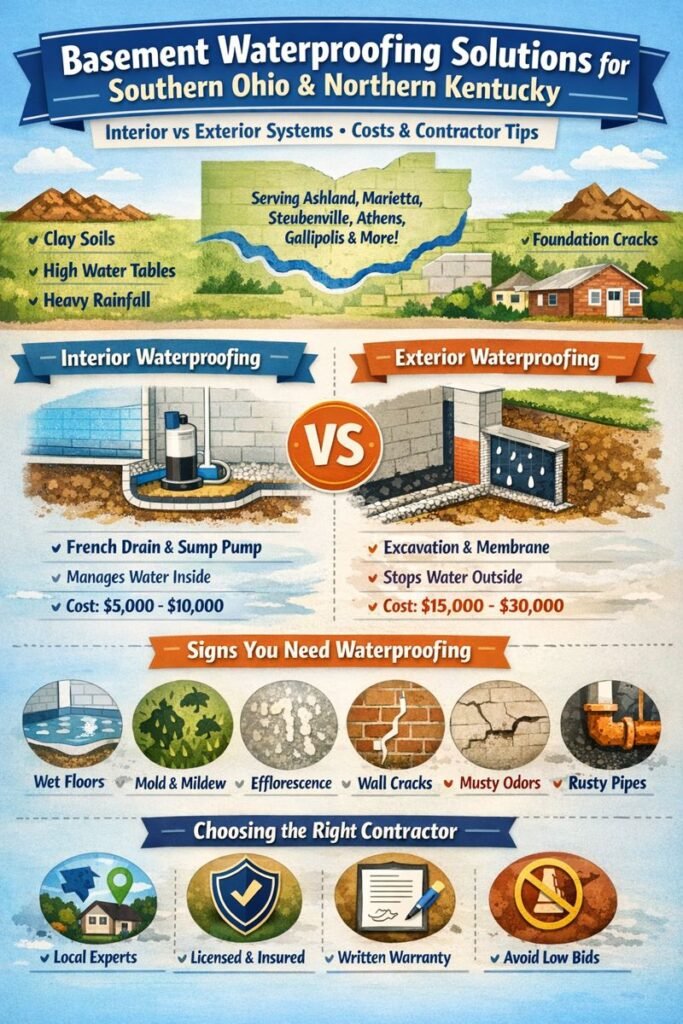
Basement waterproofing systems range from simple interior drainage solutions costing $3,000-7,000 to comprehensive exterior excavation and membrane installation costing $10,000-30,000. Understanding moisture sources, available solutions, and when each approach makes sense helps you invest appropriately in protection that actually works in our region’s challenging soil and climate conditions.
This guide explains common basement moisture problems throughout our region, how professional waterproofing systems work, interior versus exterior approaches, realistic costs, and how to find contractors who deliver lasting solutions rather than temporary fixes that fail within years.
For homeowners throughout our region planning comprehensive home remodeling or basement finishing projects, understanding waterproofing requirements prevents expensive moisture damage and ensures lasting results.
Understanding Basement Moisture in Our Region
Why Basements Throughout Our Region Face Water Problems
Southern Ohio and Northern Kentucky’s combination of clay-heavy soils, high water tables, and significant rainfall creates perfect conditions for basement moisture intrusion. Several factors contribute to widespread basement water problems:
Clay Soils: Predominant throughout our region, clay soils hold water rather than draining it away from foundations. Saturated clay expands, creating hydrostatic pressure that forces water through foundation walls and floors.
High Water Tables: Areas near the Ohio River and low-lying communities experience elevated water tables, particularly during spring wet seasons. Groundwater surrounding foundations seeks entry through any available path.
Seasonal Rainfall: Spring and summer storms deliver substantial rainfall that overwhelms inadequate drainage systems. Homes built before modern waterproofing standards lack proper foundation drainage.
Frost Heave: Winter freeze-thaw cycles crack foundation walls and create entry points for water. These cracks expand over time, worsening moisture problems.
Poor Original Construction: Many homes throughout Portsmouth, Chillicothe, and surrounding communities were built without footer drains, waterproof membranes, or adequate grading. These homes battle moisture constantly.
Condensation: Warm, humid summer air contacting cool basement surfaces condenses into water. This interior moisture source requires dehumidification rather than drainage solutions. The same bathroom moisture management strategies that control humidity in wet spaces apply to basements where condensation creates mold-friendly conditions.
Common Basement Moisture Sources
Identifying moisture sources determines appropriate waterproofing solutions. Multiple sources often contribute to basement water problems simultaneously. Following EPA guidance on moisture control, professional assessment identifies specific moisture entry points requiring correction rather than treating symptoms alone.
Common Basement Moisture Sources
Identifying moisture sources determines appropriate waterproofing solutions. Multiple sources often contribute to basement water problems simultaneously.
Surface Water: Rain and snowmelt that doesn’t drain away from foundations. Poor grading, inadequate gutters, or settled soil direct water toward rather than away from homes.
Groundwater: Water present in soil surrounding foundations. High water tables mean groundwater exists at or near basement floor level year-round in some areas.
Capillary Action: Water wicking through porous concrete and masonry. Concrete absorbs water like a sponge through microscopic pathways, allowing moisture to migrate from wet soil into dry basements.
Condensation: Warm, humid summer air contacting cool basement surfaces condenses into water. This interior moisture source requires dehumidification rather than drainage solutions.
Plumbing Leaks: Failed supply lines, drain pipes, or sewer laterals introduce water inside foundations. These problems require plumbing repairs before waterproofing work begins.
Signs Your Basement Needs Waterproofing
Early detection prevents minor problems from becoming expensive disasters. Watch for these indicators:
Visible Water: Puddles on floors, streams running down walls, or standing water after storms clearly indicate waterproofing failures requiring immediate attention.
Efflorescence: White, chalky deposits on concrete walls result from water carrying minerals through masonry. This crystalline residue proves water is penetrating walls even if you never see liquid water.
Musty Odors: Persistent damp, earthy smells indicate moisture and mold growth even when no visible water appears. Odors often concentrate in specific areas near moisture entry points.
Staining: Discoloration at wall-floor joints, on walls, or around windows shows where water enters repeatedly. Stain patterns reveal water sources and flow paths.
Spalling Concrete: Flaking, chipping concrete surfaces result from freeze-thaw damage or water dissolving cement paste. This deterioration worsens progressively.
Rust on Metal: Corrosion on furnace components, water heater bases, or stored items indicates high humidity levels even without visible water intrusion.
Mold Growth: Black, green, or white mold on walls, floors, or stored items proves excessive moisture exists. Mold requires moisture to grow and indicates conditions needing correction.
Interior Basement Waterproofing Systems
Interior waterproofing systems manage water that has already penetrated foundations. These approaches work well for many situations throughout our region and cost substantially less than exterior excavation.
Interior French Drain Systems
Professional interior drainage systems intercept water at the wall-floor joint before it floods basements. Installation involves:
Perimeter Trench: Contractors break concrete floors along basement perimeters, creating trenches 12-18 inches deep and 12 inches wide.
Drainage Pipe: Perforated PVC pipes (typically 4-inch diameter) installed in trenches collect water flowing through foundations. Pipes slope toward sump pit locations.
Gravel Base: Clean stone (typically 3/4-inch crushed rock) surrounds pipes, allowing water to flow freely to drainage pipes while preventing soil intrusion.
Vapor Barrier: Drainage mat or dimpled membrane installed against foundation walls directs water downward into drainage pipes rather than through basement floors.
Concrete Restoration: Fresh concrete covers trenches, restoring usable floor space. Properly installed systems become nearly invisible after completion.
Sump Pump System: Collected water flows to sump pits where pumps discharge it away from foundations through exterior pipes.
Interior French drains work exceptionally well for groundwater intrusion and manage substantial water volumes effectively. They don’t stop water from entering foundations but prevent it from flooding finished spaces.
Sump Pump Installation and Upgrades
Sump pumps are critical components of basement waterproofing throughout Southern Ohio and Northern Kentucky. These systems activate automatically when water reaches preset levels.
Primary Pumps: Electric submersible or pedestal pumps handle normal water volumes. Quality primary pumps move 40-60 gallons per minute, adequate for typical residential applications.
Battery Backup Pumps: Provide emergency pumping during power outages common during storms. Battery systems operate 4-8 hours on single charges depending on pumping frequency.
Water-Powered Backup Pumps: Use municipal water pressure to create suction that removes sump water. These systems work indefinitely during power outages but increase water bills during operation.
Pump Sizing: Proper sizing accounts for basement size, expected water volume, and vertical lift to discharge points. Undersized pumps run continuously without keeping up with water intrusion.
Discharge Lines: Pumps discharge through pipes extending 10-20 feet from foundations. Discharge points should direct water away from homes to prevent recycling back to basements.
Check Valves: Prevent backflow when pumps shut off. Without check valves, water flows backward into sump pits after each pump cycle, causing excessive runtime.
Sump pump systems cost $800-2,500 installed including pumps, pits, discharge lines, and check valves. Battery backup systems add $400-1,000. These investments prevent thousands in water damage during single flooding events.
Vapor Barriers and Waterproof Coatings
Interior barriers reduce moisture transmission through foundation walls without preventing water entry. These systems work best for minor moisture issues or as supplements to drainage systems.
Dimpled Drainage Membranes: Plastic sheets with raised dimples create air gaps between foundation walls and finished spaces. Water flows down membranes into drainage systems rather than through walls.
Waterproof Coatings: Cementitious or polymer-based coatings seal concrete surfaces, reducing but not eliminating moisture penetration. These products work for minor dampness but fail under hydrostatic pressure.
Vapor Barrier Paints: Specialized paints reduce moisture vapor transmission. They address condensation issues but don’t stop liquid water intrusion.
Interior barriers cost $2-5 per square foot for materials and installation. They complement drainage systems well but rarely solve problems independently when significant water pressure exists.
Interior System Costs
Complete interior waterproofing systems cost:
Basic Interior French Drain (no finishing):
- 100 linear feet: $3,000-5,000
- 150 linear feet: $4,500-7,500
Comprehensive System (drainage + sump pump + vapor barrier):
- Small basement (800-1,000 sq ft): $5,000-8,000
- Medium basement (1,000-1,500 sq ft): $6,000-10,000
- Large basement (1,500-2,000 sq ft): $8,000-12,000
Costs increase for:
- Thick concrete floors requiring heavy-duty saws
- Difficult access through finished spaces
- Multiple sump pump locations
- Battery backup systems
- Finished wall restoration
Exterior Basement Waterproofing Systems
Exterior waterproofing prevents water from reaching foundations by creating impermeable barriers and drainage systems outside homes. These comprehensive approaches cost more but deliver superior long-term protection.
Excavation and Membrane Installation
Complete exterior waterproofing requires excavating around foundations to install drainage and waterproof barriers:
Foundation Excavation: Contractors excavate 6-8 feet deep around foundations, exposing walls from footer to grade level. Excavation width varies but typically extends 4-6 feet from walls.
Wall Preparation: Pressure washing removes dirt and damaged coatings. Cracks receive repair with hydraulic cement or epoxy injections. Walls must be clean and structurally sound before membrane application.
Waterproof Membrane: Rubberized asphalt, modified bitumen, or spray-applied membranes coat foundation walls, creating continuous waterproof barriers. Quality membranes resist deterioration for 30-50 years.
Drainage Board: Rigid dimpled drainage boards install over membranes, creating air gaps and pathways for water to drain to footer drains rather than accumulating against foundations.
Footer Drain Installation: Perforated pipes surrounded by gravel install at footer level, collecting groundwater and directing it away from foundations through gravity drainage or sump discharge.
Backfill: Clean fill material (not clay) surrounds drainage systems. Proper compaction prevents settling that would create depressions collecting water near foundations.
Grade Correction: Final grading slopes away from foundations at minimum 6 inches drop per 10 feet, directing surface water away from homes.
Exterior waterproofing prevents water from entering foundations rather than managing it after entry. This proactive approach protects foundations themselves from water damage while eliminating interior moisture.
Footer Drain Systems
Footer drains collect groundwater at the lowest point around foundations before it can enter basements. Professional installations include:
Perforated Pipe: Four-inch diameter PVC pipes with holes allowing water entry. Pipes slope continuously toward discharge points.
Gravel Envelope: Clean crushed stone (typically 3/4-inch) surrounds pipes, allowing water to flow freely while filtering soil particles.
Filter Fabric: Geotextile fabric wraps gravel to prevent soil infiltration that would clog drainage systems over time.
Discharge Options: Footer drains discharge to daylight locations downhill from homes, municipal storm sewers, or sump pumps. Proper discharge prevents water from pooling near foundations.
Footer drains installed during construction rarely fail. Retrofitting footer drains to existing homes requires excavation similar to membrane installation, making combined exterior waterproofing economical.
Exterior System Costs
Complete exterior waterproofing represents significant investment:
Partial Excavation (one wall):
- Foundation preparation and membrane: $4,000-8,000
- Footer drain installation: $2,000-4,000
- Excavation and restoration: $2,000-4,000
- Total: $8,000-16,000
Complete Excavation (all walls):
- Foundation preparation and membrane: $8,000-15,000
- Footer drain installation: $4,000-8,000
- Excavation and restoration: $5,000-10,000
- Total: $17,000-33,000
Costs increase for:
- Difficult access requiring hand digging
- Extensive foundation repairs
- Deep excavations (9+ feet)
- Landscaping restoration
- Decks or structures requiring removal
Exterior waterproofing costs 2-4 times more than interior systems but delivers comprehensive protection lasting decades rather than years.
2026 Remodeling Cost Guide
Don’t get ripped off. See real pricing for bathrooms, kitchens, and HVAC.
Updated for 2026 Market Rates
Comparing Interior vs Exterior Approaches
Basement waterproofing should occur early in the proper remodeling sequence—before installing drywall, flooring, or any finished materials. Attempting to waterproof finished basements requires demolition and creates far greater expense than addressing moisture before finishing work begins.
When Interior Systems Work Best
Interior waterproofing makes sense for:
Budget Constraints: Interior systems cost 50-70% less than exterior excavation, making them accessible when comprehensive exterior work isn’t financially feasible.
Accessibility Issues: Homes with limited exterior access, close proximity to property lines, or permanent structures (porches, driveways) blocking excavation require interior approaches.
Groundwater Problems: Interior drainage manages high water tables effectively, collecting and removing groundwater regardless of source.
Immediate Need: Interior systems install in days rather than weeks, addressing urgent problems quickly.
Finished Basements: Interior systems preserve finished living spaces better than exterior work requiring extensive landscaping disturbance.
When Exterior Systems Are Necessary
Exterior waterproofing is worth the investment for:
Foundation Protection: Exterior systems prevent water from reaching and damaging foundation walls themselves, not just interior spaces.
Multiple Moisture Sources: Homes experiencing both groundwater and surface water intrusion need comprehensive exterior drainage.
New Construction or Major Renovation: Installing exterior systems during construction or extensive remodeling costs far less than retrofitting later.
Long-Term Value: Exterior systems lasting 30-50 years without maintenance deliver better lifetime value than interior systems requiring pump replacements and occasional maintenance.
Historic Homes: Protecting historic foundations from progressive water damage justifies exterior system investment.
Hybrid Approaches
Many homes throughout Ashland, Steubenville, Marietta, and Athens benefit from combining approaches:
- Exterior waterproofing on problematic walls with interior drainage on less affected areas
- Exterior systems for new construction with interior backup drainage
- Interior systems now with exterior work planned for future major renovations
Professional waterproofing contractors assess specific conditions and recommend appropriate combinations balancing effectiveness and investment.
Grading and Drainage Improvements
Many basement water problems start with poor surface water management. Correcting these issues costs far less than comprehensive waterproofing while preventing water from reaching foundations.
Proper Grading Around Foundations
Building codes require 6-inch drop per 10 feet extending away from foundations. This minimum slope directs surface water away from homes before it can infiltrate soil surrounding foundations.
Settling Issues: Soil around foundations settles over decades, creating depressions that collect water. Regrading fills low spots and reestablishes proper slope.
Landscape Modifications: Flower beds, mulch, and decorative rock often accumulate against foundations, creating water-collecting zones. Lowering landscape materials below foundation height improves drainage.
Hardscape Integration: Patios, walkways, and driveways should slope away from foundations. Settled or improperly installed hardscapes direct water toward rather than away from homes.
Professional grading correction costs $800-3,000 for typical homes depending on soil volume needed and accessibility. This investment often reduces basement moisture substantially without interior or exterior waterproofing systems.
Gutter and Downspout Systems
Gutters collect roof runoff—thousands of gallons during storms—and direct it away from foundations. Inadequate gutter systems dump water adjacent to foundations where it infiltrates soil and enters basements.
Proper Sizing: Five-inch gutters and 3-inch downspouts handle typical residential roof areas. Larger roofs or steep pitches need six-inch gutters.
Downspout Extensions: Four-foot minimum extensions direct water away from foundations. Longer extensions provide better protection. Splash blocks or buried extensions work well.
Gutter Guards: Prevent debris accumulation that blocks water flow, causing overflow near foundations. Quality guards reduce maintenance while maintaining performance.
Regular Maintenance: Cleaning gutters twice annually prevents clogs that direct water against foundations.
Gutter installation costs $6-12 per linear foot. Downspout extensions add $50-150 each. These modest investments prevent thousands in water damage and foundation repairs.
Finding Qualified Waterproofing Contractors
Basement waterproofing contractors throughout Southern Ohio and Northern Kentucky vary enormously in expertise and quality. Proper vetting prevents expensive failures.
Essential Contractor Qualifications
Specialized Experience: Look for contractors who focus primarily on waterproofing rather than general contractors offering waterproofing among many services. Specialized contractors understand moisture dynamics and drainage engineering.
Local Track Record: Contractors working extensively in our region understand our soil conditions, water tables, and climate challenges. Experience in drier climates doesn’t translate to success here.
Licensed and Insured: Verify contractor licenses where required and confirm liability insurance and workers compensation coverage. Waterproofing work involves excavation hazards and potential property damage.
References from Similar Projects: Request references from projects similar to yours within the last 2-3 years. Contact references and ask detailed questions about performance, communication, and whether systems actually solved problems.
Written Warranties: Quality contractors provide written warranties covering workmanship for 10-25 years and materials per manufacturer specifications. Avoid contractors offering only verbal assurances.
Red Flags Indicating Poor Contractors
High-Pressure Sales Tactics: Legitimate waterproofing companies understand that homeowners need time to evaluate options and compare proposals. Pressure for immediate decisions suggests questionable business practices.
Vague Problem Diagnosis: Professional contractors explain specifically what causes your moisture problems and how proposed solutions address those causes. Vague explanations like “water in basement” without identifying sources suggest inadequate expertise.
One-Size-Fits-All Solutions: Every home has unique moisture challenges. Contractors proposing identical solutions for every home aren’t performing proper diagnostics.
No Mention of Grading or Gutters: Competent contractors address surface water management before recommending expensive drainage systems. Contractors ignoring simple solutions cost you money unnecessarily.
Reluctance to Provide Written Proposals: Professional contractors document everything in detailed written proposals. Verbal estimates and handshake agreements lead to disputes.
Extremely Low Bids: Waterproofing materials and labor cost what they cost. Bids 30-40% below others suggest inferior materials, inexperienced labor, or incomplete understanding of scope.
Questions to Ask Potential Contractors
What causes water problems in my specific basement? Competent contractors identify specific sources—groundwater, surface water, foundation cracks—and explain how proposed solutions address each.
Why do you recommend interior/exterior systems for my situation? Contractors should articulate reasoning considering your home’s conditions, budget, and long-term goals.
What warranties do you provide on materials and labor? Material warranties should match manufacturer terms. Labor warranties demonstrate confidence in workmanship quality.
Can you provide references from projects in my area within the last two years? Recent local references allow you to verify contractor performance under conditions similar to yours.
How will you protect my landscaping and restore disturbed areas? Professional contractors minimize damage and restore sites to original or better condition.
What maintenance will the system require? Understanding ongoing maintenance requirements helps you evaluate true lifetime costs.
Maintenance Requirements
Even professionally installed waterproofing systems require maintenance to function properly over decades.
Sump Pump Maintenance
Quarterly Testing: Pour water into sump pits to verify pumps activate properly and discharge completely. Test float switches and backup systems.
Annual Inspection: Remove pumps from pits, clean intake screens, verify check valves function, and inspect discharge lines for damage or blockages.
Backup System Verification: Test battery backup pumps every six months. Replace batteries every 3-5 years regardless of testing results.
Discharge Line Maintenance: Ensure discharge points remain clear and water flows away from foundations. Frozen discharge lines during winter cause pump failures.
Drainage System Maintenance
Gutter Cleaning: Clean gutters twice annually—spring and fall—to prevent overflow during storms. Remove debris from downspout extensions.
Inspect Drainage Pipes: Verify underground discharge lines remain clear. Tree roots and soil can clog pipes over years.
Check Grades: Monitor grading around foundations. Settling soil creates depressions requiring periodic regrading.
Window Well Maintenance: Keep window wells clean and covers secure. Blocked drains cause window well flooding that enters basements.
Interior System Maintenance
Annual Inspection: Look for water stains, efflorescence, or odors indicating system problems. Address issues promptly before damage worsens.
Dehumidifier Operation: Run dehumidifiers maintaining 50-55% humidity during humid months. Empty collection tanks or verify drainage lines function properly.
Check Vapor Barriers: Inspect drainage membranes for damage or separation. Repair or replace damaged sections.
Regular maintenance prevents failures during storms when you need waterproofing systems most. Most homeowners handle routine maintenance themselves while scheduling professional inspections every 2-3 years.
Regional Considerations
High Water Table Areas
Communities near the Ohio River—including Ashland, Maysville, Gallipolis, Marietta, Henderson, and Owensboro—experience elevated water tables during wet seasons. These conditions make exterior footer drains less effective because discharge points exist above water table levels.
Interior drainage systems with sump pumps work better in high water table conditions, actively removing water rather than relying on gravity drainage. Battery backup systems are essential—power outages during storms leave homes vulnerable without backup pumping.
Clay Soil Challenges
Heavy clay soils throughout our region hold water and create hydrostatic pressure against foundations. This pressure forces water through any available crack or joint.
Exterior waterproofing systems resist hydrostatic pressure better than interior solutions. Comprehensive exterior barriers and drainage reduce pressure buildup before it forces water through foundations.
Seasonal Considerations
Spring represents peak season for waterproofing contractors throughout Southern Ohio and Northern Kentucky. Wet weather reveals problems, and homeowners want solutions before summer storms. Book contractors early—April through June often means 4-6 week waits.
Fall provides excellent timing for exterior waterproofing. Dry conditions facilitate excavation, and completed systems protect foundations before winter freeze-thaw cycles. Contractors often offer better availability and pricing during fall months.
Many homeowners throughout our region address multiple efficiency and moisture issues during comprehensive renovations. Combining basement waterproofing with attic insulation and air sealing maximizes comfort while preventing moisture problems throughout your home’s building envelope.
Making Informed Waterproofing Decisions
Basement waterproofing represents substantial investment, but water damage and foundation deterioration cost far more than prevention. Understanding your basement’s specific moisture sources, available solutions, and realistic costs helps you invest appropriately in protection that actually works.
For homeowners throughout Southern Ohio and Northern Kentucky dealing with basement moisture, professional assessment identifies problems accurately and recommends appropriate solutions balancing effectiveness and investment.
At Kore Komfort Solutions, we help homeowners understand basement waterproofing options and connect with qualified contractors who deliver lasting solutions throughout Ashland, Marietta, Steubenville, Athens, Gallipolis, Mt. Orab, Maysville, Paducah, Owensboro, Henderson, Portsmouth, Chillicothe, Waverly, and across our region.
Contact Kore Komfort Solutions to discuss your basement moisture concerns and discover how professional waterproofing protects your home’s foundation and creates usable living spaces free from water problems.
Frequently Asked Questions
Q: Should I choose interior or exterior basement waterproofing for my Southern Ohio home?
A: The decision depends on your specific situation, budget, and moisture sources. Interior waterproofing systems costing $5,000-10,000 work well for groundwater intrusion, install quickly (2-4 days), and don’t disturb landscaping or require excavation. They manage water after it enters foundations but before flooding finished spaces.
Exterior waterproofing costing $15,000-30,000 prevents water from reaching foundations, protects foundation walls from water damage, and addresses both surface water and groundwater comprehensively. Exterior systems last 30-50 years versus 15-25 for interior systems. Choose interior systems when budget constraints exist, exterior access is limited, or you primarily face groundwater problems.
Exterior systems may be chosen during new construction or major renovations, when protecting foundation integrity is critical, or when experiencing multiple moisture sources. Many homes throughout our region benefit from hybrid approaches—exterior waterproofing on severely affected walls with interior drainage on other areas. Professional contractors assess your specific moisture sources, foundation condition, soil type, and water table level to recommend appropriate solutions.
Q: How much does basement waterproofing cost in Southern Ohio and Northern Kentucky?
A: Basement waterproofing costs vary dramatically based on system type and project scope. Interior French drain systems with sump pumps cost $5,000-10,000 for typical basements (1,000-1,500 sq ft), including perimeter drainage installation, sump pump system, and concrete restoration. Adding battery backup pumps adds $400-1,000. Vapor barriers cost an additional $2,000-4,000.
Complete exterior waterproofing with excavation, membrane application, and footer drains costs $15,000-30,000+ depending on accessibility, foundation height, and whether all walls need treatment or just problematic areas. Simple improvements like grading correction cost $800-3,000 and gutter system installation costs $1,000-3,000—often solving problems without comprehensive waterproofing systems.
Many homes throughout Portsmouth, Chillicothe, and surrounding areas successfully combine approaches: correcting grading and gutters ($2,000-5,000) plus interior drainage on problem areas ($3,000-7,000) for total investment of $5,000-12,000. Get detailed proposals from at least three contractors specifying exactly what work is included, materials to be used, warranties provided, and payment schedules. Avoid contractors with bids 30-40% below others without clear explanation.
Another good idea is to explore energy tax credits and rebates in order to save money.
Q: Will basement waterproofing increase my home’s value?
A: Basement waterproofing impacts home value primarily by eliminating negative factors rather than adding premium features. Homes with water problems sell for 10-20% less than comparable dry properties and spend much longer on market as buyers avoid moisture issues. Professional waterproofing removes these obstacles, allowing homes to sell at market value rather than distressed prices. Waterproofing costs rarely return dollar-for-dollar at resale—a $10,000 waterproofing system doesn’t increase value by $10,000. However, it prevents the $20,000-40,000 discount moisture problems create. Finished basements add substantial value but only if properly waterproofed first. Attempting to finish basements without addressing moisture leads to mold, damaged materials, and expensive remediation. Real estate agents throughout Ashland, Steubensville, Marietta, and Athens consistently report that dry basements with transferable waterproofing warranties appeal to buyers, reducing negotiation friction and preventing deal failures during inspections. The best perspective: waterproofing protects your investment and prevents losses rather than generating profit at resale. Preventing $5,000-15,000 in water damage over years justifies waterproofing investment regardless of resale impact.
Q: Can I waterproof my basement myself to save money?
A: DIY basement waterproofing rarely succeeds for comprehensive moisture problems. Simple tasks like improving grading, extending downspouts, or sealing minor cracks work well for handy homeowners. However, interior French drain installation requires: breaking concrete floors with proper saws and equipment, understanding drainage engineering to slope pipes correctly, installing sump pump systems properly, and restoring concrete floors to original condition. Mistakes create flooding hazards, ineffective drainage, and expensive professional remediation. Exterior waterproofing requires even more expertise—excavating safely without undermining foundations, preparing walls properly, applying membranes correctly, installing footer drains at proper depths and slopes, and backfilling without creating settling problems. Liability issues complicate DIY approaches—undermined foundations collapse, damaging homes and threatening safety. Most homeowner’s insurance excludes coverage for DIY construction failures. Professional contractors carry liability insurance protecting you from installation accidents or errors. Additionally, professional waterproofing includes warranties covering workmanship for 10-25 years—DIY work has no recourse if problems emerge. Focus DIY efforts on maintenance and simple improvements while hiring professionals for comprehensive waterproofing systems. The modest savings rarely justify the substantial risks.
Q: How do I know if my basement moisture problem is serious enough to require professional waterproofing?
A: Several indicators suggest professional assessment and waterproofing are necessary rather than simple DIY approaches. Standing water appearing repeatedly after storms or during wet seasons clearly requires professional drainage systems—this isn’t a DIY problem. Widespread efflorescence (white chalky deposits) on foundation walls indicates continuous moisture penetration requiring comprehensive solutions. Visible mold covering areas larger than a few square feet suggests extensive moisture problems needing professional remediation plus waterproofing to prevent recurrence. Musty odors persisting despite dehumidifier operation indicate hidden moisture sources requiring expert diagnosis. Foundation cracks wider than 1/4 inch or showing progressive expansion need professional structural evaluation before waterproofing—these may indicate settlement or structural issues requiring repair first. Horizontal cracks or walls bowing inward suggest serious structural problems demanding immediate professional attention. Minor dampness, occasional condensation, or small water spots may respond to simple improvements like better gutters, corrected grading, or dehumidification. Professional waterproofing contractors throughout our region typically offer free or low-cost assessments identifying specific problems and recommending appropriate solutions—from simple fixes to comprehensive systems. Early assessment prevents minor problems from becoming structural emergencies costing tens of thousands to repair.
Service Areas: Ashland KY, Marietta OH, Steubenville OH, Athens OH, Gallipolis OH, Mt. Orab OH, Maysville KY, Paducah KY, Owensboro KY, Henderson KY, Portsmouth OH, Chillicothe OH, Waverly OH, and surrounding communities throughout Southern Ohio and Northern Kentucky.

Author: Mike Warner
Mike Warner — Founder, Kore Komfort Solutions LLC U.S. Army veteran. 30 years in the trades — HVAC installation, kitchen and bathroom remodeling, and residential construction across Alaska, Washington, Colorado, Ohio, Kentucky, and Tennessee. I've pulled permits, managed crews, run service calls at midnight, and built a business from a single truck. Now I build the digital infrastructure that helps contractors compete and win. Kore Komfort Solutions exists for one reason: to give small and mid-size contractors ($2M–$10M) the same AI-powered tools, websites, and business systems that the big operations use — without the enterprise price tag or the learning curve. Through Kore Komfort Digital, we design and manage high-performance WordPress websites engineered to rank on Google and convert local searches into booked jobs. Through Rose — our AI-powered business management system currently in development — we're building the future of how contractors handle leads, scheduling, estimates, and customer communication. I write about what I know: the trades, the technology reshaping them, and how to build a contracting business that runs on systems instead of chaos. Every recommendation on this site comes from someone who's actually done the work — not a marketer who Googled it.