Budget Planning Guide (2026)
Last Updated: January 18, 2026
Key Takeaways
- Average Cincinnati master bathroom remodel costs $35,000-$50,000 for a mid-range renovation of a 100-120 sq ft space
- Budget tier ($15,000-$25,000) covers basic updates with affordable materials and minimal layout changes
- Mid-range ($25,000-$45,000) includes quality fixtures, improved layouts, and popular features like walk-in showers
- Upscale ($45,000-$75,000) delivers premium materials, luxury features, and custom details
- Luxury master suites ($75,000+) feature high-end finishes, spa amenities, and complete spatial redesign
- Size matters significantly — Cincinnati master baths range from 80 sq ft (older homes) to 200+ sq ft (new construction)
- Hidden costs add 10-20% — budget for structural surprises, permit fees, and temporary bathroom setup
- ROI averages 55-65% in Cincinnati’s housing market when you sell within 5 years
Affiliate Disclosure: This article contains affiliate links to products on Amazon and other retailers. As an Amazon Associate, Kore Komfort Solutions earns from qualifying purchases. When you click these links and make a purchase, we may receive a small commission at no additional cost to you. These commissions help support our research and content creation. We only recommend products we believe offer genuine value to homeowners planning bathroom remodels.
Your master bathroom should be a personal retreat—not just another room in your Cincinnati home. Whether you’re in a 1920s Hyde Park colonial, a 1970s Anderson Township ranch, or a newer home in Mason, upgrading your master bath represents one of the most impactful renovations you can make.
But here’s what makes master bathroom renovations different from standard bath remodels: you’re working with more space, higher expectations, and significantly more investment potential. A well-planned master bath remodel can transform your daily routine while adding substantial value to your home. A poorly planned one can drain your budget without delivering the spa-like experience you’re after.
This guide breaks down what Cincinnati homeowners actually spend on master bathroom renovations in 2026, what you get at each price point, and the local factors that affect your final costs. No vague estimates or national averages—just real numbers from the Cincinnati metro area.
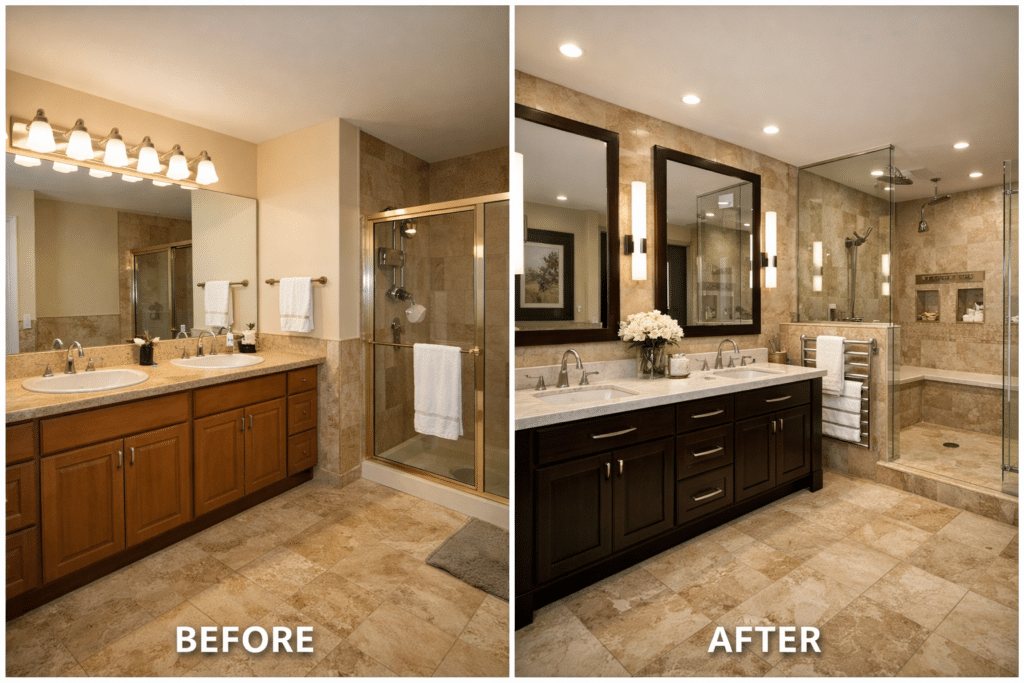
Master Bathroom Cost Overview
Cincinnati master bathroom remodels in 2026 typically fall into these price ranges:
- Budget-Friendly: $15,000-$25,000 (basic updates, minimal layout changes)
- Mid-Range: $25,000-$45,000 (quality materials, improved layout, popular features)
- Upscale: $45,000-$75,000 (premium materials, luxury features, custom details)
- Luxury: $75,000-$150,000+ (high-end finishes, spa amenities, complete redesign)
The average Cincinnati master bathroom remodel falls in the $35,000-$50,000 range for a 100-120 square foot space with mid-range materials and moderate layout changes. This differs from smaller bathroom renovations, which typically cost $8,000-$25,000 for basic to mid-range updates.
Budget-Friendly Master Bath ($15,000-$25,000)
A budget-friendly master bathroom remodel in Cincinnati focuses on cosmetic updates and strategic improvements without major plumbing or structural changes.
What You Get
Fixtures and Features: At this tier, you’re working with builder-grade or entry-level fixtures. Think a standard acrylic tub/shower combo or a basic fiberglass shower base with tile surround. Your vanity will be stock cabinets from home centers—likely particleboard or MDF construction with laminate countertops or basic granite. The toilet and faucets come from manufacturers’ budget lines.
Flooring and Walls: Ceramic tile flooring in standard sizes (12×12 or 12×24), vinyl plank flooring as a cost-saving alternative, or sheet vinyl in high-quality patterns. Walls get painted drywall or ceramic tile in the wet areas. You’re not doing floor-to-ceiling tile work at this budget.
Layout: The existing layout stays largely unchanged. Moving plumbing adds $1,500-$3,000+ per fixture, so budget remodels keep toilets, sinks, and showers where they already sit. You might swap a tub for a shower if the drain location works, but you’re not relocating the shower to the opposite wall.
Labor: Basic installation work without extensive carpentry, tile work, or custom details. In Cincinnati, expect to pay $45-$65 per hour for general contractors at this level, $65-$85 for plumbers, and $40-$60 for basic tile installers.
Typical Budget Breakdown
- Labor: $6,000-$10,000 (40%)
- Fixtures: $3,000-$5,000 (20%)
- Cabinets/Vanity: $1,500-$3,000 (12%)
- Tile/Flooring: $2,000-$3,500 (16%)
- Plumbing/Electrical: $1,500-$2,500 (12%)
Who This Works For
Budget-tier master bath remodels work well for rental properties, homes you’re preparing to sell, or situations where you need functional improvements without breaking the bank. They’re also practical in older Cincinnati neighborhoods where you’re updating a 1950s-1970s master bath but don’t need luxury finishes.
Recommended Budget Products
Maximize value with smart product selections: The Luckwind Constructor Vanity ($400-600) delivers solid construction at builder-grade pricing. Pair it with the American Standard Colony Toilet ($180-250) for reliable performance. For shower fixtures, the Gotonovo Shower Trim ($100-150) provides quality construction well below premium pricing. Flooring budget stretches further with TrafficMASTER Vinyl Tile ($2-3/sq ft), offering ceramic looks with easier installation and lower material costs.
Mid-Range Master Bath ($25,000-$45,000)
This is where most Cincinnati master bathroom remodels land—and for good reason. Mid-range budgets allow quality materials, improved layouts, and the features most homeowners want without sliding into luxury pricing.
What You Get
Fixtures and Features: Quality fixtures from recognizable brands like Kohler, Delta, or Moen. A walk-in shower with frameless or semi-frameless glass doors has become the standard at this level, often replacing the old tub-shower combo. If you’re keeping a tub, you can upgrade to a deeper soaking tub or a drop-in whirlpool. Double vanities are common if space allows.
Tile and Surfaces: Porcelain or ceramic tile in various sizes and patterns, including subway tile, large-format tiles, or even small accent areas with mosaic work. Quartz or granite countertops replace laminate. Shower walls might feature floor-to-ceiling tile or a combination of tile wainscoting with waterproof wall panels above.
Storage and Cabinets: Semi-custom vanity cabinets with plywood construction, soft-close drawers, and better hardware. Medicine cabinets with mirrors, recessed shelving in showers, and possibly a linen closet if space permits.
Lighting and Ventilation: Recessed can lights, upgraded vanity lighting, and a properly sized exhaust fan (80-110 CFM for most Cincinnati master baths). This tier often includes heated floors in the shower or throughout the bathroom—particularly popular in Cincinnati’s cold winters. Consider the Broan-NuTone InVent Series Bathroom Fan (80-110 CFM, $120-180) for quiet, energy-efficient ventilation. Vanity lighting upgrades well with Progress Lighting Blanco Collection ($180-280) for transitional style or the Kichler Winslow Collection ($150-250) for modern aesthetics.
Layout Changes: Moderate layout modifications become feasible. You might relocate a toilet to create better flow, expand a shower into former tub space, or even bump out a wall slightly if it doesn’t affect structural elements.
Typical Budget Breakdown
- Labor: $12,000-$18,000 (40-45%)
- Fixtures: $5,000-$8,000 (18%)
- Cabinets/Vanity: $4,000-$7,000 (15%)
- Tile/Flooring: $4,000-$7,000 (15%)
- Plumbing/Electrical: $2,500-$4,000 (10%)
- Permits/Misc: $500-$1,000 (2%)
Cincinnati Mid-Range Specifics
In Cincinnati’s mid-range market, you’ll see variations based on neighborhood. A $35,000 remodel in Fairfield or Sharonville gets you more square footage and features than the same budget in Indian Hill or Hyde Park, where contractor rates and material expectations run higher. That said, quality work at this price point exists throughout the metro area if you’re working with vetted professionals.
Upscale Master Bath ($45,000-$75,000)
Upscale master bathroom remodels in Cincinnati deliver premium materials, luxury features, and custom details that create a truly personalized space.
What You Get
Shower Systems: Large walk-in showers with multiple shower heads, body sprays, rainfall fixtures, and steam shower capabilities. Frameless glass enclosures are standard. Custom tile work including accent walls, decorative borders, and high-end mosaics.
Tub Options: Freestanding soaking tubs, air-jet tubs, or high-end whirlpool systems. These become focal points rather than afterthoughts.
Cabinetry: Custom or high-end semi-custom cabinets with furniture-quality construction. Full-extension drawer glides, organizational inserts, and premium finishes. Double vanities with dedicated makeup areas or dressing stations.
Countertops: Quartz in premium colors and patterns, natural stone like marble or quartzite, or even concrete for contemporary designs. Countertops at this level feature decorative edges and custom details.
Flooring: Large-format porcelain tile, natural stone, or heated luxury vinyl plank. Often includes radiant floor heating throughout the entire bathroom.
Technology: Smart mirrors, programmable shower controls, heated towel racks, built-in Bluetooth speakers, and automated lighting systems. Some Cincinnati homeowners at this level add smart toilets with bidet functions and self-cleaning features. Popular tech upgrades include the Kohler Verdera Voice Lighted Mirror ($1,200-1,800) with Alexa integration, U by Moen Smart Shower System ($1,200-2,000) with phone app control and preset temperatures, and Amba Radiant Heated Towel Rack ($400-700) for luxury warmth year-round.
Architectural Details: Coffered or tray ceilings, custom millwork, built-in furniture pieces, and architectural lighting that creates ambiance beyond basic task lighting.
Typical Budget Breakdown
- Labor: $20,000-$32,000 (42-45%)
- Fixtures and Features: $10,000-$16,000 (20%)
- Custom Cabinets: $8,000-$13,000 (16%)
- Tile/Flooring/Stone: $8,000-$12,000 (16%)
- Technology/Automation: $2,000-$4,000 (4%)
- Permits/Misc: $1,000-$2,000 (2%)
Who This Works For
Upscale remodels make sense in Cincinnati’s higher-end neighborhoods—Hyde Park, Indian Hill, Montgomery, Madeira, or newer luxury subdivisions in Mason and West Chester. They’re appropriate for forever homes where you’re investing in long-term comfort and when your home’s overall value supports the investment (typically homes valued at $400,000+).
Luxury Master Suite ($75,000+)
Luxury master bath projects in Cincinnati often involve complete spatial redesign, annexing adjacent rooms, or building additions to create spa-like master suites.
What You Get
At this tier, you’re not just remodeling a bathroom—you’re creating a private spa retreat. This might involve:
Spatial Expansion: Combining the master bath with an adjacent bedroom or adding square footage through a bump-out or addition. Some Cincinnati projects convert entire second bedrooms into expanded master suites with separate his-and-hers bathrooms.
Ultimate Fixtures: Freestanding soaking tubs positioned as art pieces, zero-threshold curbless showers large enough for two, multiple shower heads and body sprays with digital temperature controls, steam systems, and chromatherapy lighting.
Premium Materials: Imported marble or exotic stone, custom mosaic tile work, hand-crafted cement tiles, or even semi-precious stone details. Countertops in rare quartzite, book-matched marble, or custom concrete.
Custom Everything: Fully custom cabinets built to your specifications, often furniture-style pieces that don’t look like bathroom cabinets. Custom glass work, specialty hardware, and unique architectural elements.
High-End Technology: Complete home automation integration, circadian lighting systems, steam shower controls, heated floors and mirrors, integrated sound systems, and motorized window treatments for privacy.
Architectural Features: Skylights for natural light, architectural ceilings, custom millwork, built-in fireplaces, or even wet rooms with European-style open shower designs.
Don’t get ripped off. See real pricing for bathrooms, kitchens, and HVAC.
Updated for 2026 Market Rates
Budget Considerations
Luxury master suites in Cincinnati rarely follow percentage-based budgeting because each project is unique. However, labor typically represents 45-50% of costs at this level due to the complexity and craftsmanship required. Projects often take 3-6 months rather than the 6-8 weeks typical of standard remodels.
Cincinnati Luxury Market
Luxury master bath projects in Cincinnati concentrate in neighborhoods like Indian Hill, Hyde Park, Terrace Park, Mariemont, and high-end developments in Mason and West Chester. These projects require contractors with portfolio experience at this level—not every remodeler has the expertise or supplier relationships for truly high-end work.
What Drives Master Bathroom Costs?
Understanding what actually drives costs helps you make informed decisions about where to spend and where to save.
Size and Square Footage
Cincinnati master bathrooms range from 80 square feet in older homes to 200+ square feet in newer construction. Size affects everything—more tile, more cabinets, larger shower glass enclosures, more lighting fixtures. Installation costs scale with size since contractors charge by square footage for tile, flooring, and painting.
Plumbing Complexity
Keeping fixtures in existing locations saves $1,500-$3,000 per fixture moved. But Cincinnati’s older housing stock often requires plumbing updates regardless. Many homes built before 1990 have galvanized or polybutylene pipes that should be replaced during major remodels. Cast iron waste lines in pre-1960 homes might need replacement. These “necessary extras” can add $3,000-$8,000 to your budget.
Structural Modifications
Removing walls, raising ceilings, or expanding the footprint requires engineering, permits, and skilled carpentry. A simple wall removal might cost $1,500-$3,000 if it’s not load-bearing. Load-bearing wall removal with proper support beams runs $3,000-$8,000 or more.
Material Selection
This is where budgets diverge dramatically. The difference between ceramic and porcelain tile might be $2-4 per square foot in materials plus higher installation costs. Quartz versus marble countertops can swing your budget by $1,500-$4,000. A stock vanity costs $800-$1,500; a custom piece runs $4,000-$12,000.
Labor Rates in Cincinnati
Cincinnati contractor rates in 2026 vary by experience, reputation, and project complexity:
- General Contractors: $60-$95 per hour
- Licensed Plumbers: $85-$125 per hour
- Licensed Electricians: $75-$110 per hour
- Tile Installers: $6-$15 per square foot (varies with tile complexity)
- Cabinet Installers: $50-$75 per hour
- Painters: $40-$65 per hour
High-end contractors in Indian Hill or Hyde Park typically charge at the upper end of these ranges. Contractors working in suburbs like Fairfield, Hamilton, or Northern Kentucky often charge moderately less while still delivering quality work.
Size and Layout Considerations
Small Master Baths (80-100 sq ft)
Many Cincinnati homes from the 1950s-1970s have small master baths originally designed as secondary bathrooms. These spaces require thoughtful planning to feel spacious. Walk-in showers work better than tub-shower combos in tight spaces. Floating vanities create visual openness. Large-format tiles make small spaces feel bigger.
Budget expectations: $20,000-$40,000 for quality mid-range renovation
Standard Master Baths (100-130 sq ft)
This is the sweet spot for Cincinnati master bath remodels—large enough for double vanities and separate shower, possibly a small tub. Most mid-range remodels in this size deliver everything homeowners want without feeling cramped.
Budget expectations: $25,000-$55,000 for mid-range to upscale renovation
Large Master Suites (140+ sq ft)
Larger master baths offer room for luxury features: freestanding tubs, large walk-in showers, double vanities with makeup areas, separate toilet rooms, and generous storage. These spaces cost more to renovate simply due to materials and labor scaling with size.
Budget expectations: $35,000-$75,000+ depending on finishes
Layout Options
His and Hers Setup: Double vanities positioned either on the same wall or on opposite walls create personal space for couples. Separate toilet rooms add privacy. This remains the most popular layout for Cincinnati master bath remodels.
Wet Room Design: European-style wet rooms where the entire bathroom floor slopes to a drain are gaining popularity, especially in contemporary homes. These require excellent waterproofing and skilled installation but create stunning, spa-like spaces.
Traditional Compartmentalized: Separate enclosed shower, bathtub, toilet room, and vanity area. This works well for larger spaces and provides maximum privacy and functionality.
Fixture and Feature Costs
Understanding individual component costs helps you budget realistically and make trade-offs that align with your priorities.
Shower Costs
- Basic Prefab: $400-$800 (fiberglass unit with curtain)
- Tile Shower with Basic Door: $2,500-$4,500 (standard tile, framed door)
- Mid-Range Walk-In: $4,500-$8,000 (quality tile, semi-frameless glass)
- Upscale Walk-In: $8,000-$15,000 (premium tile, frameless glass, multiple heads)
- Luxury/Steam: $15,000-$30,000+ (custom tile, steam system, digital controls)
Recommended Shower Components: For shower fixtures, the Delta Faucet Linden Shower Trim Kit ($120-180) provides reliable performance at budget-friendly pricing. Mid-range remodels benefit from the Kohler Devonshire Shower System ($350-500) with pressure-balanced valve. Upgrading to a multi-function shower? The PULSE ShowerSpas Aqua Rain System ($400-600) includes rainfall head, handheld wand, and body jets. For steam showers, consider the SteamSpa Steam Generator (from $2,200), properly sized for most master bathrooms.
Bathtub Costs
- Standard Alcove Tub: $300-$600 (acrylic or fiberglass)
- Soaking Tub: $800-$2,500 (deeper, better materials)
- Whirlpool Tub: $1,200-$3,500 (jets, circulation system)
- Air-Jet Tub: $2,000-$5,000 (quieter, easier to clean than whirlpool)
- Freestanding Tub: $1,500-$8,000+ (varies widely by material and design)
Hire the Right Contractor the First Time
Use our free research guide and intelligence report to vet any contractor before you sign a contract.
Recommended Tubs: For reliable alcove tubs, the American Standard Cadet Acrylic Tub ($500-900) offers durable construction and standard sizing. Upgrading to a soaking tub? The Kohler Archer 60-inch Soaking Tub ($900-1,200) provides 19-inch depth in a standard footprint. For freestanding elegance, the Woodbridge Acrylic Freestanding Tub ($1,300-1,800) delivers modern styling with excellent heat retention. Whirlpool buyers appreciate the Jacuzzi Primo Drop-In Whirlpool ($2,200-2,800) for proven jet technology and quiet operation.
Vanity and Countertop Costs
- Stock Vanity (48″): $400-$1,000
- Semi-Custom Vanity (60″ double): $1,500-$4,000
- Custom Vanity (60-72″ double): $4,000-$10,000+
- Laminate Countertops: $25-$40 per square foot
- Granite: $50-$80 per square foot
- Quartz: $60-$120 per square foot
- Marble: $75-$150 per square foot
Recommended Vanities: For budget-conscious remodels, consider the Deluxe Living Vanity Collection ($600-800 range, solid construction). Mid-range projects benefit from the ARIEL 61″ White Double Bathroom Vanity with Sink with soft-close drawers ($1,400-1,600). For upscale remodels, the James Martin Furniture Brittany Double Vanity offers furniture-quality construction ($2,500-3,500).
Toilet Costs
- Basic Two-Piece: $150-$300
- Mid-Range Comfort Height: $300-$600
- High-Efficiency Model: $400-$800
- Smart Toilet/Bidet Combo: $1,200-$5,000+
Recommended Toilets: The Kohler Highline Comfort Height Toilet ($250-350) offers excellent value with chair-height seating and water efficiency. For high-efficiency performance, the TOTO Drake II ($350-450) delivers powerful flushing with just 1.28 gallons per flush. Upgrading to a smart toilet? The TOTO Washlet+ with integrated bidet ($1,200-1,800) provides the best value in the smart toilet category without requiring separate electrical outlets.
Flooring Costs (installed)
- Sheet Vinyl: $3-$6 per square foot
- Luxury Vinyl Plank: $5-$10 per square foot
- Ceramic Tile: $8-$15 per square foot
- Porcelain Tile: $10-$20 per square foot
- Natural Stone: $15-$35+ per square foot
- Heated Floor System: Add $8-$15 per square foot
Recommended Flooring Products: For luxury vinyl plank, TrafficMASTER Allure Ultra ($2-3/sq ft) offers waterproof construction with realistic wood looks. Upgrading to porcelain? The MSI Carrara White Porcelain Tile ($4-6/sq ft) provides marble aesthetics with superior durability. For heated floors, the WarmlyYours TempZone Floor Heating Mat ($12-15/sq ft) installs easily under tile and connects to programmable thermostats. Cincinnati homeowners particularly appreciate heated floors during cold winter months.
Cincinnati-Specific Cost Factors
Older Housing Stock
Cincinnati’s housing stock skews older compared to national averages. Many homes in neighborhoods like Hyde Park, Mt. Lookout, Northside, and Oakley date to the 1920s-1960s. These homes often require:
Plumbing Updates: Replacing galvanized pipes ($3,000-$6,000), updating waste lines ($2,000-$5,000), or addressing outdated fixtures and connections. Most contractors recommend updating all plumbing during master bath remodels in pre-1980 homes.
Electrical Upgrades: Adding GFCI outlets, installing proper bathroom ventilation circuits, upgrading old knob-and-tube or aluminum wiring near the bathroom. Budget $1,500-$4,000 for electrical work beyond basic fixture installation.
Structural Surprises: Older homes hide issues behind walls—wood rot from old leaks, outdated insulation, asbestos tiles (particularly in pre-1980 homes), or settling damage. Smart homeowners budget an extra 10-15% for contingencies.
Seasonal Considerations
Cincinnati’s weather affects remodeling timelines and costs. Winter projects face challenges when work requires opening exterior walls. Contractors stay busier in spring and fall, which can affect scheduling and pricing. Some homeowners find better contractor availability (and potentially lower prices) scheduling projects for January-March.
Permit Costs and Requirements
Hamilton County building permits for bathroom remodels typically cost $150-$400 depending on project scope. Electrical permits add $75-$150. Plumbing permits add $100-$200. Some municipalities in the Cincinnati metro area charge less; others charge slightly more. Factor in permit costs early since most professional contractors pull necessary permits as part of their service.
Material Availability and Supply Chains
Cincinnati benefits from proximity to major suppliers and manufacturers. Most major tile, fixture, and material suppliers maintain strong inventory. However, custom orders (specialty tiles, custom vanities, imported stone) still face 6-12 week lead times. Plan accordingly if your design includes custom elements.
Regional Labor Market
Cincinnati’s construction labor market remains competitive but not as tight as some coastal markets. Skilled tradespeople are available, though top-tier contractors often book 2-4 months out during peak season. Northern Kentucky contractors sometimes offer slightly lower rates than Cincinnati proper, though quality varies by company.
Hidden Costs to Budget For
Even well-planned master bathroom remodels encounter unexpected costs. Here’s what Cincinnati homeowners often overlook:
Structural and System Surprises
Budget 10-15% extra for discoveries behind walls: damaged floor joists from old water damage ($1,500-$4,000 to repair), insufficient subflooring that needs replacement ($800-$2,000), outdated venting that doesn’t meet code ($500-$1,500), or insulation updates required when walls are open ($600-$1,800).
Permit and Inspection Fees
Beyond initial permit costs, some projects require multiple inspections. Budget $500-$1,000 total for permits, inspections, and any administrative costs.
Temporary Living Arrangements
Master bath remodels take 4-10 weeks depending on scope. During this time, you’ll need alternative bathroom access. Most homeowners use a hall bathroom, but some larger projects require temporary solutions. Budget for inconvenience items: temporary bathroom setup ($200-$500), additional water and utility use, or even temporary lodging in extreme cases.
Finishes and Hardware
Those small details add up fast: towel bars, toilet paper holders, robe hooks, mirrors, medicine cabinets, and lighting fixtures. Budget $800-$2,500 for bathroom hardware and accessories depending on quality level.
Miscellaneous Costs
Debris removal and disposal ($500-$1,200), temporary protective barriers to isolate construction dust ($200-$400), and final cleaning ($150-$300). If you’re living in the home during construction, budget for HEPA air filtration rental ($150-$300) to manage dust.
Design and Engineering
Complex projects benefit from professional design services. Bathroom designers in Cincinnati charge $75-$150 per hour, with master bath designs typically requiring 5-10 hours ($375-$1,500). If structural changes are involved, engineering services add $800-$2,500.
Return on Investment
Master bathroom remodels in Cincinnati typically return 55-65% of their cost when you sell within five years, according to regional real estate data. However, ROI varies significantly based on several factors.
Neighborhood Impact
Upscale remodels in modest neighborhoods often fail to recoup costs. A $75,000 master bath remodel in a $250,000 home represents over-improvement. Conversely, a dated master bath in a $500,000 Indian Hill home can hold back the entire property’s value. Match your remodel scope to your home’s overall value and neighborhood standards.
Market Timing
Recent remodels (0-2 years old) return higher percentages than older updates. A master bath remodeled five years ago shows wear and dated style choices by the time you sell. If you’re planning to sell within 2-3 years, a strategic remodel makes financial sense. If you’re staying 10+ years, focus on personal enjoyment rather than resale ROI.
Quality Matters
Mid-range remodels consistently return better percentages than luxury upgrades. A $40,000 mid-range master bath might return 60-65% ($24,000-$26,000 value added). A $100,000 luxury master suite might return only 45-50% ($45,000-$50,000 value added). Buyers appreciate quality but rarely pay dollar-for-dollar for luxury upgrades.
What Buyers Value Most
Cincinnati home buyers consistently value certain features more than others:
High Impact: Walk-in showers with good water pressure, double vanities, quality tile work that looks current, excellent lighting, and proper ventilation. These features appeal to the broadest buyer pool.
Medium Impact: Heated floors, soaking tubs, frameless glass shower doors, quartz countertops, and upgraded fixtures. Nice-to-have features that some buyers specifically seek.
Lower Impact: Steam showers, whirlpool tubs, smart toilets, and ultra-high-end finishes. These appeal to luxury buyers but limit your buyer pool.
Personal Enjoyment Value
ROI calculations miss an important point: you live with your master bathroom every day. If a remodel improves your daily quality of life over 10-15 years, the intangible value often exceeds simple resale return calculations. Just don’t count on full cost recovery when you eventually sell.
Financing Your Master Bath Remodel
Few Cincinnati homeowners pay cash for $35,000-$75,000 master bathroom remodels. Here’s how most people finance these projects:
Home Equity Line of Credit (HELOC)
HELOCs offer the most flexibility for remodeling projects. You borrow against your home’s equity and pay interest only on what you use. Cincinnati lenders in 2026 offer HELOC rates from 7.5-9.5% depending on credit score and loan-to-value ratio. You can draw funds as needed during construction rather than taking a lump sum.
Pros: Flexible, lower closing costs than cash-out refinances, interest may be tax-deductible if used for home improvements
Cons: Variable interest rates, requires home equity, your home serves as collateral
Home Equity Loan
Similar to HELOCs but with fixed interest rates and lump sum payouts. Rates typically run 8-10% in Cincinnati’s current market. You receive all funds upfront and make fixed monthly payments over 5-15 years.
Pros: Fixed rates and payments, predictable budgeting, potential tax deduction
Cons: Requires home equity, less flexible than HELOC, your home serves as collateral
Cash-Out Refinance
If current mortgage rates are competitive with your existing rate, cash-out refinancing lets you tap equity while potentially improving your mortgage terms. You refinance for more than you owe and take the difference in cash.
Pros: Single loan payment, potentially lower rate than home equity products, fixed rate
Cons: Higher closing costs ($2,000-$5,000), resets your mortgage term, only makes sense if rates are favorable
Personal Loans
Unsecured personal loans avoid using your home as collateral but come with higher interest rates (9-15%) and shorter terms (3-7 years). Best for smaller projects ($15,000-$30,000) or borrowers without substantial home equity.
Pros: No home equity required, faster approval, no home lien
Cons: Higher rates, shorter terms, lower borrowing limits
Contractor Financing
Some larger Cincinnati remodeling companies offer financing through third-party lenders. Rates and terms vary widely. Always compare against traditional financing options before committing.
Financing Strategy
For mid-range to upscale master bath remodels ($35,000-$75,000), most Cincinnati homeowners use HELOCs or home equity loans. These offer reasonable rates, tax benefits, and borrowing capacity that matches project costs. Reserve personal loans for smaller projects or situations where you lack home equity.
Project Timeline
Understanding realistic timelines helps you plan around the disruption and set appropriate expectations.
Planning and Design Phase (2-6 weeks)
Before construction begins, you’ll spend time selecting materials, finalizing design, and getting contractor bids. This phase can extend if you’re working with a designer or architect, ordering custom materials, or facing contractor scheduling delays. Budget at least 4 weeks for planning unless you’re working with a design-build firm that streamlines the process.
Permit Approval (1-3 weeks)
Cincinnati-area building departments typically review and approve standard bathroom remodel permits within 1-2 weeks. Complex projects involving structural changes might take longer. Some municipalities offer expedited review for additional fees.
Construction Phase
- Budget Remodel (3-4 weeks): Straightforward cosmetic updates with minimal plumbing changes
- Mid-Range Remodel (4-6 weeks): Standard master bath with new fixtures, tile work, and moderate updates
- Upscale Remodel (6-8 weeks): Custom features, extensive tile work, multiple trades coordination
- Luxury/Addition Projects (8-12+ weeks): Structural changes, additions, or complete spatial redesigns
What Affects Timeline
Material Lead Times: Stock materials arrive within days. Custom vanities take 6-8 weeks. Imported tile can take 8-12 weeks. Plan accordingly or be prepared to adjust design based on availability.
Structural Surprises: Discovering rotten subflooring, plumbing issues, or electrical problems can add 3-7 days to address properly.
Weather: Winter projects face delays if work requires opening exterior walls. Spring and fall offer ideal conditions for projects affecting building envelopes.
Coordination: Master bath remodels require multiple trades—plumbers, electricians, tile setters, carpenters, painters. Scheduling conflicts or delays cascade through the timeline.
Realistic Expectations
Add 1-2 weeks to any contractor’s estimated timeline. Unexpected issues, material delays, or scheduling conflicts affect nearly every project. Buffer time prevents stress and disappointment.
Finding the Right Contractor
Your contractor choice affects everything—final quality, actual costs, timeline adherence, and stress level throughout the project. Here’s how to find quality contractors in the Cincinnati metro area.
Minimum Qualifications
Licensing: Ohio requires contractors performing work over $25,000 to hold a contractor’s license. Verify licenses through the Ohio Construction Industry Licensing Board. Plumbers and electricians need separate state licenses.
Insurance: Require proof of general liability insurance ($1-2 million coverage) and workers’ compensation coverage. This protects you from liability if workers are injured or property is damaged.
References: Ask for 3-5 recent references from projects similar in scope to yours. Actually call them. Ask about timeline adherence, communication, problem-solving, and final quality.
Portfolio Review
Quality contractors maintain portfolios showing recent work. Look for projects matching your budget tier and style preferences. Pay attention to tile work quality, fixture alignment, and finish details in photos. Visit active job sites if possible.
Detailed Estimates
Get 3-4 written estimates for comparison. Quality estimates include:
- Detailed scope of work (what’s included, what’s not)
- Material specifications (brands, models, allowances)
- Labor breakdown by trade
- Project timeline with key milestones
- Payment schedule (never more than 50% upfront)
- Warranty information
- Change order process
Be wary of estimates significantly lower than others—they often indicate missing items, lower-quality materials, or unlicensed labor.
Contract Essentials
Never start work without a written contract specifying:
- Complete scope of work
- All material specifications
- Start and completion dates
- Payment schedule tied to milestones
- Lien waiver requirements
- Warranty terms
- Dispute resolution process
- Permit responsibility
Red Flags to Avoid
- Pressure Tactics: “Sign today for this price” or artificial urgency
- Cash-Only Deals: Legitimate contractors accept checks and document payment
- No Written Contract: Never proceed without detailed written agreements
- Large Upfront Payments: Industry standard is 10-30% down, 50% maximum
- No License or Insurance: Non-negotiable requirements
- Poor Communication: Unresponsive during bidding phase = worse during construction
Finding Contractors
Start with referrals from friends, neighbors, or colleagues who’ve completed similar projects. Online reviews help but verify claims independently. Local professional associations maintain contractor directories. Our network partners with vetted contractors throughout the Cincinnati metro area and can connect you with qualified professionals matching your project scope and budget.
Related Articles
Looking for more information on bathroom remodeling in Cincinnati? Check out these helpful guides:
- Bathroom Remodeling in Cincinnati: The Complete Homeowner’s Guide — Our comprehensive pillar article covering all aspects of Cincinnati bathroom renovations
- How Much Does a Bathroom Remodel Cost in Cincinnati? — General bathroom remodeling costs for all bathroom sizes
- Small Bathroom Remodel Cost in Cincinnati — Specific pricing for compact bathrooms and powder rooms
- Walk-In Shower Installation Cost Cincinnati — Everything you need to know about converting to walk-in showers
- Accessible Bathroom Remodeling Cincinnati — ADA-compliant and aging-in-place bathroom solutions
- Bathroom Remodel ROI: What Return Can You Expect? — Detailed analysis of bathroom remodeling return on investment
Frequently Asked Questions
How much should I budget for a master bathroom remodel in Cincinnati?
Budget $35,000-$50,000 for a mid-range master bathroom remodel in Cincinnati covering a 100-120 square foot space. This includes quality fixtures, tile work, new vanity, and lighting with moderate layout modifications. Budget projects start around $15,000-$25,000 for cosmetic updates only, while upscale remodels with luxury features run $45,000-$75,000. Complete master suite transformations with additions or significant spatial changes often exceed $75,000-$100,000. Your final cost depends on bathroom size, material selections, layout complexity, and whether you’re updating an older home requiring additional plumbing or electrical work.
Should I include a bathtub in my master bathroom remodel?
This depends on your household needs and resale considerations. Many Cincinnati homeowners convert tub-shower combos to walk-in showers in master baths, especially in homes with additional bathtubs elsewhere. Walk-in showers offer better accessibility, easier maintenance, and more luxurious showering experiences. However, if your master bath is the only full bathroom in your home, keeping at least one tub maintains broader buyer appeal when you eventually sell. Families with young children typically want at least one bathtub in the home. Consider your current needs, future plans, and whether other bathrooms in your home have tubs before eliminating your master bath tub entirely.
What’s the biggest mistake Cincinnati homeowners make with master bath remodels?
The most common mistake is under-budgeting for unexpected issues in older homes. Cincinnati’s housing stock includes many pre-1980 homes hiding outdated plumbing, electrical systems, or structural issues behind walls. Homeowners who budget exactly to their contractor’s estimate often face difficult decisions when problems emerge. Smart approach: budget an extra 15-20% for contingencies when remodeling master baths in homes built before 1990. Second common mistake: choosing ultra-modern or trendy designs in traditional homes that clash with the overall architectural style. Your master bath should complement your home’s character while incorporating modern function and comfort.
How long will my master bathroom remodel take?
Most mid-range master bathroom remodels in Cincinnati take 4-6 weeks from demolition to completion. Budget-level cosmetic updates might finish in 3-4 weeks, while upscale projects with custom features take 6-8 weeks. Projects involving structural changes, additions, or significant plumbing relocations can extend to 8-12 weeks or longer. Timeline factors include material lead times (custom vanities take 6-8 weeks to manufacture), scheduling coordination between multiple trades, permit approval times, and whether unexpected issues emerge during demolition. Add 1-2 weeks buffer to any contractor’s estimated timeline since some delays affect nearly every renovation project. Winter weather can extend timelines for projects requiring exterior wall openings.
Will a master bathroom remodel increase my Cincinnati home’s value?
Master bathroom remodels typically return 55-65% of their cost when you sell within five years in Cincinnati’s market. A $40,000 remodel might add $22,000-$26,000 to your home’s value. However, ROI varies significantly based on your neighborhood, home’s overall value, and remodel quality. Upscale remodels in modest neighborhoods often fail to recoup costs—avoid spending $75,000 updating a bathroom in a $250,000 home. Conversely, dated master baths in higher-end neighborhoods (Indian Hill, Hyde Park, Montgomery) can hold back property values. Best ROI comes from mid-range remodels that bring your master bath to neighborhood standards. Features buyers value most include walk-in showers, double vanities, quality tile work, and good lighting. Ultra-luxury features like steam showers or smart toilets appeal to fewer buyers and return lower percentages. If you’re staying in your home 10+ years, focus on personal enjoyment rather than resale return calculations.
Affiliate Disclosure: This article contains affiliate links to products. We earn commissions from qualifying purchases through these links at no additional cost to you. Product recommendations are based on quality, value, and suitability for Cincinnati bathroom remodels.
Hire the Right Contractor the First Time
Use our free research guide and intelligence report to vet any contractor before you sign a contract.