Article Navigation
- Understanding Southern Ohio’s Impact on Kitchen Flooring
- Ceramic and Porcelain Tile: Durability and Performance
- Luxury Vinyl Plank: Modern Performance at Mid-Range Pricing
- Hardwood Flooring: Traditional Appeal and Regional Challenges
- Laminate Flooring: Budget-Friendly with Limitations
- Natural Stone: Marble, Slate, and Travertine
- Sheet Vinyl and Linoleum: Traditional Options
- Cork Flooring: Specialty Applications
- Total Cost of Ownership Analysis
- Selecting the Right Flooring for Your Kitchen
- Frequently Asked Questions
Affiliate Disclosure: This article contains affiliate links to products we recommend. If you purchase through these links, we may earn a commission at no additional cost to you. We only recommend products our network contractors have used successfully in Southern Ohio installations. Read our full disclosure policy.
Key Takeaways
- Southern Ohio’s climate matters: Seasonal humidity swings from 20-30% in winter to 70-80% in summer affect flooring performance differently than national averages suggest.
- Best performers in humid conditions: Ceramic/porcelain tile and quality luxury vinyl plank with SPC cores handle the region’s moisture challenges most reliably.
- Hardwood requires commitment: Real wood can work beautifully but demands consistent year-round HVAC operation and careful maintenance in Southern Ohio’s environment.
- Budget materials have hidden costs: Laminate’s low initial price often leads to premature replacement due to water damage in 5-8 years versus 12-15 years for mid-range LVP.
- Older homes need extra prep: Many pre-1970 Southern Ohio homes require subfloor reinforcement, leveling, or moisture barriers that add $2-$5 per square foot to any flooring project.
- Total cost beats initial cost: Ceramic tile at $1,560 installed lasting 25 years costs $62/year, while budget laminate at $660 lasting 6 years costs $110/year.
- No perfect solution exists: Every flooring type involves tradeoffs between cost, comfort, durability, and maintenance—matching material to your specific priorities produces the best outcomes.
Kitchen flooring represents one of the most important decisions in any kitchen renovation or upgrade. In Southern Ohio—spanning communities from Portsmouth and Ashland to Marietta, Athens, Gallipolis, and Steubenville—homeowners face unique considerations that impact both flooring selection and long-term performance. The region’s distinct climate patterns, prevalence of older housing stock, and soil characteristics create specific challenges that don’t always align with generic flooring advice.
Our network of experienced flooring contractors throughout the Ohio Valley has installed thousands of kitchen floors across every material type, from century-old farmhouses in Scioto County to newer construction homes in Gallia County. This guide examines every major kitchen flooring option with detailed cost breakdowns, performance expectations specific to regional conditions, and honest assessments based on real-world installation experience in Southern Ohio homes.
Understanding Southern Ohio’s Impact on Kitchen Flooring Performance
Before examining specific flooring types, it’s essential to understand the environmental factors that make Southern Ohio different from other regions. These factors directly impact flooring performance, longevity, and cost-effectiveness in ways that homeowners often don’t discover until problems emerge years after installation.
Southern Ohio experiences significant seasonal humidity swings, with summer humidity regularly reaching 70-80% and winter indoor humidity dropping to 20-30% when heating systems run continuously. This dramatic fluctuation causes expansion and contraction in many flooring materials, creating gaps, buckling, or cupping depending on the material and installation quality. Our partner contractors consistently report that flooring issues in this region trace back to humidity-related movement more than any other single factor.
The region’s clay-heavy soils, particularly common in river valley communities along the Ohio River, contribute to moisture issues in crawl spaces and basements that can impact flooring through substrate moisture transmission. The housing stock throughout Portsmouth, Ironton, Gallipolis, Marietta, and surrounding communities includes substantial numbers of homes built before 1970, many with original subflooring that may be uneven, have moisture damage, or lack proper vapor barriers.
These older homes frequently have floor joists on 16-inch or even 24-inch centers rather than the 12-inch spacing common in newer construction, which affects deflection and the suitability of certain flooring types. Additionally, many Southern Ohio homes were built without central air conditioning, meaning they experience greater indoor temperature fluctuations than homes in regions where climate control has always been standard.
The Ohio River valley’s proximity creates localized microclimates with higher humidity levels, particularly in communities like Portsmouth, Steubenville, and Marietta. Homes within a few miles of the river often experience 10-15% higher relative humidity than homes in upland areas, which significantly impacts wood-based flooring performance. The region’s freeze-thaw cycles, while less severe than Northern Ohio, still create foundation movement and settling that can stress rigid flooring materials over time.
For detailed regional climate data, resources like Ohio State University’s Climate Extension help homeowners understand their specific microclimate conditions.
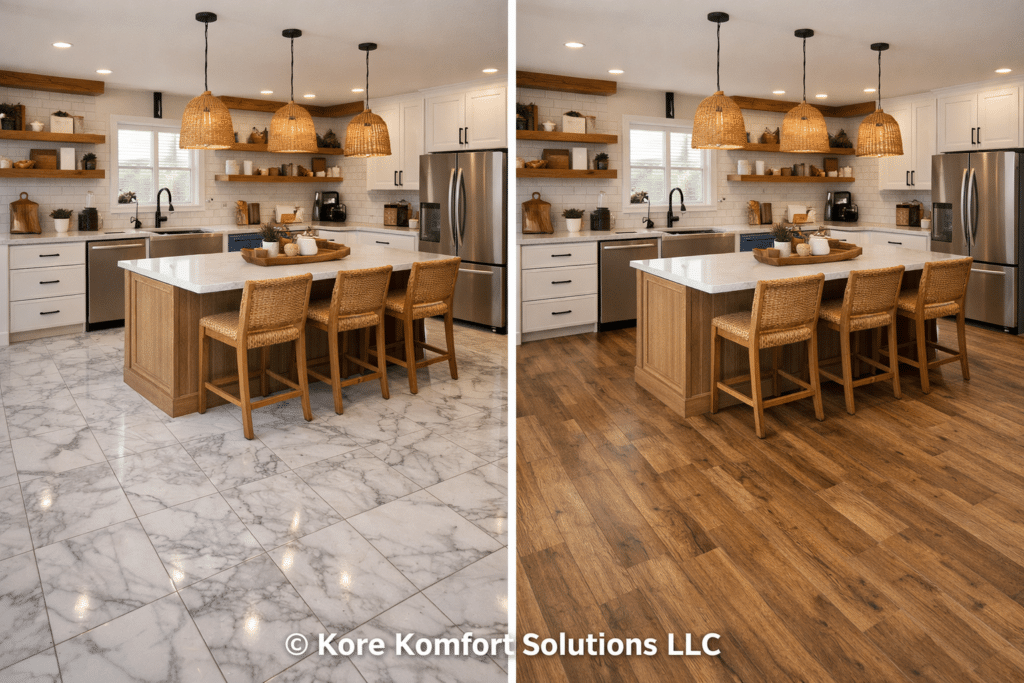
Ceramic and Porcelain Tile: Cost, Performance, and Regional Considerations
Ceramic and porcelain tile represent the most durable, water-resistant kitchen flooring option available, making them particularly suitable for Southern Ohio’s humidity challenges. Understanding the differences between ceramic and porcelain, along with realistic cost expectations and installation requirements, helps homeowners make informed decisions about whether tile’s benefits justify its higher initial investment.
Material Costs and Installation Expenses
Ceramic tile for kitchens typically costs between $2-$8 per square foot for the tile itself, with builder-grade ceramic starting around $2-$3 per square foot and mid-range options in the $4-$6 range. Higher-end ceramic, including larger format tiles and designer patterns, reaches $8-$12 per square foot. Porcelain tile, which offers greater density and water resistance, ranges from $4-$15 per square foot depending on size, finish, and quality level. Large format porcelain tiles (24×24 inches or larger) that create fewer grout lines generally cost $8-$15 per square foot.
Our partner installers throughout Southern Ohio typically charge $5-$12 per square foot for tile installation depending on tile size, pattern complexity, and subfloor preparation requirements. Simple grid patterns with standard 12×12 or 16×16 tiles generally cost $5-$7 per square foot for installation, while diagonal patterns, herringbone layouts, or mixed-size patterns increase labor to $8-$12 per square foot. These costs include thinset mortar, grout, and sealant, but assume a properly prepared subfloor.
For a typical 120-square-foot kitchen, material and installation costs break down as follows:
- Builder-grade ceramic: $2/sf tile + $6/sf installation = $960 total
- Mid-range ceramic: $5/sf tile + $7/sf installation = $1,440 total
- Standard porcelain: $6/sf tile + $7/sf installation = $1,560 total
- Premium large-format porcelain: $10/sf tile + $10/sf installation = $2,400 total
These figures assume minimal subfloor preparation beyond standard cement board installation over existing flooring or subfloor.
Subfloor Preparation Requirements in Older Homes
Tile installation in Southern Ohio’s older housing stock frequently requires significant subfloor preparation that can add $2-$5 per square foot to total project costs. Our network’s contractors report that homes built before 1970 often have plank subflooring rather than plywood, which requires a plywood overlay before cement board installation. Uneven floors, common in homes with settling foundations or aged floor joists, need leveling compound to create a flat surface—tile installed over uneven substrate will crack along grout lines or develop hollow spots that eventually lead to broken tiles.
Homes with springy or bouncy floors indicate inadequate structural support for tile’s rigid nature. Floor joists on 24-inch centers, common in many area homes, create too much deflection for tile unless reinforced with additional blocking or cross-bracing between joists. Our partner contractors can assess structural adequacy and arrange necessary reinforcement, which typically adds $500-$1,500 to a kitchen tile project depending on access and complexity.
Crawl space homes with moisture issues may need vapor barriers installed before tile work proceeds, adding another $300-$800 depending on crawl space size and accessibility. Cement board installation, essential for tile longevity, costs $1.50-$2.50 per square foot including materials and labor. This waterproof underlayment prevents moisture transmission from the subfloor while providing the rigid, stable surface tile requires.
The Tile Council of North America provides detailed installation standards that professional installers should follow to ensure long-term performance.
Grout Selection and Maintenance Realities
Grout selection significantly impacts tile’s long-term appearance and maintenance requirements. Standard cement grout, while less expensive initially at $1-$2 per square foot installed, requires regular sealing and shows stains readily in kitchen environments. Epoxy grout, costing $3-$5 per square foot installed, provides stain resistance and eliminates sealing requirements, but demands precise installation and costs roughly double standard grout.
In Southern Ohio’s humid environment, unsealed grout in kitchens darkens within 2-3 years from moisture absorption, cooking oils, and normal use. Even with proper sealing every 1-2 years using a quality grout sealer, cement grout requires periodic deep cleaning to maintain appearance. Light-colored grout shows staining more readily, while darker grout colors (grays, taupes, charcoals) disguise staining and maintain appearance longer between cleanings.
Grout line width also impacts maintenance—wider grout lines (3/8 inch or more) collect more dirt and require more frequent cleaning with a grout brush and cleaner, while narrow grout lines (1/8 to 1/4 inch) minimize maintenance but demand very precise tile installation. Large format tiles with minimal grout lines offer the best combination of tile’s durability with reduced maintenance, though they cost more initially and require expert installation.
Tile Performance in Southern Ohio Conditions
Tile performs exceptionally well in Southern Ohio’s humidity cycles because neither ceramic nor porcelain absorb moisture or expand/contract with humidity changes. This dimensional stability makes tile ideal for homes near the Ohio River or in areas with persistent humidity issues. Tile’s imperviousness to water damage also provides insurance against inevitable kitchen spills, leaking dishwashers, or refrigerator water line failures that ruin other flooring types.
However, tile’s hardness and coldness present legitimate drawbacks in kitchen environments. Standing on tile for extended cooking or cleaning sessions fatigues legs and feet more than resilient flooring options. The surface feels noticeably cold in winter, particularly in homes without radiant floor heating, making it less comfortable during Southern Ohio’s heating season. Dropped dishes, glasses, or cookware break more readily on tile than other surfaces, and the tile itself can chip or crack from heavy impacts.
Tile’s longevity often exceeds 25-30 years when properly installed and maintained, making it the longest-lasting kitchen flooring option. This durability partially offsets higher initial costs when amortized over the floor’s lifespan. Tile also maintains its appearance better than most alternatives—while grout may require maintenance, the tile surface itself resists scratching, staining, and wear patterns that affect other materials.
Quick Summary – Ceramic & Porcelain Tile
- Best for: Long-term durability, homes near Ohio River, any humidity level
- Cost: $960-$2,400 for 120 sq ft kitchen (installed)
- Lifespan: 25-30+ years
- Water Resistance: Excellent (100% waterproof)
- Comfort: Hard and cold underfoot
- Ideal Southern Ohio homes: Solid subfloor, any age with proper prep
- Maintenance: Low (grout sealing every 1-2 years)
Luxury Vinyl Plank and Tile: Modern Performance at Mid-Range Pricing
Luxury vinyl plank (LVP) and luxury vinyl tile (LVT) have emerged as dominant flooring choices in kitchen renovations over the past decade, offering water resistance approaching tile’s performance at substantially lower costs and with warmer, softer feel underfoot. Understanding the significant quality differences within the LVP/LVT category, along with realistic performance expectations in Southern Ohio’s environment, separates successful installations from disappointing results.
Material Quality Tiers and Cost Ranges
Luxury vinyl quality varies dramatically based on wear layer thickness, core material, and manufacturing standards. Budget LVP, typically found at big-box retailers for $1.50-$2.50 per square foot, features wear layers of 6-12 mils (a mil equals 0.001 inches) and thinner overall construction of 3-4mm. These economy products work adequately in low-traffic areas but show wear patterns and scuffing within 3-5 years in kitchens, and their thinner cores telegraph subfloor imperfections more readily.
Mid-range LVP, costing $3-$5 per square foot, offers 12-20 mil wear layers and 5-6mm overall thickness. These products provide good durability for residential kitchens, with realistic lifespans of 10-15 years before showing significant wear. This category represents the sweet spot for most Southern Ohio homeowners—adequate performance at reasonable cost. Products like luxury vinyl plank fall into this category and perform well in humid environments.
Premium LVP, ranging from $5-$8 per square foot, features 20-30 mil wear layers, 6-8mm thickness, and enhanced core materials that provide greater stability and sound dampening. These products often carry 20-year or lifetime residential warranties and perform comparably to mid-range hardwood in terms of longevity.
The core material significantly impacts performance. Stone Plastic Composite (SPC) cores, made from limestone and PVC, provide rigid stability that works exceptionally well in Southern Ohio’s humidity fluctuations—SPC doesn’t expand or contract noticeably with temperature or humidity changes. Wood Plastic Composite (WPC) cores include wood fibers that make the floor slightly softer and warmer underfoot but can expand slightly with extreme humidity. Both perform adequately in properly climate-controlled homes, but SPC proves more forgiving in homes without consistent HVAC operation.
Installation Costs and Methods
Our partner contractors typically charge $2-$4 per square foot for floating LVP installations and $3-$5 per square foot for glue-down applications. Floating installations, where planks click together and float over underlayment without adhesive attachment to the subfloor, represent the most common installation method for residential renovations. This approach allows installation directly over most existing flooring, reducing demolition costs and installation time.
A typical 120-square-foot kitchen with mid-range LVP costs approximately $1,080 total ($4/sf material + $5/sf installation) including underlayment.
Glue-down LVP, while less common in residential applications, provides greater dimensional stability and eliminates the hollow sound sometimes associated with floating floors. Glue-down installation costs more due to additional labor and adhesive expenses, but produces a floor that feels more solid underfoot and performs better in commercial or high-traffic applications. Most residential kitchens don’t require glue-down installation, but it’s worth considering in homes where subfloor deflection or unevenness makes floating installation problematic.
Underlayment selection impacts both cost and performance. Basic foam underlayment, often included with LVP products, provides minimal sound dampening and no moisture barrier. Upgraded underlayment with vapor barrier ($0.50-$1.00/sf) proves essential in homes with crawl spaces or concrete slabs, protecting the flooring from moisture transmission. Premium underlayment with sound-dampening properties ($1-$2/sf) reduces hollow sound and adds slight cushioning but isn’t necessary for all installations.
Subfloor Requirements and Preparation
LVP’s flexibility allows installation over less-than-perfect subfloors, but “less than perfect” doesn’t mean “completely neglected.” Subfloors should be flat within 3/16 inch over 10 feet—deviations beyond this create waves or gaps in floating installations. Many Southern Ohio homes with aged hardwood subfloors or settled foundations require floor leveling compound ($1-$2/sf) to meet this flatness standard.
LVP can install directly over old vinyl, linoleum, or ceramic tile if the existing floor is solidly adhered and relatively flat. This saves demolition costs and installation time. However, cushion vinyl or deeply embossed surfaces telegraph through LVP, creating visible patterns and uneven wear. In these cases, our network’s contractors typically recommend installing 1/4-inch plywood over the existing floor ($1.50-$2/sf) to provide the smooth surface LVP requires.
Moisture testing proves critical when installing LVP over concrete slabs, particularly in older homes without vapor barriers under the slab. A quality concrete moisture meter costs $30-$50 and provides reliable readings—moisture levels above 4.5% require moisture mitigation before installation. The ASTM F2170 standard provides detailed protocols for accurate concrete moisture testing.
Performance Expectations in Southern Ohio Kitchens
Quality LVP performs well in Southern Ohio’s environment, showing minimal expansion or contraction with seasonal humidity changes. The waterproof core means spills, leaks, or even standing water won’t damage the flooring—a significant advantage over laminate or hardwood. However, waterproof doesn’t mean water can’t cause problems. Water infiltrating between planks can sit on the subfloor, potentially causing wood rot or mold if not discovered and dried promptly. Proper installation with tight plank connections minimizes this risk.
LVP’s vinyl composition makes it susceptible to indentation from heavy furniture or appliances, particularly lower-quality products with thinner cores. Refrigerators, stoves, and dishwashers can create permanent indentations where they sit, visible if appliances are later moved. Using heavy-duty furniture pads under furniture legs and appliance feet helps distribute weight and minimize indentation.
Surface scratching and scuffing represent LVP’s primary weakness compared to tile. Even premium products with thick wear layers show scratches from dragged appliances, dropped knives, or pet nails over time. The vinyl surface scratches more readily than ceramic tile or quality hardwood, and these scratches cannot be refinished or repaired—damaged planks require replacement. Dark colors show scratches more obviously than medium or light tones.
Quick Summary – Luxury Vinyl Plank (LVP)
- Best for: Budget-conscious, high water resistance, comfort priority
- Cost: $660-$1,320 for 120 sq ft kitchen (installed)
- Lifespan: 10-15 years (mid-range quality)
- Water Resistance: Excellent (100% waterproof core)
- Comfort: Softer and warmer than tile
- Ideal Southern Ohio homes: Any age, especially homes without consistent HVAC (SPC core)
- Maintenance: Very low (regular mopping only)
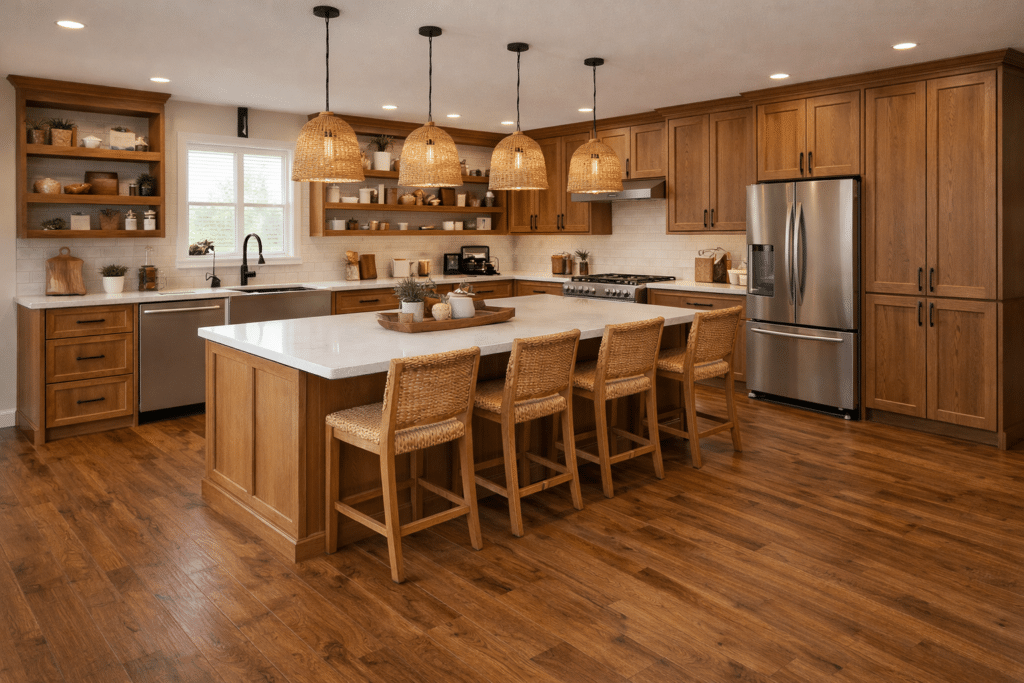
Hardwood Flooring: Traditional Appeal and Southern Ohio Challenges
Hardwood flooring provides timeless appeal and genuine wood’s warmth and character, making it a frequent choice for homeowners prioritizing aesthetics and resale value. However, hardwood’s performance in Southern Ohio kitchens requires honest assessment—the material’s sensitivity to moisture and humidity creates legitimate challenges in this environment. Understanding these challenges, along with strategies to minimize problems, helps homeowners decide whether hardwood’s benefits justify its risks and costs in kitchen applications.
Material Costs and Species Selection
Hardwood flooring costs vary significantly based on wood species, grade, and finish type. Red oak, the most common and affordable hardwood option, typically costs $4-$7 per square foot for 3/4-inch solid hardwood in common grades. White oak, increasingly popular for its slightly more contemporary appearance and superior durability, ranges from $6-$10 per square foot. Exotic species like Brazilian cherry, hickory, or acacia cost $8-$14 per square foot but offer enhanced hardness and distinctive grain patterns.
Prefinished hardwood, where the stain and polyurethane finish are applied in the factory, costs slightly more than unfinished wood but eliminates the dust, fumes, and time required for site finishing. The factory finish also provides more durable wear resistance than most site-applied finishes. Unfinished hardwood allows custom stain colors and on-site sanding to ensure perfectly level surfaces between planks, but our partner contractors need to add $2-$3 per square foot for professional sanding and finishing work.
Engineered hardwood—real wood veneer over a plywood core—offers greater dimensional stability than solid hardwood, making it better suited to Southern Ohio’s humidity swings. Quality engineered hardwood with 3-4mm wear layers costs $5-$9 per square foot, comparable to solid hardwood. The engineered construction resists cupping and gapping more effectively than solid wood, though it provides fewer refinishing opportunities over its lifespan.
Don’t get ripped off. See real pricing for bathrooms, kitchens, and HVAC.
Updated for 2026 Market Rates
Installation Costs and Methods
Our network’s hardwood installers throughout Southern Ohio typically charge $4-$8 per square foot depending on installation method, subfloor condition, and room complexity. Nail-down installation over wood subfloors, the traditional method for 3/4-inch solid hardwood, costs $4-$6 per square foot including materials. This method requires a wood subfloor and produces the most solid, traditional feel underfoot.
Glue-down installation, used for engineered hardwood over concrete or wood subfloors, costs $5-$7 per square foot including adhesive. Floating installation, where engineered planks click together without attachment to the subfloor, costs $3-$5 per square foot and allows installation over various subfloor types. However, floating hardwood often feels less solid than nail-down or glue-down installations and can develop a hollow sound when walked on. Most contractors in our network recommend against floating installations in kitchens due to the method’s reduced water resistance—spills can seep between planks more readily than with glued installations.
A typical 120-square-foot kitchen using mid-range oak hardwood costs approximately $1,560 total ($7/sf material + $6/sf installation). Higher-grade materials or complex installation patterns increase this to $2,000-$2,400. These figures assume proper subfloor condition—many older Southern Ohio homes require subfloor repair or leveling that adds $2-$4 per square foot.
Moisture and Humidity Performance Challenges
Hardwood’s fundamental weakness in kitchens stems from wood’s natural response to moisture and humidity changes. Wood absorbs moisture from humid air, causing expansion, then releases moisture in dry conditions, causing contraction. This cycle creates gaps between planks during heating season and potential buckling or cupping during humid summer months, particularly in Southern Ohio’s dramatic seasonal swings.
Homes without consistent year-round HVAC operation experience more severe hardwood movement. Many area homes built before widespread air conditioning adoption lack the humidity control that hardwood requires for optimal performance. Running air conditioning during humid summer months and maintaining humidity levels with humidifiers during winter heating season minimizes but doesn’t eliminate wood movement. Using a digital hygrometer to monitor indoor humidity helps maintain the ideal 35-45% range for hardwood. Even with perfect climate control, oak hardwood typically develops 1/16 to 1/8-inch gaps between boards during peak winter heating season.
Kitchens present additional moisture challenges beyond ambient humidity. Dishwasher leaks, refrigerator water line failures, and sink overflow incidents occur eventually in every kitchen, and hardwood tolerates standing water poorly. Water sitting on hardwood for even a few hours causes staining, and water remaining overnight typically causes permanent cupping or warping in affected boards. Unlike tile or quality LVP, hardwood cannot be described as waterproof or even highly water-resistant.
Many homeowners who insist on hardwood kitchens eventually arrange replacement with tile or LVP in the immediate sink area after experiencing water damage.
Maintenance, Refinishing, and Longevity
Hardwood’s refinishing capability represents its primary advantage over other flooring materials. Solid 3/4-inch hardwood typically allows 3-5 complete refinishing cycles over its lifespan, with each refinishing essentially providing a new floor surface. This capability means properly maintained hardwood can last 30-50 years or more, though kitchen hardwood generally requires refinishing more frequently than hardwood in living areas due to higher traffic and wear.
Our partner contractors typically charge $3-$5 per square foot for sanding and refinishing with polyurethane. A 120-square-foot kitchen costs $360-$600 to refinish, typically needed every 7-10 years depending on traffic and wear. Spot repairs for water-damaged sections cost $150-$300 depending on extent, requiring removal of damaged boards, subfloor drying, and installation of matching replacement boards—a process that rarely produces invisible results since new boards won’t match the patina of aged wood.
Daily maintenance requires dust mopping or vacuuming plus damp mopping with hardwood-specific cleaners. Avoid excessive water during cleaning—wet mopping with dripping mops causes the same problems as spills and leaks. The National Wood Flooring Association provides detailed maintenance guidelines and installation standards that help ensure hardwood longevity in challenging environments.
Engineered hardwood provides 1-2 refinishing opportunities depending on wear layer thickness, compared to solid hardwood’s 3-5 cycles. This reduced refinishing capability shortens engineered hardwood’s effective lifespan to 20-30 years, though its greater dimensional stability may justify this tradeoff in Southern Ohio’s climate.
Quick Summary – Hardwood Flooring
- Best for: Resale value, traditional aesthetics, climate-controlled homes
- Cost: $1,320-$2,040 for 120 sq ft kitchen (installed)
- Lifespan: 30-50 years (solid), 20-30 years (engineered) with refinishing
- Water Resistance: Poor (requires immediate cleanup)
- Comfort: Moderate warmth, moderate hardness
- Ideal Southern Ohio homes: Consistent HVAC operation, away from Ohio River valley
- Maintenance: Medium-high (specialized cleaning, refinishing every 7-10 years)
Laminate Flooring: Budget-Friendly Option with Significant Limitations
Laminate flooring provides wood appearance at substantially lower costs than hardwood, making it attractive for budget-conscious renovations. However, laminate’s limitations in kitchen environments, particularly regarding water resistance and durability, require careful consideration. Understanding what laminate does well versus what it does poorly prevents disappointment and premature replacement.
Material Costs and Quality Levels
Hire the Right Contractor the First Time
Use our free research guide and intelligence report to vet any contractor before you sign a contract.
Laminate flooring costs range from $1-$5 per square foot depending on thickness, wear layer rating, and visual quality. Budget laminate at $1-$2 per square foot features thin construction (6-7mm), low AC ratings (AC2-AC3), and obviously artificial wood-grain printing that doesn’t convincingly mimic real wood. Mid-range laminate at $2-$3.50 per square foot offers 8-10mm thickness, AC3-AC4 ratings suitable for moderate residential use, and better visual realism. Premium laminate at $3.50-$5 per square foot provides 10-12mm thickness, AC4-AC5 ratings, and high-definition printing that closely mimics genuine hardwood appearance.
The AC rating (Abrasion Criteria) indicates wear resistance: AC2 suits light residential use, AC3 handles moderate residential traffic, AC4 accommodates heavy residential or light commercial use, and AC5 withstands heavy commercial applications. Kitchens should use minimum AC3-rated laminate, with AC4 providing noticeably better longevity in this high-traffic environment.
Thickness impacts both feel and performance. Thicker laminate (10-12mm) feels more solid underfoot, produces less hollow sound when walked on, and better resists impacts and indentation. Thin laminate (6-8mm) feels noticeably cheaper and transmits subfloor imperfections more readily, creating an inferior installation even when products carry similar AC ratings.
Installation Costs and Requirements
Our partner contractors typically charge $2-$4 per square foot for floating laminate installations, which represents the standard installation method. Laminate planks click together and float over underlayment without attachment to the subfloor, allowing installation directly over most existing flooring. This installation simplicity makes laminate appealing for DIY installation, though professional installation ensures proper expansion gaps and produces better long-term results.
A typical 120-square-foot kitchen using mid-range laminate costs approximately $660 total ($3/sf material + $2.50/sf installation) including underlayment. This represents roughly half the cost of mid-range LVP and one-third the cost of hardwood, explaining laminate’s continued popularity despite its limitations.
Water Resistance Reality and Failure Modes
Laminate’s most significant limitation in kitchens is its poor water resistance despite manufacturer claims of “water-resistant” products. Laminate consists of a wood-fiber core with printed laminate layer on top and backing layer below. Water infiltrating between planks or through damaged surfaces reaches the wood-fiber core, causing swelling that creates permanent buckling or separation. This swelling occurs within hours of water exposure and cannot be reversed—affected planks require replacement.
The edge seams between laminate planks represent particular vulnerability. Even tightly clicked seams allow some water penetration during spills or mopping. Over time, repeated minor exposures cause cumulative damage, with swelling first appearing at plank edges. Kitchens see more water exposure than other rooms, accelerating this degradation. Realistic expectations for laminate in active kitchens range from 5-8 years before water damage becomes visible, compared to 10-15 years in low-moisture areas like bedrooms.
Recent “waterproof” or “water-resistant” laminate products incorporate wax or chemical treatments at plank edges to repel water. These treatments slow but don’t prevent moisture infiltration, buying additional time before damage appears. True waterproof performance requires solid waterproof cores like LVP’s vinyl construction—laminate’s wood-fiber core cannot achieve genuine waterproof status regardless of surface treatments or marketing claims.
Standing water represents the worst-case scenario for laminate. Water from dishwasher leaks, sink overflows, or refrigerator failures sitting on laminate for hours causes rapid core swelling and dramatic buckling. Affected areas typically require replacement of multiple planks, and finding matching replacement planks 3-4 years after original installation proves difficult or impossible as manufacturers discontinue product lines regularly.
Durability and Maintenance Considerations
Laminate’s surface wear resistance, determined by AC rating, generally performs adequately in residential kitchens when quality products are selected. AC4-rated laminate resists scratching and scuffing reasonably well, though not as effectively as quality LVP or ceramic tile. The printed wear layer shows traffic patterns and fading after 7-10 years, particularly in front of sinks, stoves, and refrigerators.
Impact resistance represents another weakness. Dropped cookware or appliances can chip or crater laminate surfaces, exposing the wood-fiber core. These damages cannot be repaired—only replaced. The inability to refinish or repair surface damage means laminate appearance degrades permanently over time, unlike hardwood which can be refinished or tile which rarely shows surface damage.
Maintenance requires dry or barely damp mopping using laminate-specific cleaners. Excessive water during cleaning causes the same swelling problems as spills and leaks. Many laminate failures result from using wet mops or steam cleaners, both of which introduce too much moisture.
Quick Summary – Laminate Flooring
- Best for: Tight budgets, low-moisture areas, temporary solutions
- Cost: $480-$900 for 120 sq ft kitchen (installed)
- Lifespan: 5-8 years in kitchens, 10-15 in dry areas
- Water Resistance: Poor (wood-fiber core swells)
- Comfort: Moderate warmth, hollow feel
- Ideal Southern Ohio homes: Use caution—not recommended for humid areas or near Ohio River
- Maintenance: Low (avoid excessive water when cleaning)
Natural Stone Flooring: Marble, Slate, and Travertine Considerations
Natural stone flooring provides unique aesthetic appeal impossible to replicate with manufactured materials. However, stone’s higher costs, maintenance requirements, and variable performance characteristics make it less common in Southern Ohio kitchens than in other regions. Understanding stone’s specific attributes helps homeowners determine whether its distinctive appearance justifies the investment and ongoing maintenance.
Material Costs and Stone Type Selection
Natural stone costs vary dramatically by stone type and source. Slate tiles, offering excellent durability and slip resistance, typically cost $6-$12 per square foot for standard gauges. Travertine, providing warm Mediterranean appearance, ranges from $8-$15 per square foot for tumbled or honed finishes. Marble, the most expensive common kitchen stone, costs $12-$25 per square foot for quality grades, with premium marbles exceeding $30 per square foot.
Stone tile thickness impacts both cost and installation requirements. Standard 3/8-inch thick tiles cost less than thicker 1/2-inch or 5/8-inch materials but require flatter subfloors and more careful installation. Thicker stones tolerate slightly uneven substrates better and feel more substantial underfoot, but their increased weight demands proper structural support—floor joists on 24-inch centers may require reinforcement for heavy stone installation.
Honed or matte-finished stones provide better slip resistance than polished surfaces, making them preferable for kitchens. Polished marble or granite, while beautiful, becomes dangerously slippery when wet from spills or mopping. The honed finish also shows wear and staining less obviously than polished surfaces, reducing apparent maintenance requirements.
Installation Costs and Complexity
Our partner stone installers throughout Southern Ohio typically charge $8-$15 per square foot depending on stone type, size, and pattern complexity. The higher installation costs compared to ceramic or porcelain tile reflect stone’s weight, brittle nature requiring careful handling, and natural variation demanding selective placement for aesthetic results. Professional installation proves essential—DIY stone installation frequently produces poor results due to inexperienced handling of variable-thickness natural materials.
Subfloor preparation for stone follows ceramic tile requirements but demands even greater attention to flatness and structural support. Stone’s weight and brittleness means any subfloor flexing or unevenness creates crack risks. Many Southern Ohio homes require floor joist reinforcement before stone installation, adding $800-$2,000 to project costs. Cement board installation proves mandatory—stone installed without proper underlayment fails prematurely.
A typical 120-square-foot kitchen using mid-range slate costs approximately $2,040 total ($9/sf material + $8/sf installation), while travertine reaches $2,400 and marble exceeds $3,000. These costs assume minimal subfloor work—factor an additional $3-$5 per square foot for structural reinforcement or extensive leveling in older homes.
Maintenance Requirements and Performance
Natural stone requires more maintenance than ceramic tile or manufactured flooring materials. Most stones are porous, absorbing liquids and oils that cause staining unless properly sealed. Initial sealing after installation costs $1-$2 per square foot using a quality natural stone sealer, with resealing required every 1-3 years depending on stone type and sealer quality. Marble, being more porous and softer than granite or slate, requires more frequent sealing—often annually in kitchen environments.
Acidic substances damage marble and travertine surfaces, etching the finish and leaving dull spots. Common kitchen items like lemon juice, vinegar, tomato sauce, and wine cause permanent etching if not cleaned immediately. This sensitivity to acids makes marble problematic in active kitchens despite its beauty. Slate and granite resist acid etching better, making them more practical kitchen choices among natural stones.
Stone’s longevity potentially exceeds even ceramic tile when properly maintained, with lifespans of 40-60 years or more. However, achieving this longevity requires consistent sealing maintenance and prompt attention to spills and stains.
Quick Summary – Natural Stone
- Best for: Luxury aesthetics, high-end homes, design priority
- Cost: $2,040-$4,200+ for 120 sq ft kitchen (installed)
- Lifespan: 40-60+ years with proper maintenance
- Water Resistance: Good when sealed (requires regular sealing)
- Comfort: Very hard and cold underfoot
- Ideal Southern Ohio homes: Strong subfloor structure, committed to maintenance
- Maintenance: High (annual sealing, immediate spill cleanup)
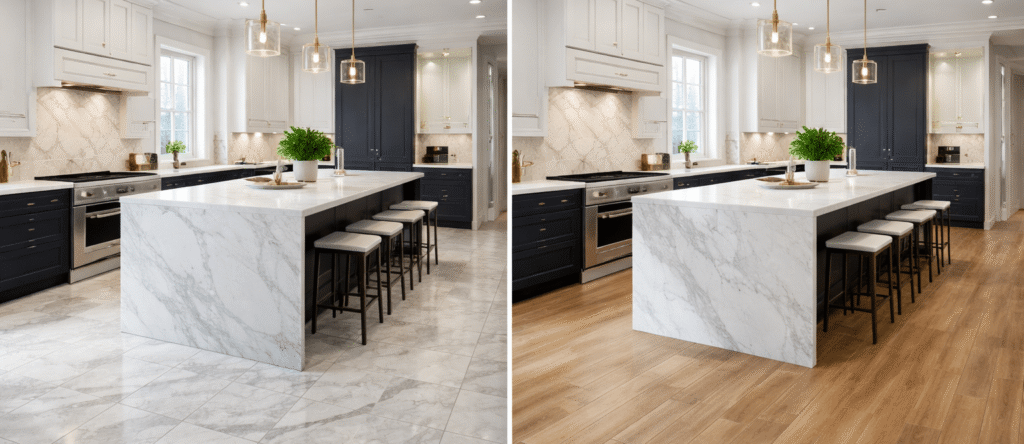
Sheet Vinyl and Linoleum: Traditional Budget Options
Sheet vinyl and linoleum represent older flooring technologies largely superseded by LVP in new installations, but they remain relevant for certain applications and appear in many existing Southern Ohio homes. Understanding these materials’ characteristics and when they still make sense helps homeowners make informed decisions about repair-versus-replace scenarios.
Sheet Vinyl Composition and Costs
Modern sheet vinyl consists of multiple layers including a backing layer, foam comfort layer (in cushioned vinyl), printed design layer, and clear wear layer protecting the design. Quality varies significantly: builder-grade sheet vinyl costs $0.75-$1.50 per square foot, mid-range products run $2-$3.50 per square foot, and premium sheet vinyl reaches $4-$6 per square foot for thick, cushioned products with realistic stone or wood appearances.
Our partner contractors typically charge $2-$4 per square foot for professional installation, including seam sealing and adhesive. Small rooms often install without seams, but larger kitchens require seams that remain visible despite heat welding. DIY installation proves challenging—achieving invisible seams and proper adhesive coverage without bubbles or wrinkles requires experience.
A typical 120-square-foot kitchen using mid-range sheet vinyl costs approximately $660 total ($2.50/sf material + $3/sf installation), comparable to laminate but with superior water resistance.
Linoleum: Natural Material Alternative
True linoleum—made from linseed oil, cork dust, wood flour, and pigments—differs fundamentally from vinyl despite similar appearance. Linoleum costs $4-$8 per square foot for materials, with installation running $3-$5 per square foot. The higher costs compared to sheet vinyl reflect linoleum’s natural composition and smaller manufacturing scale.
Linoleum offers environmental benefits over vinyl but requires more maintenance. The material needs periodic waxing or sealing to maintain appearance and water resistance. Without proper maintenance, linoleum becomes porous and stains readily. Linoleum’s durability exceeds sheet vinyl, with properly maintained installations lasting 25-40 years compared to 10-15 years for sheet vinyl.
Performance Limitations and Considerations
Sheet vinyl’s primary weakness is its susceptibility to tears, cuts, and gouges from dropped knives or dragged appliances. Once the wear layer is breached, moisture can infiltrate to the backing and subfloor, causing degradation. Repairs prove difficult or impossible—patching vinyl rarely produces acceptable results, and matching discontinued products becomes impossible after 5-7 years.
The cushioned foam layer in padded vinyl feels comfortable initially but compresses permanently under heavy furniture and appliances, creating visible indentations. Sheet vinyl performs adequately in Southern Ohio’s humidity but can curl at seams in extremely dry conditions during winter heating season.
Quick Summary – Sheet Vinyl & Linoleum
- Best for: Budget projects, rental properties, temporary solutions
- Cost: $420-$780 for 120 sq ft kitchen (installed)
- Lifespan: 10-15 years (vinyl), 25-40 years (linoleum with maintenance)
- Water Resistance: Good (seamless installation)
- Comfort: Soft (cushioned vinyl), moderate (linoleum)
- Ideal Southern Ohio homes: Budget-conscious, older homes needing affordable update
- Maintenance: Low (vinyl), medium (linoleum requires waxing)
Cork Flooring: Specialty Option with Niche Applications
Cork flooring provides unique characteristics—warmth, sound absorption, and cushioned comfort—that appeal to homeowners prioritizing standing comfort. However, cork’s limitations in high-moisture environments and its higher costs relative to performance make it uncommon in Southern Ohio kitchens.
Material Costs and Installation
Cork flooring costs $4-$8 per square foot for tiles or planks, comparable to mid-range hardwood or premium LVP. Our partner contractors charge $3-$5 per square foot for floating installations or $4-$6 per square foot for glue-down applications. The total cost of $7-$14 per square foot installed positions cork above LVP but below premium hardwood.
Performance Characteristics and Limitations
Cork’s cellular structure creates inherent cushioning that reduces standing fatigue more effectively than any other kitchen flooring material. This comfort appeals particularly to homeowners who spend extended periods cooking or working in kitchens. The material also provides excellent sound absorption, reducing noise from footfalls and dropped items.
However, cork’s softness creates vulnerability to indentation from heavy furniture and appliances. Refrigerators, stoves, and dishwashers leave permanent depressions that remain visible if appliances are moved. The surface also scratches and scuffs more readily than harder flooring materials, showing wear patterns within 5-7 years in active kitchens.
Cork requires sealing to achieve water resistance—unsealed cork absorbs moisture readily and stains permanently. Even properly sealed cork tolerates standing water poorly compared to tile or LVP. Cork’s water sensitivity makes it inappropriate for areas directly in front of sinks or dishwashers.
Maintenance and Longevity
Cork requires resealing every 2-3 years using a quality cork floor sealer to maintain water resistance and appearance, adding ongoing maintenance costs and effort. Expected cork lifespan in kitchens ranges from 10-15 years with proper maintenance, comparable to mid-range LVP but shorter than tile or quality hardwood. Cork cannot be refinished like solid hardwood—once the wear layer is compromised, replacement becomes necessary.
Quick Summary – Cork Flooring
- Best for: Maximum comfort, eco-conscious buyers, sound dampening
- Cost: $840-$1,680 for 120 sq ft kitchen (installed)
- Lifespan: 10-15 years with maintenance
- Water Resistance: Moderate (requires sealing, poor with standing water)
- Comfort: Excellent (softest option)
- Ideal Southern Ohio homes: Not recommended for high-moisture areas
- Maintenance: High (resealing every 2-3 years)
Comparing Total Cost of Ownership: Initial Investment vs. Lifespan
Kitchen flooring decisions should consider total cost of ownership over the floor’s expected lifespan rather than just initial installation costs. Materials with higher upfront costs often provide better long-term value when their durability, maintenance requirements, and replacement timing are factored into the analysis.
Cost-Per-Year Analysis
For a typical 120-square-foot kitchen, cost-per-year calculations reveal surprising value differences:
- Budget laminate: $660 installed, 6-year lifespan = $110 per year before replacement
- Mid-range LVP: $1,080 installed, 12-year lifespan = $90 per year
- Quality ceramic tile: $1,560 installed, 25-year lifespan = $62 per year
- Premium hardwood: $1,800 installed, 30+ year lifespan, but requires refinishing ($400 every 8-10 years) = approximately $100 per year
These calculations assume proper installation and reasonable maintenance. Poor installation significantly shortens lifespan across all materials. Water damage events can prematurely end any floor’s service life, though tile and LVP recover better than hardwood or laminate.
Maintenance Cost Comparison
Annual maintenance costs vary substantially by flooring type:
- Tile: Minimal maintenance—routine mopping plus periodic grout cleaning or sealing costing $50-$100 annually
- LVP: Regular mopping with no special maintenance, essentially zero additional annual cost
- Hardwood: Specialized cleaners and periodic refinishing, averaging $150-$200 annually when refinishing costs are amortized
- Natural stone: Regular sealing plus specialized cleaners, totaling $100-$150 annually
- Cork: Periodic resealing costs approximately $120 annually when amortized over 2-3 year intervals
Resale Value Considerations
Flooring impacts home resale value, though the effect varies by overall home value and local market preferences. In Southern Ohio’s real estate market, tile and hardwood command premiums over vinyl or laminate options, particularly in homes above $200,000 where buyers expect quality finishes. Well-maintained hardwood or ceramic tile can add $2,000-$3,000 to perceived home value, while premium LVP increasingly commands similar respect among buyers who recognize quality materials.
However, poorly maintained hardwood or dated tile can reduce value compared to fresh, modern LVP. The key to resale value lies more in condition and contemporary appearance than material type alone. Fresh laminate appears more valuable than worn, outdated hardwood despite hardwood’s inherent material superiority.
Selecting Appropriate Flooring for Your Southern Ohio Kitchen
Flooring selection should consider multiple factors beyond cost and appearance: lifestyle requirements, home characteristics, maintenance willingness, and realistic performance expectations in Southern Ohio’s environment. No single flooring type suits every situation—matching material characteristics to specific circumstances produces the best outcomes.
Prioritizing Decision Factors
Homeowners who cook frequently or spend extended time standing in kitchens should prioritize comfort, making LVP, cork, or cushioned vinyl preferable to tile or hardwood. Water-resistant materials (tile or quality LVP) prove essential near sinks, dishwashers, and refrigerators regardless of other preferences. Homes without consistent HVAC operation should avoid hardwood due to humidity-related movement issues.
Older homes with marginal subflooring favor lighter materials like LVP or laminate that don’t require structural reinforcement, while homes with solid framing can accommodate tile or stone. Households with large dogs benefit from harder surfaces like tile that resist scratching, while homes without pets can successfully use softer materials. Budget constraints obviously influence decisions, but focusing exclusively on initial cost often leads to premature replacement that costs more long-term.
Regional Specific Recommendations
Southern Ohio’s humidity cycles and older housing stock create conditions where certain materials perform notably better than generic guidance suggests. Quality LVP with SPC cores excels in this environment, providing water resistance, dimensional stability, and reasonable costs. The material tolerates Southern Ohio’s humidity swings while resisting common kitchen moisture challenges.
Ceramic or porcelain tile represents the optimal choice for homeowners prioritizing longevity and willing to accept hardness underfoot. Tile’s immunity to Southern Ohio’s humidity and its extreme durability justify higher initial costs in properly framed homes. However, homes with questionable structural support should avoid tile’s weight and rigidity.
Hardwood can succeed in climate-controlled homes maintained at consistent 35-45% relative humidity year-round, but it struggles in homes with inconsistent HVAC operation. The region’s dramatic seasonal humidity swings stress hardwood more than materials in naturally moderate climates. Homeowners committed to hardwood should choose engineered products over solid wood for greater dimensional stability.
Laminate should be approached cautiously in Southern Ohio kitchens despite its budget appeal. The material’s poor water resistance creates too much failure risk in the humid environment, particularly in homes near the Ohio River or with crawl space moisture issues. Spending slightly more for water-resistant LVP provides substantially better long-term results.
Frequently Asked Questions About Kitchen Flooring in Southern Ohio
What flooring material holds up best in Southern Ohio’s humid climate?
Ceramic or porcelain tile performs best in Southern Ohio’s humid conditions because the material neither absorbs moisture nor changes dimensions with humidity fluctuations. Quality luxury vinyl plank with stone polymer composite cores ranks second, offering nearly comparable humidity resistance at lower cost with greater comfort underfoot. Both materials withstand the region’s seasonal humidity swings from 20% winter indoor humidity to 75%+ summer outdoor humidity without gapping, cupping, or buckling.
Hardwood struggles most with humidity changes, particularly in homes without consistent year-round HVAC operation. The dramatic seasonal swings cause expansion during humid months and contraction during heating season, creating gaps between boards and occasional buckling in extreme cases. Engineered hardwood tolerates humidity changes better than solid hardwood but still shows more movement than tile or LVP.
How much should I budget for kitchen flooring installation in a typical Southern Ohio home?
Budget $8-$12 per square foot total (materials plus installation) for quality results in most Southern Ohio kitchens, with costs varying based on material selection and home condition. A typical 120-square-foot kitchen costs $960-$1,440 total at this range. Laminate installations can come in lower at $4-$7 per square foot total, while premium materials like natural stone or exotic hardwoods reach $15-$25 per square foot.
These estimates assume reasonable subfloor condition—older homes often require additional preparation work adding $2-$5 per square foot. Homes built before 1970 frequently need subfloor leveling, joist reinforcement, or moisture barrier installation that budget estimates don’t capture. Our partner contractors provide detailed quotes specifying what subfloor work is included versus what constitutes an additional charge.
Can I install kitchen flooring myself, or should I hire professionals?
Floating floor installations—luxury vinyl plank, laminate, or click-together engineered hardwood—suit confident DIY installers who follow instructions carefully and use proper tools. These installations require no adhesive or fasteners, making them forgiving for beginners. Budget 50-75% longer than estimated installation time for first-time installers, and expect some learning-curve mistakes in less-visible areas.
Tile, glue-down hardwood, and sheet vinyl require professional installation for quality results. These methods demand specialized tools, technique knowledge, and experience achieving proper adhesive coverage, flat surfaces, or invisible seams. Poor DIY installation of these materials creates premature failure costing more to correct than professional installation would have cost initially. Our network includes experienced flooring contractors throughout Southern Ohio who can ensure quality installation, and we’re happy to arrange consultations to discuss your specific project needs.
How do I know if my old subfloor is adequate, or if it needs work before new flooring?
Walk across the kitchen floor checking for bounce, flex, or squeaking—these indicate inadequate support requiring attention before flooring installation. Use a 6-foot or 8-foot level to check flatness, marking high and low spots. Flooring requires flatness within 3/16 inch over 10 feet for most materials, with tile demanding even tighter tolerances. Deviations beyond this need leveling compound or plywood overlays.
Inspect visible subfloor areas in basements or crawl spaces for water damage, wood rot, or sagging between joists. Dark staining, soft spots, or musty odors indicate moisture problems requiring correction before flooring installation. Moisture meters ($30-$50) provide objective measurements—wood subfloors should read below 12% moisture content, and concrete slabs below 4.5%. Higher readings mean delaying installation until moisture sources are identified and corrected. Our partner contractors can inspect and quote work before any demolition begins, allowing accurate cost estimates and avoiding mid-project surprises.
What’s the best flooring choice for a kitchen in a home I plan to sell within the next few years?
Mid-range luxury vinyl plank offers the best combination of contemporary appearance, reasonable cost, and broad buyer appeal for homes selling within 3-5 years. Quality LVP looks modern, performs well in showings, and costs substantially less than tile or hardwood while appearing more upscale than laminate. Choose neutral colors (grays, taupes, medium wood tones) that appeal to broad buyer preferences rather than distinctive colors or patterns that may date quickly.
Avoid budget materials that will show wear before sale—fresh laminate appears cheap while worn hardwood suggests deferred maintenance. If existing flooring remains in decent condition, consider professional deep cleaning and minor repairs rather than replacement. Fresh, clean flooring in outdated style often shows better than new flooring in the same budget tier. Buyers understand that flooring reflects personal preference and many plan to replace it anyway, so condition and cleanliness matter more than material type for near-term sales. Reserve significant flooring investment for homes you’ll occupy long enough to amortize costs over 7-10 years of use.
Affiliate Disclosure: As an Amazon Associate and affiliate partner, we earn from qualifying purchases. This article contains affiliate links to products we recommend based on our network’s experience in Southern Ohio installations. Purchasing through these links supports our educational content at no additional cost to you. Read our full disclosure policy.
Ready to Explore Kitchen Flooring Options?
Our network includes experienced flooring contractors throughout Southern Ohio who understand the region’s unique challenges and can help you select and install the right flooring for your kitchen. Whether you’re comparing tile versus luxury vinyl, evaluating hardwood feasibility in your specific home, or need subfloor assessment before making flooring decisions, our partner contractors provide honest guidance based on decades of combined experience in Ohio Valley homes.
We connect homeowners with vetted professionals who:
- Understand Southern Ohio’s humidity patterns and how they affect different flooring materials
- Provide accurate subfloor assessments before quoting flooring costs
- Explain realistic performance expectations based on your specific home conditions
- Offer multiple material options with honest pros and cons for each
- Stand behind their work with proper warranties and follow-up service
Connect With Local Flooring Contractors
Related Resources
- Kitchen Remodeling in Southern Ohio and Northern Kentucky
- Complete Kitchen Remodeling Cost Guide for Southern Ohio
- Kitchen Remodeling Calculator
- Kitchen Cabinet Options and Costs
- Kitchen Layout and Design Planning
- Kitchen Remodeling in Chillicothe, OH
- Kitchen Remodeling in Portsmouth, OH
Hire the Right Contractor the First Time
Use our free research guide and intelligence report to vet any contractor before you sign a contract.