Use Our Professional Calculator to Get Accurate Results
When it comes to heating and cooling your home, size matters—a lot. An incorrectly sized HVAC system can cost you thousands in wasted energy, uncomfortable temperatures, and premature equipment failure. Yet surprisingly, many contractors still use outdated “rules of thumb” that lead to oversized or undersized systems.
That’s why we created this comprehensive HVAC sizing calculator and guide. Whether you’re replacing an old system, building a new home, or just curious about whether your current HVAC is properly sized, this tool gives you professional-grade Manual J calculations in minutes.
Why Accurate HVAC Sizing Is Critical (And Why Most Systems Are Wrong)
Here’s an uncomfortable truth: studies show that 60-70% of residential HVAC systems in America are improperly sized. The consequences are real and expensive.
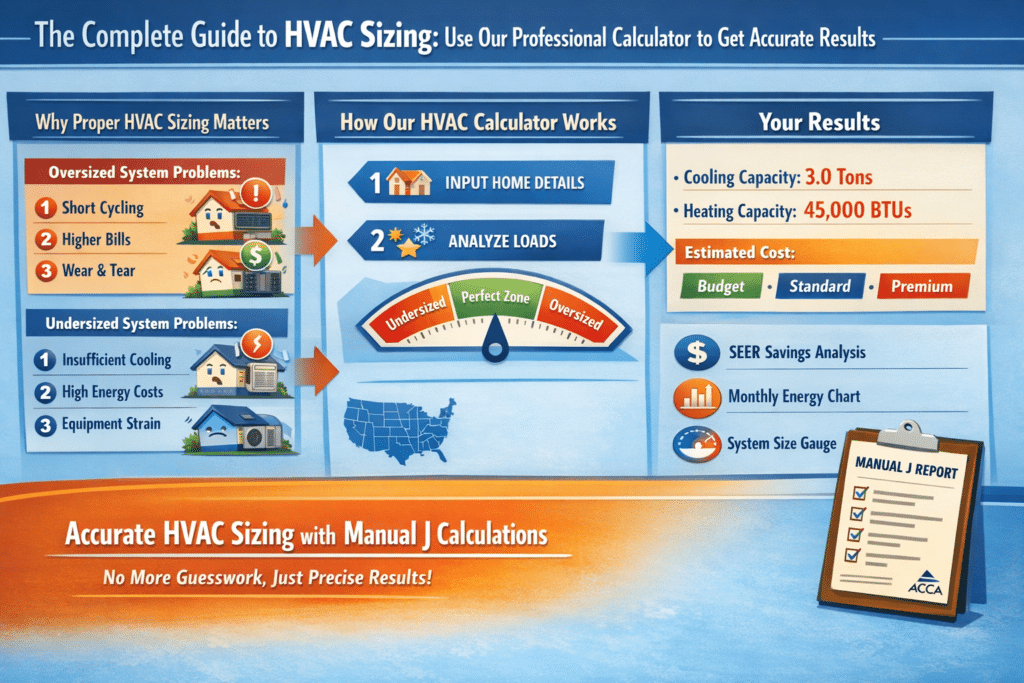
The Problems with Oversized Systems
Many homeowners assume “bigger is better” when it comes to HVAC capacity. Unfortunately, that’s exactly backward. Oversized systems create multiple problems:
Short cycling is the most immediate issue. When your AC or furnace is too powerful, it reaches your thermostat’s set point too quickly, then shuts off. This constant on-off cycling prevents the system from running long enough to properly dehumidify your home in summer. You end up with a house that feels cold but clammy—technically at the right temperature but uncomfortable due to excess moisture.
Additionally, short cycling dramatically reduces equipment lifespan. HVAC systems experience the most wear during startup and shutdown. A properly sized system might cycle 3-4 times per hour on a hot day. An oversized system might cycle 8-10 times per hour, doubling the mechanical stress and cutting the equipment’s life expectancy in half.
The financial impact compounds over time. You pay more upfront for the larger equipment, spend more on energy because the system never reaches peak efficiency, and replace the equipment sooner. Over a 15-year period, an oversized system can cost $5,000-$10,000 more than a properly sized one.
The Problems with Undersized Systems
On the opposite end, undersized systems struggle to maintain comfort during temperature extremes. Your AC runs continuously on the hottest summer days but never quite reaches your desired temperature. Your furnace battles constantly during cold snaps but can’t keep up.
This constant operation leads to sky-high energy bills and premature component failure. Compressors, heat exchangers, and blower motors wear out from relentless use. Moreover, you’re uncomfortable in your own home—which defeats the entire purpose of having HVAC in the first place.
Why Contractors Get It Wrong
The construction industry has perpetuated several myths about HVAC sizing:
The “500 square feet per ton” rule is the most common oversimplification. This crude estimate ignores insulation quality, window efficiency, ceiling height, local climate, sun exposure, and a dozen other factors that dramatically affect heating and cooling loads.
Some contractors deliberately oversize systems because they believe it’s “safer” or because homeowners request more powerful equipment. Others lack the training or tools to perform proper Manual J load calculations. A few are simply trying to upsell larger, more expensive equipment.
Regardless of the reason, the result is the same: a system that doesn’t match your home’s actual needs.
Understanding Manual J Load Calculations
Manual J is the industry-standard methodology for calculating residential heating and cooling loads, developed by the Air Conditioning Contractors of America (ACCA). It’s not guesswork or rules of thumb—it’s engineering.
What Manual J Measures
A proper Manual J calculation accounts for over 20 variables:
Your building envelope includes square footage, volume (accounting for ceiling height), number and type of windows, number of exterior doors, wall and attic insulation R-values, and air infiltration rates. Each element affects how quickly heat enters or escapes your home.
Climate factors incorporate heating degree days and cooling degree days for your specific location, which measure how much and how often you need heating versus cooling. A home in the desert Southwest needs very different equipment than an identical home in the upper Midwest, even if both are 2,000 square feet.
Internal heat gains come from occupants (each person generates about 400 BTUs per hour), appliances, lighting, and home office equipment. A family of five with a home office needs more cooling capacity than a retired couple in the same house.
Solar heat gain varies dramatically based on your home’s orientation, window placement, shading from trees or adjacent buildings, and whether you have energy-efficient Low-E windows or older single-pane glass.
How Our HVAC Load Calculator Works
Our calculator implements the Manual J methodology in a user-friendly format. You input details about your home—square footage, insulation quality, window count and type, ceiling height, number of stories, and more. The calculator then:
First, it establishes your base heating and cooling loads based on your home’s volume and local climate data. We’ve pre-loaded climate information for multiple regions, so you get location-specific calculations.
Next, it applies adjustment factors for insulation quality, window efficiency, sun exposure, and occupancy. These modifiers fine-tune the base calculation to match your home’s specific characteristics.
Then it separates heating and cooling loads because most homes need different capacities for each. In colder climates, heating loads typically exceed cooling loads. In warmer regions, the opposite is true.
Finally, it converts the BTU requirements to tonnage (for cooling) and provides equipment recommendations with cost estimates. The calculator also identifies whether your current system might be oversized or undersized.
Step-by-Step: Using the HVAC Sizing Calculator
Let’s walk through the calculator to help you get the most accurate results.
Section 1: Your Location
Select your location from the dropdown menu. This is crucial because climate dramatically affects HVAC sizing. The calculator uses your location to apply the correct heating degree days and cooling degree days to your calculation.
If your specific city isn’t listed, choose “Other Location” for a general estimate, though results will be less precise. For the most accurate sizing, you’ll want a Manual J calculation from a qualified contractor who can account for your exact climate zone.
Section 2: Home Details
Enter your total conditioned square footage—this means any space that’s heated or cooled. Include finished basements if they’re conditioned, but exclude garages, unfinished areas, and unheated spaces.
Select your ceiling height carefully. Standard 8-foot ceilings are the baseline, but many modern homes have 9-10 foot ceilings, and some feature vaulted or cathedral ceilings reaching 12-14 feet or higher. Higher ceilings mean more volume to heat and cool, which increases your load.
Choose your home’s age range. Newer homes (0-10 years) typically have better insulation and more efficient windows than older homes. Historic homes (50+ years) often have minimal insulation and single-pane windows, significantly increasing heating and cooling loads.
Indicate the number of stories. Multi-story homes have different heating and cooling dynamics than single-story homes. Heat rises, so second floors tend to be warmer in summer and first floors cooler in winter. This affects both sizing and system type recommendations.
Section 3: Building Envelope
Your building envelope is the barrier between conditioned interior space and the outside environment. It’s one of the most important factors in HVAC sizing.
Insulation quality has an enormous impact. Check your attic if possible. If you see 10-12 inches of fluffy pink or white insulation, you likely have R-38 or better (good to excellent). Six inches or less indicates poor insulation (R-19 or less). If you’re unsure, select “Average” and consider getting an energy audit for precise information.
Window count and type matter because windows are major sources of heat gain in summer and heat loss in winter. Count all windows in heated/cooled spaces. Single-pane windows have minimal insulation value. Double-pane windows are much better. Low-E (low-emissivity) double-pane windows with argon or krypton gas fill offer the best performance.
Don’t forget exterior doors. Each door is another point where heat transfers between inside and outside.
Section 4: Environmental Factors
Sun exposure significantly affects cooling loads. A home with large south and west-facing windows and minimal shade will gain substantial solar heat in summer. Heavy shade from mature trees or adjacent buildings reduces solar gain. Be honest in your assessment—this can change your cooling load by 15-20%.
Occupancy matters because people generate heat. Each person adds about 400 BTUs per hour of cooling load. A family of five needs more cooling capacity than a couple, even in the same house.
Section 5: Current System Information (Optional)
If you know what type of system you currently have, enter it. If you’re experiencing specific comfort issues—upstairs always too hot, high energy bills, short cycling, humidity problems, or uneven temperatures—check those boxes. The calculator uses this information to provide more targeted recommendations, particularly around zoned systems or mini-splits.
Interpreting Your Results: What the Numbers Mean
Once you click “Calculate,” you’ll receive a comprehensive analysis with multiple sections.
The Visual Gauge System
The gauge shows where your calculated system size falls on a spectrum from undersized to oversized. The “Perfect Zone” in the middle represents optimal sizing—enough capacity to handle your peak heating and cooling needs without excessive power that leads to short cycling.
If your marker falls in the red zones on either end, pay attention. This indicates potential sizing issues that you should discuss with contractors.
Cooling and Heating Capacity
These numbers represent the BTUs (British Thermal Units) per hour your home requires. BTU is the standard measure of heating and cooling capacity. One BTU is the amount of energy needed to raise one pound of water by one degree Fahrenheit.
For context, a typical residential HVAC system ranges from 18,000 BTU (1.5 tons) for a small, well-insulated home to 60,000 BTU (5 tons) for a large home with average insulation. Your heating and cooling loads may differ—this is normal and important for selecting the right equipment.
System Size in Tons
HVAC cooling capacity is measured in tons, a holdover from when ice was used for cooling. One ton of cooling capacity equals 12,000 BTU per hour—the amount of heat needed to melt one ton of ice in 24 hours.
Most residential systems range from 1.5 to 5 tons. The calculator rounds to the nearest half-ton because that’s how equipment is manufactured. If your calculation shows 2.7 tons, you’d typically select a 2.5 or 3-ton system depending on whether you’re in a heating-dominated or cooling-dominated climate.
Cost Estimates
The calculator provides three-tier pricing: budget systems, mid-range systems, and premium systems. These estimates include complete installation with ductwork or line sets, permits, labor, and basic warranties.
Budget systems typically feature SEER 14 efficiency (the minimum allowed by federal law), standard warranties, and basic thermostats. They do the job but lack advanced features.
Mid-range systems often include SEER 16-17 efficiency, better warranties (often 10 years on parts), and programmable or WiFi thermostats. These offer the best value for most homeowners.
Premium systems feature SEER 18+ efficiency, extended warranties, variable-speed compressors for quieter operation and better humidity control, and advanced smart thermostats. They cost more upfront but deliver superior comfort and lower operating costs.
Actual prices vary based on your specific home, accessibility challenges (attic access, crawl space conditions), local labor rates, and chosen brand. Use these estimates as ballpark figures for budgeting.
The SEER ROI Calculator
SEER (Seasonal Energy Efficiency Ratio) measures cooling efficiency. Higher SEER numbers mean better efficiency and lower operating costs, but equipment costs more upfront.
The calculator shows annual operating costs for SEER 14, 16, 18, and 20+ systems, plus the payback period for each efficiency tier. This helps you make an informed decision about whether higher efficiency is worth the investment.
For most climates and usage patterns, SEER 16 offers the sweet spot—significantly better than the minimum requirement without the premium pricing of ultra-high efficiency systems. However, if you live in a very hot climate with long cooling seasons, SEER 18+ can pay for itself within 5-7 years.
Seasonal Analysis Chart
This bar chart breaks down your estimated monthly heating and cooling costs throughout the year, helping you visualize when you’ll use the most energy and what your total annual operating costs might be.
You’ll notice heating costs peak in winter months (January, February, December) while cooling costs peak in summer (June, July, August). Spring and fall typically show minimal HVAC costs as outdoor temperatures are comfortable.
The annual total gives you a realistic expectation for your HVAC energy budget. Keep in mind this assumes a SEER 16 system. Higher efficiency systems will reduce these costs; lower efficiency systems will increase them.
Contractor Comparison Tool
This powerful feature lets you verify contractor quotes against your calculated needs. Simply enter the system size a contractor recommended, and the calculator will tell you if it’s appropriate, oversized, or undersized.
If a contractor quotes a significantly different size than your calculation, it’s not necessarily wrong—they may have identified factors you didn’t account for. But it definitely means you should ask questions: “Can you show me your Manual J calculation? What factors led you to recommend this size? How did you account for my specific insulation and window situation?”
Good contractors welcome these questions because they’ve done the work to support their recommendations. Contractors who can’t explain their sizing methodology should raise red flags.
Mini-Split System Configurator
For homes with multiple stories, additions, or rooms that are always too hot or too cold, the calculator suggests a mini-split configuration. Mini-splits allow independent temperature control for different zones—solving the “upstairs is always too hot” problem that plagues many homes.
Select the rooms where you want independent control, and the calculator recommends the outdoor unit size and number of indoor heads you’ll need, along with estimated costs. This is particularly valuable for homes where a single-zone central system struggles to maintain consistent comfort throughout.
Common HVAC Sizing Mistakes (And How to Avoid Them)
Even with good intentions, homeowners and contractors make predictable errors in HVAC sizing.
Mistake #1: Relying on Square Footage Alone
The “one ton per 500 square feet” rule ignores so many variables that it’s essentially useless. A 2,000-square-foot home with poor insulation and single-pane windows might need 5 tons of cooling. An identical 2,000-square-foot home with excellent insulation and Low-E windows might only need 2.5 tons.
Always account for insulation quality, window efficiency, ceiling height, and local climate. Square footage is just the starting point.
Mistake #2: Matching the Old System Size
“My old system was 3 tons, so I need a new 3-ton system” is dangerous logic. Your old system might have been improperly sized from day one. If you’ve upgraded windows, added insulation, or made other improvements, your load has changed. If you’ve added square footage or converted an attic to living space, your load has increased.
Calculate from scratch based on your home’s current condition, not what was installed years ago.
Mistake #3: Ignoring Ductwork Condition
Even a perfectly sized system will underperform with leaky, poorly insulated, or undersized ductwork. Studies show that typical duct systems lose 20-30% of conditioned air through leaks before it reaches living spaces.
If you’re replacing an old system, have your ductwork inspected. Sealing leaks and adding insulation to ducts in unconditioned spaces (attics, crawlspaces) can improve efficiency by 20% or more. In some cases, you might need a smaller system once ductwork is properly sealed.
Mistake #4: Failing to Account for Future Changes
Are you planning to add insulation next year? Replace windows? Add a sunroom? Finish the basement? These changes affect your heating and cooling loads.
If improvements are imminent, factor them into your current sizing. You don’t want to install an oversized system today that will be even more oversized after you upgrade your home’s envelope.
Mistake #5: Choosing Equipment Before Sizing
Some homeowners fall in love with a specific brand or model before determining what size they need. This puts the cart before the horse. Sizing always comes first—then you choose among appropriately sized options.
Features like variable-speed compressors, two-stage heating, and advanced humidity control matter, but only if the system is correctly sized for your home.
Real-World Sizing Examples
Let’s examine how different home characteristics affect sizing requirements.
Example 1: Well-Insulated Modern Home
Consider a 2,000-square-foot single-story home built in 2018 with R-38 attic insulation, R-19 wall insulation, Low-E double-pane windows, and 8-foot ceilings. The home has minimal solar gain due to strategic window placement and mature shade trees. A family of three lives here.
For a temperate climate with moderate heating and cooling needs, the calculation might yield:
- Cooling load: 28,000 BTU (2.3 tons)
- Heating load: 42,000 BTU
A 2.5-ton cooling system would be appropriate, paired with a furnace or heat pump sized for the heating load. The excellent insulation and efficient windows dramatically reduce both heating and cooling requirements compared to what square footage alone would suggest.
Example 2: Older Home with Planned Improvements
Now consider a 1,800-square-foot two-story home built in 1975. It currently has poor attic insulation (R-19), original single-pane windows, and 8-foot ceilings. However, the homeowners plan to upgrade to Low-E windows and add attic insulation to R-49 within the next year.
Current calculation might show:
- Cooling load: 42,000 BTU (3.5 tons)
- Heating load: 68,000 BTU
After improvements:
- Cooling load: 30,000 BTU (2.5 tons)
- Heating load: 48,000 BTU
In this scenario, sizing for the post-improvement condition makes sense. Installing a 3.5-ton system now would leave it severely oversized after the planned upgrades. A 2.5 or 3-ton system sized for the improved home is the smarter choice, even if it means dealing with slightly less capacity during the transition period.
Example 3: Hot Climate with Solar Gain
Finally, consider a 2,400-square-foot single-story home in a hot climate with 1,800-2,000 cooling degree days annually. The home has average insulation (R-30 attic), double-pane windows, but significant west-facing glass and minimal shading. Five people live here, and there’s a home office with multiple computers.
Calculation shows:
- Cooling load: 48,000 BTU (4 tons)
- Heating load: 32,000 BTU (minimal heating needed)
The high solar gain, internal heat from occupants and equipment, and hot climate drive the cooling load well above what square footage alone would predict. A 4-ton system is appropriate, and high-efficiency (SEER 18+) makes financial sense given the long cooling season. The homeowner should also consider adding shade structures or window film to reduce solar gain and lower both equipment size and operating costs.
The Complete HVAC Inspection Checklist
Whether you’re sizing a new system or troubleshooting an existing one, this checklist helps you gather the critical information:
Home Structure
- [ ] Total conditioned square footage (exclude garages, unfinished spaces)
- [ ] Ceiling height in each room
- [ ] Number of stories
- [ ] Year built
- [ ] Type of construction (frame, brick, stone)
Insulation
- [ ] Attic insulation depth and type
- [ ] Attic insulation R-value
- [ ] Wall insulation (if known)
- [ ] Basement or crawlspace insulation
- [ ] Ductwork insulation (in unconditioned spaces)
Windows and Doors
- [ ] Total number of windows
- [ ] Window type (single-pane, double-pane, Low-E)
- [ ] Window size and orientation (which direction each faces)
- [ ] Number and type of exterior doors
- [ ] Storm windows or doors (if present)
Climate and Environment
- [ ] Local climate zone
- [ ] Average summer high temperature
- [ ] Average winter low temperature
- [ ] Shading from trees or structures
- [ ] Sun exposure throughout the day
Current HVAC System (if applicable)
- [ ] Equipment age
- [ ] System type (central AC, heat pump, mini-split, etc.)
- [ ] Tonnage or BTU rating
- [ ] SEER rating (efficiency)
- [ ] Thermostat type and location
- [ ] Known issues or comfort problems
Ductwork (for central systems)
- [ ] Duct locations (attic, crawlspace, basement, walls)
- [ ] Visible duct condition
- [ ] Return air locations
- [ ] Supply register locations
- [ ] Any sealed or insulated duct sections
Usage and Preferences
- [ ] Number of occupants
- [ ] Daily schedule (when home/away)
- [ ] Temperature preferences
- [ ] Humidity concerns
- [ ] Noise sensitivity
- [ ] Energy efficiency priorities
This comprehensive checklist gives contractors everything they need for an accurate Manual J calculation and helps you understand the factors driving your HVAC requirements.
Beyond Sizing: Other Factors for HVAC Success
Proper sizing is foundational, but it’s not the only consideration for HVAC success.
Air Distribution and Zoning
Even a perfectly sized system can deliver poor comfort if air distribution is inadequate. Rooms far from the main trunk lines may receive insufficient airflow. Upstairs bedrooms often run hot because warm air rises and ductwork may not deliver enough cooling to compensate.
Zoning addresses these issues by dividing your home into multiple zones, each with independent temperature control. Motorized dampers in the ductwork direct conditioned air where it’s needed. A programmable zoning controller manages the dampers based on individual zone thermostats.
For multi-story homes, rooms with high solar gain, master suites, or home offices, zoning can solve persistent comfort problems that no amount of HVAC tweaking can fix with a single-zone system.
Mini-split systems offer inherent zoning because each indoor head operates independently. This makes them ideal for homes with diverse heating and cooling needs across different spaces.
Humidity Control
Temperature is only half the comfort equation—humidity matters just as much. High humidity makes summer feel oppressive even at comfortable temperatures. Low humidity in winter causes dry skin, static electricity, and respiratory discomfort.
Properly sized systems dehumidify better than oversized ones because they run longer cycles. However, in humid climates, you might need supplemental dehumidification even with correct sizing.
Whole-house dehumidifiers integrate with your HVAC system to maintain optimal humidity (30-50% relative humidity year-round). They’re particularly valuable in humid regions or homes with moisture issues.
In dry climates, whole-house humidifiers add moisture during heating season, improving comfort and protecting wood flooring and furniture from damage due to low humidity.
Indoor Air Quality
Modern HVAC systems can do much more than heat and cool—they can dramatically improve indoor air quality with the right accessories.
High-efficiency filtration (MERV 11-13 filters or better) captures allergens, dust, and airborne particles. Electrostatic filters use static electricity to trap even smaller particles. UV lights installed in ductwork kill mold, bacteria, and viruses.
Fresh air ventilation brings outdoor air inside in controlled amounts, diluting indoor pollutants without wasting energy. Energy recovery ventilators (ERVs) pre-condition incoming fresh air using exhaust air, minimizing the energy penalty.
These features are worth discussing with your contractor, especially if anyone in your home has allergies, asthma, or respiratory sensitivities.
Programmable and Smart Thermostats
Even the best HVAC system needs intelligent control. Programmable thermostats automatically adjust temperatures based on your schedule—lowering heating at night and when you’re away, raising it before you wake up or return home.
Smart thermostats take this further with learning algorithms, remote control via smartphone, energy reports, and integration with smart home ecosystems. They can even adjust based on weather forecasts or occupancy sensors.
The energy savings from smart thermostat features can offset the cost within 1-2 years through reduced runtime during unoccupied periods.
Regular Maintenance
Proper sizing means nothing if your system isn’t maintained. Dirty filters restrict airflow, forcing the system to work harder. Low refrigerant charge reduces capacity. Dirty coils decrease efficiency.
At minimum, replace filters every 1-3 months (monthly during heavy use seasons). Schedule professional maintenance annually—spring for AC, fall for heating. A good technician will:
- Clean indoor and outdoor coils
- Check refrigerant charge
- Inspect electrical connections
- Lubricate moving parts
- Test safety controls
- Measure airflow
- Verify thermostat operation
This preventive maintenance extends equipment life, maintains efficiency, and catches small problems before they become expensive failures.
Frequently Asked Questions
How do I know if my current HVAC system is the right size?
Use the calculator to determine your home’s actual heating and cooling loads, then compare those numbers to your current equipment. Your AC’s tonnage should be listed on the outdoor unit nameplate. If the difference between calculated and actual is more than 10-15%, your system is likely mismatched to your home’s needs.
Additionally, watch for telltale signs: If your AC cycles on and off frequently (every 5-10 minutes) on mild days, it’s probably oversized. If it runs constantly on the hottest days without reaching your set temperature, it’s undersized. If humidity feels high even when the temperature is comfortable, oversizing is the likely culprit.
Can I use this calculator for heat pumps, mini-splits, and other system types?
Yes. The heating and cooling loads calculated are the same regardless of equipment type. A heat pump, furnace with AC, or mini-split all need to provide the same amount of heating and cooling for your specific home.
The difference is in how equipment delivers that capacity. Heat pumps use the same equipment for both heating and cooling. Mini-splits offer zone-level control. But the underlying BTU requirements calculated by Manual J remain the same.
For mini-split systems specifically, the configurator section helps you distribute capacity across multiple zones based on your home’s layout and usage patterns.
What if my calculation differs significantly from what a contractor quoted?
A difference of 10-15% isn’t concerning—contractors may account for factors you didn’t capture in the online calculator. However, differences of 25% or more warrant questions.
Ask to see the contractor’s Manual J calculation. A reputable contractor should willingly share this and explain the reasoning. Ask specifically what factors led to their recommendation and how they accounted for your insulation, windows, and climate.
If the contractor can’t produce a Manual J calculation or can’t explain their sizing methodology, that’s a red flag. Consider getting a second opinion from a contractor who uses industry-standard calculation methods.
Does the age of my home affect what size HVAC system I need?
Absolutely. Building codes have evolved dramatically over the past several decades. A 1960s home typically has minimal wall insulation (R-7 or less), single-pane windows, and poor air sealing. A modern home built to current code has R-13 to R-21 wall insulation, R-38+ attic insulation, Low-E windows, and much better air sealing.
These differences can change HVAC requirements by 30-50% or more for identically sized homes. That’s why the calculator asks for your home’s age—it applies different baseline assumptions for homes built in different eras.
If you’ve upgraded an older home with new insulation, windows, or air sealing, treat it as a newer home for sizing purposes. The actual construction date matters less than the current condition of your home’s envelope.
Should I oversize slightly “just to be safe”?
No. This is one of the most persistent myths in the HVAC industry, and it causes tremendous problems. The “safety” of oversizing is an illusion that costs you money and comfort.
Oversized systems cost more to buy, operate less efficiently due to short cycling, fail to dehumidify properly, create temperature swings, and wear out faster. You’re not “safe”—you’re wasting money and accepting inferior comfort.
Proper sizing with a correctly performed Manual J calculation already includes safety margins for extreme weather days. You don’t need to add more buffer. Trust the engineering rather than outdated rules of thumb.
Take Control of Your Home Comfort
Accurate HVAC sizing is the foundation of home comfort. With this calculator and the knowledge you’ve gained from this guide, you’re equipped to make informed decisions about your heating and cooling system.
Use the calculator to understand your home’s specific needs. Compare contractor quotes against those calculations. Ask informed questions. And remember that the lowest price isn’t always the best value—proper sizing and quality installation matter more than saving a few hundred dollars on equipment.
At Kore Komfort Solutions, we specialize in mini-split HVAC installations that provide zone-level comfort control and exceptional efficiency. If you’re interested in a traditional central air system, packaged unit, or furnace installation, we’re happy to refer you to qualified contractors in our network who handle those systems.
Ready to get started? Use the calculator now to discover what your home really needs, and take the first step toward optimal comfort and efficiency.
Further Resources
- Compare contractor quotes – Use your calculated size to verify contractor recommendations
- Explore system types – Learn about mini-split vs central air options
- Find qualified contractors – Browse our HVAC contractor directory
- Check available rebates – See tax credits and local incentives
Questions about your results? Email us at mike@korekomfortsolutions.com Call or text 740-716-5324.