Article Navigation
- Understanding Chillicothe’s Kitchen Remodeling Landscape
- Unique Challenges for Ross County Kitchen Renovations
- Cost Breakdown: What Chillicothe Homeowners Actually Pay
- Design Considerations for Different Chillicothe Neighborhoods
- Materials Guide: What Works in Southern Ohio
- Navigating Permits and Regulations in Ross County
- How to Select Kitchen Remodeling Contractors
- Timeline Planning for Your Kitchen Project
- ROI and Home Value in the Chillicothe Market
- Frequently Asked Questions
FTC Disclosure: This article may contain affiliate links. When you click on these links and make a purchase, we may earn a commission at no additional cost to you. We only recommend products and services that we believe will add value to our readers. Our network includes contractors and service providers throughout the Ohio Valley, and we may receive compensation for qualified referrals. All opinions and recommendations are our own based on our research and experience serving Ross County homeowners. For more information, please see our full affiliate disclosure policy.
Kitchen Remodeling in Chillicothe, OH: Complete Guide for Ross County Homeowners
Chillicothe is a city of distinct neighborhoods, from the stately historic homes downtown to the mid-century and modern subdivisions on University Hill and in the West End. But whether you’re in a Victorian on 5th Street or a brick ranch on Carlisle Hill, the kitchen is often the one room that feels stuck in the past.
At Kore Komfort Solutions, we serve as Southern Ohio’s educational authority on home improvement, helping Ross County homeowners navigate kitchen remodeling decisions through comprehensive guides based on real contractor data, local building requirements, and regional market conditions. Our network includes experienced kitchen remodeling professionals throughout the Ohio Valley who understand the specific challenges of renovating in the First Capital.
This guide provides the educational foundation you need to plan a successful kitchen remodel in Chillicothe, covering everything from navigating the city-county code divide to understanding realistic costs for Ross County projects. Whether you’re planning a minor refresh or a complete gut renovation, you’ll find the data-driven information necessary to make confident decisions about your investment. For homeowners considering whole-home improvements, see our guides on bathroom remodeling in Chillicothe and HVAC systems for Ross County homes.
Back to Article Navigation
Understanding Chillicothe’s Kitchen Remodeling Landscape
Chillicothe’s housing stock tells the story of Ohio’s First Capital, with construction spanning from the early 1800s through modern developments. This diversity creates unique opportunities and challenges for kitchen remodeling that homeowners must understand before beginning any project.
The Housing Stock Diversity Challenge
Ross County contains approximately 15,000 residential structures, with Chillicothe proper accounting for roughly 9,000 of these homes. According to U.S. Census data, the median home age in Chillicothe is 62 years, meaning the typical house was built in the early 1960s. However, this median masks significant variation:
- Downtown Historic District: Homes dating from 1800-1920, featuring plaster walls, coal-converted heating systems, and kitchens that were often afterthoughts added to the rear of the home
- West End and Paint Street Corridor: Primarily 1920-1950 construction with galley-style kitchens, limited electrical capacity, and cast iron plumbing
- University Hill and Brewer Heights: 1960-1980s construction featuring the “work triangle” kitchen layout, lowered bulkhead ceilings, and laminate countertops
- Newer Developments (SR-35 Corridor): Post-2000 construction with builder-grade kitchens that homeowners often upgrade within 10-15 years
Each housing era presents distinct remodeling challenges that impact project scope, cost, and complexity. Contractors serving the Chillicothe market report that understanding these building-era-specific issues is critical to accurate project estimation and successful outcomes.
Why Chillicothe Kitchens Age Differently Than National Averages
Southern Ohio’s climate and housing conditions accelerate certain types of kitchen deterioration while slowing others. The Ohio Valley’s humidity levels, which average 70-75% during summer months according to National Weather Service data, create specific challenges. Managing this humidity is critical – consider compact dehumidifiers ($50-$100) for kitchens without adequate ventilation or moisture meters ($20-$40) to monitor problem areas during renovation planning.
- Wood cabinet deterioration: Particle board and MDF cabinets from the 1970s-1990s often show significant swelling and delamination around sinks and dishwashers
- Grout failure: Tile backsplashes and countertops experience accelerated grout degradation in poorly ventilated kitchens
- Subfloor issues: Many Chillicothe homes lack proper kitchen ventilation, leading to moisture accumulation that damages subflooring over decades
- Finish preservation: Lower UV exposure compared to southern climates means that cabinet finishes and countertop materials often last longer than national averages suggest
These regional factors mean that kitchen remodeling timelines in Chillicothe don’t always match national guidelines. A kitchen that might be considered “20 years old” in Arizona could functionally be equivalent to a 30-year-old kitchen in Ross County due to moisture-related deterioration.
Back to Article Navigation
Unique Challenges for Ross County Kitchen Renovations
Renovating a kitchen in Chillicothe requires understanding challenges that are either unique to this market or significantly more pronounced here than in other regions. Our network of contractors identifies these as the most common complications that affect project planning and budgeting.
The City vs. County “Code” Divide
Chillicothe presents a regulatory complexity that confuses even experienced homeowners: requirements change drastically depending on exactly where your property line sits. This isn’t just a minor administrative detail—it fundamentally impacts your project timeline, budget, and contractor selection.
Inside City Limits (City of Chillicothe):
- Building permits required for major kitchen remodels, especially those involving structural changes, electrical panel upgrades, or plumbing rerouting
- Permits obtained through the City Building Department at 35 South Paint Street
- Electrical work must be performed by licensed electricians and inspected
- Plumbing modifications require separate permits and inspection
- Typical permit costs: $75-$200 depending on project scope
- Average inspection timeline: 2-5 business days for scheduling
Unincorporated Ross County:
- Residential building permits generally not required for interior renovations
- Electrical and plumbing work still must meet National Electric Code (NEC) and Ohio Plumbing Code standards
- Ross County Health District oversees plumbing permits for any work involving waste lines
- Contractors report that while permits aren’t required, following code is still legally mandatory and affects homeowner’s insurance coverage
Historic District Considerations:
- Properties within Chillicothe’s downtown Historic District face additional review for exterior modifications
- Interior kitchen remodels generally do not require Design Review Board approval unless you’re altering exterior windows, doors, or adding exterior venting
- Installing a commercial-grade range hood that vents through an exterior wall typically requires Design Review Board approval
- The board meets monthly, adding 30-45 days to project timelines when approval is required
The practical impact: A homeowner on Paint Street (inside city limits) might pay $150 in permits and wait 5-7 days for inspections, while their neighbor two miles east on SR-104 (unincorporated county) faces no permit requirements but must still ensure code compliance. Both scenarios require contractors who understand the applicable regulations.
Modernizing “The Hill” Kitchens: The Bulkhead Problem
Homes in the University Drive, Brewer Heights, and Carlisle Hill areas—predominantly built between 1970-1985—share a common kitchen design flaw: lowered “bulkhead” ceilings above the cabinets. These drywall boxes were originally installed to hide ductwork and plumbing, but they create several problems:
- Visual compression: The bulkhead makes 8-foot ceilings feel like 7-foot ceilings, creating a cramped atmosphere
- Lost storage: The gap between cabinet tops and ceiling represents 15-20% of potential storage space
- Dust collection: The flat surface above cabinets becomes a maintenance headache
- Dated appearance: Bulkheads immediately signal a 1970s-1980s kitchen
Contractors in our network report that removing bulkheads is one of the most transformative interventions for these homes, but it’s not always straightforward. The bulkhead usually contains:
- HVAC supply or return ducts (in 60-70% of cases)
- Plumbing vent stacks (in 30-40% of cases)
- Electrical wiring (in nearly 100% of cases)
Removing the bulkhead while addressing these mechanicals typically adds $2,500-$6,000 to a project budget, depending on what needs to be rerouted. However, homeowners consistently report this expense as worthwhile—the dramatic increase in perceived ceiling height and the addition of 18-24 inches of upper cabinet storage creates immediate impact. Maximize this new storage space with pull-down shelf organizers ($80-$150) and stackable storage containers designed for hard-to-reach upper cabinets.
Venting Challenges in Historic Downtown Properties
If you live in a downtown Victorian or early-20th-century home and dream of a professional-grade range, you’ll face a challenge that suburban homeowners never encounter: how to properly vent a high-CFM range hood through historic masonry walls. For comprehensive guidance on kitchen ventilation systems, see our complete kitchen ventilation and range hood guide.
Modern commercial-style ranges require 600-1200 CFM (cubic feet per minute) of ventilation according to Energy Star guidelines. Popular options for Ohio Valley kitchens include wall-mounted range hoods with 900 CFM capacity ($400-$900) or island hoods with adjustable CFM ($600-$1,200). This necessitates:
- A 6-8 inch diameter exhaust duct (compared to standard 4-inch dryer vents)
- Exterior termination with a proper cap to prevent backdrafting
- Make-up air systems in tightly sealed homes to prevent negative pressure
The problem: You cannot simply core-drill an 8-inch hole through a historic brick facade without potentially violating historic district guidelines and certainly without careful structural consideration. Contractors report several solutions:
- Rear wall venting: If your kitchen is at the back of the house (common in Victorian layouts), venting through the less-visible rear wall often receives approval
- Existing chimney adaptation: Many historic homes have unused chimneys that can be lined and adapted for kitchen venting
- Soffit venting: Running ductwork through interior walls to vent through roof soffits (requires significant carpentry)
- Downdraft systems: Floor-level ventilation that vents through the basement or crawl space (least efficient but sometimes necessary)
These creative solutions add $1,500-$4,500 to project costs compared to standard suburban installations where contractors can simply punch through vinyl siding into the nearest exterior wall.
Electrical Capacity Limitations
Many Chillicothe homes, particularly those built before 1970, have 100-amp electrical service. Modern kitchens with multiple appliances can strain this capacity. For comprehensive information on electrical service upgrades, see our electrical panel upgrade guide for Ohio homes.
- Electric range: 40-50 amps
- Dishwasher: 10-15 amps
- Refrigerator: 15-20 amps
- Microwave: 10-15 amps
- Disposal, lighting, outlets: 30-40 amps combined
Contractors in our network report that 20-30% of Ross County kitchen remodels require electrical service upgrades to 200-amp panels, adding $2,000-$4,000 to project costs. This is particularly common when homeowners switch from gas to electric cooking or add high-powered appliances like induction cooktops.
Back to Article Navigation
Cost Breakdown: What Chillicothe Homeowners Actually Pay
Kitchen remodeling costs in Ross County typically run 8-12% below national averages due to lower labor rates, but this savings comes with trade-offs in material selection and contractor availability. Understanding local cost structures helps homeowners budget realistically and identify when estimates are out of line with market norms. For guidance on financing your project, see our home improvement financing guide.
Chillicothe Kitchen Remodeling Cost Ranges (2025)
Based on data from contractors in our network serving the Ross County market, here are typical investment levels for different project scopes:
Minor Refresh ($8,000-$18,000):
- Cabinet refacing or painting
- Countertop replacement (laminate or entry-level quartz)
- New sink and faucet
- Updated lighting fixtures
- Backsplash installation
- Paint and minor repairs
- Timeline: 1-3 weeks
Mid-Range Remodel ($25,000-$55,000):
- Stock or semi-custom cabinetry replacement
- Quartz or granite countertops
- Mid-grade appliance package
- New flooring (vinyl plank or ceramic tile)
- Updated electrical and plumbing
- Recessed lighting installation
- Tile backsplash
- Timeline: 4-8 weeks
High-End Remodel ($60,000-$120,000+):
- Custom cabinetry with specialty finishes
- Premium countertops (quartzite, marble, or exotic granite)
- Professional-grade appliance package
- Hardwood or luxury vinyl flooring
- Structural modifications (wall removal, ceiling work)
- Custom island with specialty features
- High-end lighting and fixtures
- Timeline: 8-16 weeks
Line-Item Cost Breakdown for Typical Ross County Projects
For a standard 12×16 foot kitchen remodel in Chillicothe (192 square feet), contractors report typical costs:
- Cabinetry: $8,000-$18,000 (42-48 linear feet of stock to semi-custom cabinets)
- Countertops: $2,400-$5,500 (35-40 square feet of quartz or granite)
- Appliances: $3,500-$8,000 (mid-range package: range, refrigerator, dishwasher, microwave)
- Popular mid-range options: GE 30″ Slide-In Gas Range ($1,200-$1,500)
- French door refrigerators: Frigidaire Gallery 26.8 cu ft ($1,800-$2,200)
- Quiet dishwashers: Bosch 300 Series ($800-$1,000)
- Flooring: $1,900-$3,800 (200 square feet including waste factor)
- Backsplash: $800-$2,200 (20-30 square feet of ceramic or glass tile)
- Sink and Faucet: $400-$1,200
- Farmhouse sinks: Kraus 33″ Stainless Steel ($300-$450)
- Pull-down faucets: Moen Arbor Motionsense ($250-$350)
- Lighting: $800-$2,000 (recessed cans, under-cabinet, pendants)
- Under-cabinet LED: LE LED Strip Lights ($25-$50 per section)
- Pendant lighting: Globe Electric Nate Industrial Pendants ($80-$120 each)
- Electrical Updates: $1,500-$3,500 (new circuits, outlets, switches)
- Plumbing: $1,200-$2,800 (if relocating fixtures)
- Labor (Installation): $8,000-$16,000 (varies significantly by scope)
- Permits and Inspections: $150-$400 (city projects only)
- Contingency (10-15%): $2,800-$6,400 (for unexpected issues)
Total: $31,450-$70,200
This represents a typical mid-to-upper-mid-range remodel. Actual costs vary based on material selections, structural complications, and whether the project includes specialty features like custom islands or professional appliances.
Hidden Costs Specific to Chillicothe/Ross County
Several cost factors are more prevalent in this market than national averages suggest:
- Asbestos abatement: Homes built before 1980 may have asbestos in floor tile, mastic, or drywall compound. Professional abatement costs $1,500-$4,000 for a typical kitchen. For detailed information on identification and safe removal, see our asbestos abatement guide for Ohio homes
- Plaster wall replacement: Historic homes with plaster and lath walls often require complete drywall replacement when opening walls, adding $2,000-$5,000
- Floor leveling: Older homes frequently have uneven floors requiring self-leveling compound before installing tile or luxury vinyl, adding $800-$2,000
- Knob-and-tube wiring replacement: Pre-1950 homes may have knob-and-tube electrical that must be completely replaced, adding $3,000-$8,000
- Cast iron plumbing replacement: Homes from the 1920s-1950s with cast iron drain lines often require replacement when disturbed, adding $1,500-$4,000
Contractors emphasize that pre-renovation inspections identifying these issues early prevent budget overruns and project delays.
How Chillicothe Costs Compare to Regional Markets
Kitchen remodeling costs in Chillicothe typically position as follows relative to nearby markets:
- Columbus: Chillicothe costs run 15-20% lower due to reduced labor rates and material costs (see our Columbus kitchen remodeling guide)
- Cincinnati: Chillicothe costs run 12-18% lower for similar reasons
- Portsmouth/Athens: Chillicothe costs run roughly comparable, within 5% either direction (see our Portsmouth kitchen remodeling guide and Athens kitchen remodeling guide)
- Marietta/Parkersburg: Chillicothe costs run 5-8% higher due to slightly larger contractor base and material availability (see our Marietta kitchen remodeling guide)
The trade-off for lower costs is typically longer lead times for specialty materials and fewer contractors capable of high-end custom work compared to Columbus or Cincinnati markets.
Back to Article Navigation
Design Considerations for Different Chillicothe Neighborhoods
Successful kitchen design respects the architectural context of your home while incorporating modern functionality. What works in a West End ranch may be completely inappropriate for a downtown Victorian, and understanding these distinctions prevents costly design mistakes.
Historic Downtown (Pre-1920 Homes)
Victorian, Federal, and early-20th-century homes in the Paint Street Historic District and surrounding downtown areas require design approaches that balance period authenticity with livability:
Design Principles:
- Preserve original architectural details (crown molding, plaster medallions, wood trim)
- Use inset or beaded-inset cabinet doors rather than overlay styles
- Select cabinet hardware that reflects the home’s era (oil-rubbed bronze, polished nickel)
- Maintain the room’s original footprint when possible—historic kitchens were often smaller, separate rooms
- Use period-appropriate materials for visible finishes while hiding modern conveniences
Common Projects:
- Installing modern cabinetry with period-correct door styles and finishes
- Hiding modern appliances behind cabinet panels
- Updating plumbing and electrical while preserving plaster walls
- Adding functional pantry storage in former butler’s pantries or back hallways
- Installing farmhouse sinks with reproduction fixtures
What to Avoid:
- Ultra-modern cabinet styles (flat-panel, handleless European designs)
- Open-concept conversions that destroy the home’s original floor plan logic
- Industrial or contemporary finishes that clash with Victorian millwork
- Removing original built-in features like breakfast nooks or butler’s pantries
West End and Mid-Century Neighborhoods (1920s-1960s)
Homes along Paint Street Corridor, West End, and established neighborhoods near Yoctangee Park represent Chillicothe’s middle housing era—sturdy, well-built homes with smaller kitchens that benefit from thoughtful expansion:
Design Principles:
- Open the kitchen to adjacent dining rooms to create family gathering spaces
- Maximize storage through floor-to-ceiling cabinetry
- Update the “work triangle” to modern “work zones” that accommodate multiple cooks
- Replace small windows with larger units for natural light
- Install peninsula or island seating for casual dining
Common Projects:
- Removing walls between kitchen and dining room (common load-bearing wall location requires beam installation)
- Expanding into adjacent porches or mudrooms
- Adding breakfast bars or peninsula seating
- Installing recessed lighting to replace single ceiling fixtures
- Creating walk-in pantries from coat closets
What Works Well:
- Transitional cabinet styles that bridge traditional and contemporary
- Quartz countertops in neutral tones
- Stainless steel appliances with mid-range features
- Subway tile or simple geometric backsplashes
- Hardwood or luxury vinyl flooring
University Hill and 1970s-1980s Subdivisions
Homes in Brewer Heights, University Drive, and Carlisle Hill areas represent Chillicothe’s suburban expansion era. These kitchens were built with the “work triangle” principle but feel dated by contemporary standards:
Design Principles:
- Remove bulkhead ceilings to install full-height cabinets
- Replace laminate countertops with quartz or granite
- Update oak cabinets with painted or stained alternatives
- Open galley layouts to create L-shaped or U-shaped designs with islands
- Install larger windows or add skylights for natural light
Common Projects:
- Complete cabinet replacement (refacing rarely makes sense when removing bulkheads)
- Adding center islands with seating and storage. Maximize island functionality with pull-out trash and recycling systems ($80-$150) and built-in spice rack organizers ($40-$80)
- Installing slide-in ranges to replace drop-in cooktop/wall oven combinations
- Upgrading to French-door refrigerators with water/ice dispensers
- Installing under-cabinet lighting and recessed ceiling cans
- Adding water filtration systems – Ohio Valley water quality varies significantly by neighborhood. Consider under-sink reverse osmosis systems ($200-$400) or whole-house sediment filters ($150-$300) for homes with well water
What Works Well:
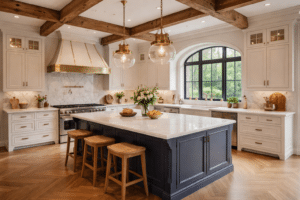
- Shaker-style cabinets in white, gray, or two-tone finishes
- Waterfall-edge islands with contrasting countertop materials
- Large-format tile backsplashes (subway, arabesque, or geometric patterns)
- Stainless or slate appliance finishes
- Wide-plank luxury vinyl or engineered hardwood flooring
- Quality garbage disposals for Ohio Valley cooking – InSinkErator Evolution Excel ($280-$350) handles fibrous vegetables common in regional cooking
- Deep drawer organizers – bamboo expandable drawer dividers ($30-$50) and pan organizer racks ($25-$40) maximize storage efficiency
Newer Developments (Post-2000)
Homes in developments along the SR-35 corridor and newer subdivisions often have builder-grade kitchens that homeowners upgrade within 10-15 years:
Common Upgrades:
- Replacing builder-grade cabinets with semi-custom options
- Upgrading laminate countertops to quartz
- Installing apron-front sinks
- Adding cabinet crown molding and decorative toe-kick details
- Upgrading to professional-style ranges or built-in appliances
- Installing custom backsplashes (builder-grade homes often have minimal or no backsplash)
These projects typically fall in the $15,000-$40,000 range since the underlying infrastructure is modern and code-compliant.
Back to Article Navigation
Materials Guide: What Works in Southern Ohio
Southern Ohio’s climate—characterized by high summer humidity, freeze-thaw cycles, and significant temperature swings—affects material performance differently than national averages suggest. Our network of contractors shares insights on which materials perform well in Ross County homes.
Countertop Materials for Ohio Valley Kitchens
Selecting the right countertop material is one of the most important decisions in your kitchen remodel. For an in-depth comparison of all available options, see our complete kitchen countertop comparison guide.
Quartz (Engineered Stone): Most Popular Choice
- Cost: $60-$120 per square foot installed
- Why it works here: Non-porous surface resists moisture damage in humid conditions; doesn’t require sealing
- Local considerations: Performs excellently in homes without air conditioning or with marginal ventilation
- Longevity: 20-25+ years with minimal maintenance
- Best for: All Chillicothe kitchen types; particularly good for high-use family kitchens
Granite (Natural Stone): Traditional Premium Choice
- Cost: $50-$100 per square foot installed
- Why it works here: Heat-resistant; handles temperature extremes well
- Local considerations: Requires annual sealing to prevent staining in humid environments; lighter colors show less etching from acidic foods common in Ohio Valley cooking
- Longevity: 20-30+ years with proper sealing
- Best for: Historic homes where natural material aesthetics are important; serious cooks who need heat resistance
Butcher Block (Wood): Specialty Application
- Cost: $40-$75 per square foot installed
- Why it works here: Renewable surface; warm aesthetic suits historic homes
- Local considerations: Requires frequent oiling to prevent moisture damage; not recommended for areas around sinks in humid climates unless properly maintained
- Longevity: 10-20 years depending on maintenance
- Best for: Islands, baking stations, or accent areas rather than full-kitchen applications
Flooring Materials: Performance in Ross County
Kitchen flooring must withstand high traffic, moisture exposure, and temperature fluctuations common in Southern Ohio homes. For more detailed guidance on flooring options, see our comprehensive kitchen flooring guide for Ohio Valley homes.
Luxury Vinyl Plank (LVP): Fastest Growing Category
- Cost: $4-$8 per square foot installed
- Why it works here: 100% waterproof; handles humidity without cupping or warping; comfortable underfoot
- Local considerations: Ideal for homes with moisture concerns; performs well over imperfect subfloors common in older homes
- Longevity: 15-25 years depending on wear layer thickness
- Best for: All kitchen types, but particularly valuable in homes with moisture issues or concrete slab foundations
- Popular options: LifeProof vinyl plank flooring (DIY-friendly, waterproof core) or TrafficMaster allure ultra flooring (budget-friendly option)
Ceramic or Porcelain Tile: Traditional Durable Choice
- Cost: $8-$16 per square foot installed
- Why it works here: Completely moisture-proof; handles temperature extremes; available in designs mimicking wood or stone
- Local considerations: Cold underfoot in winter (radiant heat systems add $8-$12 per square foot); grout requires sealing in humid environments
- Longevity: 30-50+ years with proper installation
- Best for: High-end remodels; homeowners prioritizing longevity over comfort
Engineered Hardwood: Premium Natural Option
- Cost: $10-$18 per square foot installed
- Why it works here: More dimensionally stable than solid hardwood in humidity; can be refinished 1-3 times
- Local considerations: Requires acclimatization before installation; not waterproof (avoid areas prone to standing water)
- Longevity: 20-30 years with refinishing
- Best for: Open-concept spaces where kitchen flows into living areas; homeowners wanting natural wood aesthetics
Cabinet Materials and Finishes
Cabinet selection represents the largest single expense in most kitchen remodels and has the greatest visual impact. For comprehensive guidance on cabinet styles, materials, and selection criteria, see our complete kitchen cabinet buyer’s guide.
Plywood Box Construction with Hardwood Doors:
- Gold standard for Ross County installations
- Plywood boxes resist humidity-related expansion better than particle board
- Full-overlay or inset door styles depending on home era
- Painted finishes most popular (white, gray, navy); stained finishes for traditional homes
- Soft-close drawer slides and door hinges now standard across price points
Finishes for Southern Ohio Humidity:
- Catalyzed conversion varnish or lacquer finishes provide best moisture resistance
- Avoid oil-based finishes that can yellow in low-light environments
- Painted finishes perform better long-term in high-humidity kitchens than stained finishes
Don’t get ripped off. See real pricing for bathrooms, kitchens, and HVAC.
Updated for 2026 Market Rates
Backsplash Materials
Backsplash selection in Chillicothe kitchens typically balances budget, aesthetics, and ease of cleaning:
- Ceramic subway tile: $8-$15 per square foot installed; classic look suits all home styles. Popular DIY option: peel-and-stick subway tile ($12-$18 per sq ft, no installation required)
- Glass tile: $15-$30 per square foot installed; reflects light well in darker kitchens; easy to clean
- Natural stone: $18-$35 per square foot installed; coordinates with granite countertops; requires sealing
- Quartz slab: $25-$50 per square foot installed; seamless appearance; no grout maintenance
- Stainless steel: Modern option at $20-$40 per square foot installed. DIY alternative: stainless steel peel-and-stick tiles ($15-$25 per sq ft)
Contractors report that grout sealing is particularly important in Southern Ohio due to humidity and cooking-related moisture. Epoxy grout, while more expensive initially ($3-$5 per square foot premium), eliminates sealing requirements and resists staining. For DIY grout sealing, Aqua Mix Sealer’s Choice Gold ($25-$35 per bottle) provides professional-grade protection.
Back to Article Navigation
Navigating Permits and Regulations in Ross County
Understanding the permitting landscape prevents project delays and ensures legal compliance. The regulatory environment in Chillicothe and Ross County requires understanding jurisdictional boundaries and when permits are actually necessary versus when they’re optional but advisable. For detailed guidance on permits across all Southern Ohio counties, see our Southern Ohio home improvement permits guide.
Determining Your Jurisdiction
The first step in any kitchen remodel is determining exactly which governmental entity has authority over your property. This isn’t always obvious—some addresses that appear to be “in Chillicothe” are actually in unincorporated Ross County for building purposes.
How to Verify Your Status:
- Check your property tax bill—it will indicate city vs. county jurisdiction
- Call the City Building Department at (740) 702-7097 with your address
- Review the city limits map available at the Ross County Auditor’s office
- Your contractor should verify this before providing a final estimate
Hire the Right Contractor the First Time
Use our free research guide and intelligence report to vet any contractor before you sign a contract.
City of Chillicothe Permit Requirements
If your home is within city limits, here’s what to expect:
Building Permit Required For:
- Removing or relocating walls (load-bearing or non-load-bearing)
- Installing or relocating gas appliances
- Major electrical work including panel upgrades or new circuits
- Plumbing modifications involving drain line changes
- Adding or relocating windows
- Any work exceeding $5,000 in value
Building Permit Generally Not Required For:
- Cabinet replacement (same footprint)
- Countertop replacement
- Flooring replacement
- Paint and cosmetic updates
- Fixture replacement (same location)
Permit Application Process:
- Contractor submits application with project drawings to Building Department (35 South Paint Street)
- Plan review typically takes 3-5 business days
- Permit fee paid upon approval ($75-$200 based on project value)
- Permit posted at job site
- Inspections scheduled at specified project milestones
- Final inspection and approval before work is considered complete
Typical Inspection Points:
- Rough-in inspection: Electrical and plumbing before drywall/finish installation
- Final inspection: Completed work including cabinetry, appliances, and all finishes
Unincorporated Ross County
Properties outside city limits face different requirements:
- Building permits: Generally not required for interior residential renovations
- Plumbing permits: Required for any modifications to water supply or waste lines; obtained through Ross County Health District
- Electrical permits: Not required at county level, but work must meet National Electric Code standards
- Code compliance: Still legally required even without permits; insurance claims can be denied for non-code-compliant work
Contractors emphasize that the absence of permit requirements doesn’t mean absence of code requirements. Homeowners insurance policies typically require that modifications meet applicable building codes regardless of whether permits were obtained.
Historic District Considerations
Properties within Chillicothe’s Historic District (primarily downtown area bounded roughly by Paint Street to the west, Water Street to the east, 7th Street to the north, and 2nd Street to the south) face additional review for certain modifications:
Requires Design Review Board Approval:
- Exterior modifications visible from public streets
- New exterior venting (range hood exhausts, HVAC penetrations)
- Window or door replacements affecting exterior appearance
- Addition of exterior architectural elements
Does Not Require Design Review Board Approval:
- Interior kitchen remodels with no exterior impact
- Repair or replacement of existing features in-kind
- Routine maintenance
The Design Review Board meets on the third Tuesday of each month. Applications must be submitted at least two weeks prior to the meeting. This process adds 30-45 days to project timelines when required, so homeowners should plan accordingly.
Working Without Permits: Understanding the Risks
Some homeowners in unincorporated areas or those undertaking cosmetic updates may be tempted to skip permits even when technically required. Understanding the risks helps make informed decisions:
Potential Consequences:
- Insurance issues: Homeowner’s insurance may deny claims related to unpermitted work
- Resale complications: Unpermitted modifications must be disclosed to buyers; can complicate financing
- Safety concerns: Uninspected electrical and plumbing work may not meet safety standards
- Retroactive permits: If discovered, you may be required to obtain after-the-fact permits and potentially expose finished work for inspection
- Fines: City can assess penalties for work performed without required permits
Contractors in our network universally recommend obtaining required permits. The modest cost and slight time delay provide legal protection and peace of mind that far outweigh the inconvenience.
Back to Article Navigation
How to Select Kitchen Remodeling Contractors in Ross County
Selecting the right contractor is arguably more important than any single design decision. A skilled contractor can overcome material limitations and budget constraints, while a poor contractor can turn premium materials into a disappointing result. Our network connects homeowners with vetted professionals, but understanding what to look for empowers better decision-making.
Essential Contractor Qualifications
Licensing and Insurance:
- Ohio doesn’t require general contractor licensing at the state level, but legitimate contractors carry comprehensive general liability insurance ($1-2 million minimum)
- Workers’ compensation insurance (confirm with Ohio Bureau of Workers’ Compensation)
- Specific trades (electrical, plumbing) require state licensing—verify through Ohio eLicense
Local Experience:
- Minimum 5 years serving Ross County market
- Portfolio demonstrating experience with your home’s era (Victorian, mid-century, contemporary)
- Understanding of local permitting requirements and building department relationships
- Knowledge of regional material suppliers and lead times
Financial Stability:
- Established business address (not just a P.O. box)
- Professional website and online presence
- Trade accounts with local suppliers (indicates established business relationships)
- Ability to provide detailed, itemized estimates
Red Flags to Avoid
Contractors serving the Chillicothe market identify these warning signs of problematic contractors:
- Unusually low bids: Estimates 30%+ below competitors often indicate unrealistic timelines, low-quality materials, or unlicensed subcontractors
- Large upfront payments: Legitimate contractors typically request 10-30% deposits, not 50%+ upfront
- No written contract: All work should be documented in detailed contracts specifying materials, timelines, payment schedules, and change order processes
- Pressure tactics: “This price is only good today” or similar urgency-based sales techniques
- No local references: Contractors should readily provide 5-10 references from Ross County projects completed in the past 2-3 years
- Cash-only payment: Legitimate businesses accept checks and credit cards; cash-only requests suggest tax avoidance
- No permanent phone number: Cell-phone-only contractors with no business address or website lack business stability
Interview Questions to Ask
Before hiring any contractor, homeowners should ask:
- “How many kitchen remodels have you completed in Ross County in the past year?” Look for 10-20+ for established kitchen specialists
- “Can you provide three references from projects similar to mine?” Actually contact references and ask about timeline accuracy, budget adherence, and problem resolution
- “Who will be on-site daily?” Understand whether the owner/estimator actually performs work or exclusively manages subcontractors
- “What’s your typical project timeline for a kitchen of this scope?” Compare to national averages: cosmetic update 2-3 weeks, mid-range remodel 4-8 weeks, extensive renovation 8-16 weeks
- “How do you handle change orders?” Understand the process and cost implications for mid-project changes
- “What’s your payment schedule?” Typical: 10-30% deposit, 30-40% at rough-in, 30-40% at substantial completion, final 10% upon completion and final inspection
- “Do you pull permits, or is that my responsibility?” Professional contractors handle all permitting as part of their service
- “What warranties do you provide?” Look for minimum 1-year workmanship warranty; material warranties vary by product
Understanding Contractor Estimates
Quality estimates should include:
- Detailed scope of work describing exactly what will be done
- Specific material specifications (brands, models, colors when known)
- Labor costs broken out separately from materials
- Permitting and inspection costs
- Project timeline with major milestones
- Payment schedule tied to project phases
- Allowances for items not yet selected (fixtures, appliances, etc.)
- Exclusions (what’s specifically not included)
- Change order procedures and pricing structure
Be wary of vague estimates that simply list total cost without itemization. These make it impossible to compare contractors fairly or understand where your money is being spent.
Contract Essentials
Before work begins, ensure your contract includes:
- Complete scope of work with material specifications
- Total project cost with payment schedule
- Start and completion dates (with allowances for delays due to weather, material availability, or unforeseen conditions)
- Permit responsibility and costs
- Warranty terms for labor and materials
- Insurance certificates for liability and workers’ comp
- Change order procedures
- Cleanup and disposal responsibilities
- Lien waiver requirements (protects you from subcontractor claims)
- Dispute resolution procedures
Have contracts reviewed by an attorney if the project exceeds $50,000 or involves significant structural modifications.
Back to Article Navigation
Timeline Planning for Your Chillicothe Kitchen Project
Realistic timeline expectations prevent frustration and help homeowners plan around the disruption of kitchen remodeling. Chillicothe-specific factors—including contractor availability, material lead times, and seasonal considerations—affect project duration. For comprehensive guidance on managing your renovation project, see our complete home remodeling project management guide.
Typical Project Phases and Durations
Phase 1: Planning and Design (4-8 weeks)
- Initial consultation and scope definition: 1-2 weeks
- Design development and material selection: 2-4 weeks (use a laser measuring tool for accurate room dimensions, $30-$60)
- Contractor bidding (if soliciting multiple quotes): 2-3 weeks
- Contract negotiation and signing: 1 week
Phase 2: Pre-Construction (2-6 weeks)
- Permit applications and approval: 1-2 weeks (city projects)
- Material ordering and delivery: 2-8 weeks depending on custom items
- Contractor scheduling and crew allocation: 1-2 weeks
Phase 3: Demolition (2-5 days)
- Cabinet and countertop removal: 1 day
- Flooring removal: 1 day
- Structural demolition (if removing walls): 1-2 days
- Disposal and cleanup: 1 day
Phase 4: Rough-In Work (1-3 weeks)
- Structural modifications (beam installation, framing): 2-5 days
- Electrical rough-in: 2-4 days
- Plumbing rough-in: 2-3 days
- HVAC modifications: 1-3 days
- Rough-in inspection: 1 day scheduling lag
Phase 5: Closing Walls and Prep (1-2 weeks)
- Drywall installation and finishing: 3-5 days
- Painting: 2-3 days
- Flooring installation: 2-4 days
Phase 6: Finish Work (2-3 weeks)
- Cabinet installation: 2-4 days
- Countertop templating: 1 day (occurs 1-2 weeks before installation)
- Countertop fabrication and installation: 1-2 weeks total
- Backsplash installation: 1-2 days
- Appliance installation: 1 day
- Plumbing fixture installation: 1 day
- Electrical fixture installation: 1-2 days
- Trim and finish carpentry: 2-3 days
Phase 7: Final Inspection and Punch List (3-7 days)
- Final inspection scheduling and completion: 2-3 days
- Punch list items and touch-ups: 2-4 days
- Final cleaning: 1 day
Total Timeline Expectations
Based on contractor data for Ross County projects:
- Cosmetic refresh: 2-4 weeks actual construction
- Mid-range remodel: 6-10 weeks from demolition to completion
- High-end/complex renovation: 10-16 weeks from demolition to completion
Add 4-8 weeks for planning, design, and material procurement before construction begins.
Factors That Extend Timelines in Chillicothe
Several Ross County-specific issues commonly add time to projects:
- Unexpected structural issues: Older homes frequently reveal problems during demolition (30-40% of pre-1970 homes); adds 1-3 weeks
- Custom cabinet lead times: Semi-custom cabinetry from regional manufacturers typically requires 6-8 weeks; custom work can require 10-12 weeks
- Stone countertop delays: Templating cannot occur until cabinets are installed; fabrication requires additional 1-2 weeks
- Contractor availability: Peak season (April-September) can delay project starts by 2-6 weeks
- Material backorders: Specific appliances or specialty finishes can have 8-16 week lead times
- Weather delays: Dumpster access, material deliveries, and outdoor work affected by snow/ice (December-February)
- Historic home complications: Discovery of asbestos, lead paint, or structural issues requiring engineering consultation adds 2-4 weeks
Seasonal Considerations
Best Times to Start Projects:
- Late winter/early spring (February-March): Contractors less busy; project completion before summer entertaining season
- Late fall (October-November): Good availability; completion before holidays possible with smaller projects
Challenging Times:
- Peak season (May-August): Contractor availability limited; material lead times extended; premium pricing common
- Holiday season (November-December): Disrupts holiday cooking and entertaining; contractor availability limited around Thanksgiving/Christmas
Living Without a Kitchen: Temporary Solutions
Most Chillicothe remodels require 4-12 weeks without full kitchen access. Contractors recommend:
- Set up temporary kitchen in dining room or basement with countertop microwave ($80-$150), toaster oven ($50-$100), and electric kettle ($30-$50)
- Use outdoor grill for main cooking (weather permitting)
- Stock paper plates and disposable utensils
- Plan for increased dining out expenses ($200-400/week for families)
- Set up temporary sink in laundry room or bathroom for dishwashing, or use a portable countertop dishwasher ($250-$400)
- Store refrigerator in garage or basement
Some homeowners choose to stay with family or rent temporary housing for major renovations, particularly if working from home or homeschooling requires reliable kitchen access.
Back to Article Navigation
ROI and Home Value in the Chillicothe Market
Kitchen remodeling represents a significant investment, and homeowners naturally want to understand how this investment affects home value. While personal enjoyment should be the primary motivation—you’ll use your kitchen daily for years—understanding market dynamics helps make informed decisions about project scope and material selection.
National vs. Chillicothe ROI Data
According to Remodeling Magazine’s Cost vs. Value Report, kitchen remodeling nationally returns approximately 60-75% of investment at resale. However, Ross County market conditions create some variation from these national averages.
Chillicothe Market Factors Affecting ROI:
- Lower median home values: Chillicothe’s median home value of approximately $145,000 (2024 data) means that over-improving for the neighborhood is easier than in higher-value markets
- Neighborhood variation: University Hill and West End properties support higher-end improvements than rural Ross County properties
- Historic home premium: Well-executed renovations in the Historic District often command premium pricing from buyers seeking character homes
- Age of housing stock: Updated kitchens stand out more dramatically in a market where many homes retain original 1950s-1980s kitchens
ROI by Project Scope
Based on real estate data from Ross County:
Minor Kitchen Remodel ($15,000-$25,000):
- Typical recovery: 75-85% at resale
- Why it performs well: Addresses buyer objections without over-improving
- Best for: Homes valued under $150,000 or properties being prepared for sale
Mid-Range Kitchen Remodel ($30,000-$55,000):
- Typical recovery: 60-70% at resale
- Why it performs adequately: Meets buyer expectations for move-in-ready condition
- Best for: Homes valued $150,000-$250,000; homeowners planning to stay 5+ years
High-End Kitchen Remodel ($60,000+):
- Typical recovery: 50-60% at resale
- Why it underperforms: Limited buyer pool willing to pay premium in this market
- Best for: Homes valued $250,000+; homeowners prioritizing personal enjoyment over resale value
Which Improvements Add the Most Value
Real estate professionals serving the Chillicothe market identify these improvements as having the highest impact on home value and sale-ability:
High-Impact Improvements:
- Updated appliances (stainless or slate finish): Modern appliances signal overall home care to buyers
- Quartz or granite countertops: Eliminates common buyer objection about dated surfaces
- Fresh cabinetry (painted or neutral stain): Updated cabinets transform kitchen appearance
- Improved lighting: Recessed cans and under-cabinet lighting make kitchens feel modern and functional
- Open layout (when appropriate): Removing walls to create open-concept significantly increases buyer appeal
Medium-Impact Improvements:
- New flooring: Fresh floors improve overall impression but don’t drive offers alone
- Backsplash: Adds visual interest; relatively modest cost-to-impact ratio
- New sink and faucet: Small investment that suggests overall care
- Island addition: Desirable but doesn’t always justify cost in smaller kitchens
Lower-Impact Improvements (From Resale Perspective):
- Professional-grade appliances: Limited buyer appreciation in this price point
- Custom cabinet details: Buyers notice updated cabinets but rarely value custom details proportionally
- Exotic countertop materials: Quartzite and marble command no premium over quality quartz in this market
- Specialty features: Pot fillers, warming drawers, and built-in coffee systems appeal to narrow buyer segments
Timing Your Sale After Remodeling
Kitchen remodeling ROI changes based on how long you stay in the home after completion:
- Immediate sale (0-2 years): Lowest ROI; you’re unlikely to fully recover costs but will sell faster and at higher price than with dated kitchen
- Medium-term (3-7 years): Optimal ROI window; kitchen still feels new to buyers while you’ve enjoyed the improvement
- Long-term (8-15 years): Personal enjoyment value maximized but kitchen may need updates again before resale
- Very long-term (15+ years): Kitchen will feel dated again to buyers; minimal resale value but tremendous personal use value
Market-Specific Advice for Chillicothe Homeowners
If planning to sell within 3 years:
- Focus on cosmetic updates and high-impact improvements
- Avoid over-improving for the neighborhood
- Choose neutral finishes (white/gray cabinets, neutral countertops)
- Budget: 5-8% of home’s value maximum
If planning to stay 5+ years:
- Invest in personal preferences and quality materials
- Focus on features that improve daily life rather than resale value
- Consider future needs (aging in place, family size changes)
- Budget: Based on personal priorities rather than strict ROI calculations
For historic homes in downtown:
- Quality period-appropriate renovations command premiums from character-home buyers
- Maintain architectural integrity while modernizing functionality
- Document historic features preserved during renovation
Back to Article Navigation
Frequently Asked Questions About Kitchen Remodeling in Chillicothe
Q: Can I remove the soffits (bulkheads) in my 1970s kitchen?
A: In most cases, yes—bulkhead removal is one of the most transformative improvements for University Hill and Brewer Heights homes from this era. However, these soffits weren’t installed arbitrarily; they hide mechanical systems that must be addressed. Contractors in our network report finding HVAC ductwork in 60-70% of bulkheads, plumbing vent stacks in 30-40%, and electrical wiring in virtually all of them.
The process typically involves using inspection cameras to identify what’s inside before demolition, then rerouting these systems if necessary. Removing bulkheads and installing floor-to-ceiling cabinetry usually adds $2,500-$6,000 to project costs, but homeowners consistently report this as worthwhile—you gain 18-24 inches of upper cabinet storage and the dramatic visual impact of making 8-foot ceilings feel taller rather than compressed. If you’re planning a kitchen remodel in one of these homes, budget for bulkhead removal from the beginning rather than treating it as an optional add-on.
Q: Do I need permits for my kitchen remodel if I live outside Chillicothe city limits?
A: This is one of the most common questions from Ross County homeowners, and the answer requires understanding the distinction between permit requirements and code compliance. If your home is in unincorporated Ross County (outside Chillicothe city limits), you generally do not need building permits for interior residential renovations. However—and this is critical—you still must comply with all applicable building codes, and plumbing work requires permits from the Ross County Health District regardless of location.
The absence of permit requirements doesn’t mean absence of legal obligations. Homeowner’s insurance policies typically require code-compliant work regardless of whether permits were obtained, and insurance companies can deny claims related to non-compliant modifications. When selling your home, you must disclose unpermitted work, which can complicate buyer financing. Most contractors in our network recommend following code requirements even when permits aren’t technically required—it provides legal protection and peace of mind that far outweigh any short-term convenience of avoiding the process.
Q: How much value does a kitchen remodel add to my home in the Chillicothe market?
A: Real estate data for Ross County suggests that kitchen remodeling returns vary significantly based on project scope and neighborhood. Minor kitchen remodels ($15,000-$25,000) typically recover 75-85% of investment at resale and significantly improve market time—homes with updated kitchens sell 30-40% faster than comparable homes with original 1970s-1980s kitchens. Mid-range remodels ($30,000-$55,000) recover approximately 60-70% of cost at resale, while high-end remodels ($60,000+) typically recover 50-60%.
The Chillicothe market’s median home value of approximately $145,000 means that over-improving for your neighborhood is easier than in higher-value markets. University Hill and West End properties support higher-end improvements than rural Ross County properties. However, these percentages only tell part of the story—they measure resale value, not personal use value. If you plan to stay in your home 5+ years, the daily quality-of-life improvement from a modern, functional kitchen often justifies investments that strict ROI calculations wouldn’t support. The key is matching your investment to your timeline: if selling within 3 years, focus on high-impact cosmetic updates; if staying longer, invest in features that improve your daily life.
Q: What’s the best time of year to start a kitchen remodel in Chillicothe?
A: Late winter and early spring (February-March) represent the optimal window for starting kitchen projects in Ross County. Contractors experience lower demand during these months, which translates to better availability, more competitive pricing, and more attention to your project. Starting in February or March also allows completion before summer entertaining season, giving you a functional kitchen for graduation parties, Fourth of July celebrations, and outdoor cooking season. The second-best window is late fall (October-November), which offers good contractor availability and allows completion of smaller projects before the holiday season.
Avoid starting major projects during peak season (May-August) when contractor availability is most limited, material lead times extend significantly, and pricing often reflects premium seasonal demand. The holiday season (late November through December) is particularly challenging because kitchen unavailability disrupts holiday cooking and entertaining, and contractor availability is limited around Thanksgiving and Christmas.
Winter weather (December-February) can delay material deliveries and outdoor work, but interior kitchen projects are less affected than exterior improvements. One often-overlooked consideration: if you’re ordering custom or semi-custom cabinetry, factor in 8-12 week lead times when planning your start date—ordering cabinets in January for a March installation means accounting for these manufacturing timelines.
Q: Should I install gas or electric appliances in my Chillicothe kitchen?
A: The gas-versus-electric decision in Chillicothe depends on your home’s existing infrastructure, cooking preferences, and long-term energy costs. Many Chillicothe homes have access to natural gas through Columbia Gas, making gas ranges an option worth considering.
Gas cooking offers instant heat control, works during power outages, and many professional cooks prefer it for precise temperature management. However, running new gas lines costs $500-$1,500 depending on distance from existing service, and gas ranges require proper ventilation—typically more challenging in historic homes than suburban construction. Electric ranges, particularly modern induction cooktops, have become increasingly sophisticated with temperature control that rivals gas while offering easier cleanup and improved energy efficiency.
Induction cooking is particularly appealing if you’re upgrading electrical service anyway (common in pre-1970 homes). The energy cost difference in Southern Ohio is modest: gas typically costs slightly less than electric for cooking, but the monthly difference rarely exceeds $10-15 for typical home cooking. Consider your cooking style, existing infrastructure, and whether you’re planning other electrical or gas system upgrades.
If you already have gas service and your kitchen is near the gas meter, gas ranges make sense. If you’re upgrading electrical service or don’t currently have gas, modern induction cooktops deliver professional-level cooking without gas line installation costs.
Q: How do I choose between quartz and granite countertops for a Southern Ohio kitchen?
A: Both quartz and granite perform well in Southern Ohio’s humid climate, but each has distinct advantages for Ross County kitchens. Quartz (engineered stone) has become the most popular choice among Chillicothe homeowners because its non-porous surface resists moisture damage without requiring sealing—a significant advantage in Ohio Valley humidity.
Quartz costs $60-$120 per square foot installed, offers consistent patterns that make slab selection easier, and requires minimal maintenance. It’s particularly valuable in homes without air conditioning or with marginal ventilation where humidity exposure is higher. Granite (natural stone) costs $50-$100 per square foot installed, provides unique natural patterns, and offers better heat resistance for setting hot pots directly on the surface.
However, granite requires annual sealing to prevent staining in humid environments, and lighter granite colors show less etching from acidic foods common in Ohio Valley cooking (tomatoes, vinegar-based sauces). The practical difference in Chillicothe: if you value low maintenance and consistent appearance, choose quartz. If you want natural stone character and don’t mind annual sealing, granite remains an excellent choice.
Both materials last 20-30+ years, so personal aesthetic preference should guide your decision. One local tip: visit fabricators in Chillicothe or Circleville to see full slabs rather than small samples—natural stone variation means your kitchen may look quite different from the showroom sample.
FTC Disclosure: This article may contain affiliate links to products and services we recommend. When you make a purchase through these links, we may earn a commission at no additional cost to you. We partner with contractors and service providers throughout the Ohio Valley and may receive compensation for qualified referrals. All recommendations are based on our research, experience, and commitment to serving Ross County homeowners with accurate, helpful information. Thank you for supporting our work. For complete details, please review our affiliate disclosure policy.
Trust Local Knowledge for Your Chillicothe Kitchen Project
Kitchen remodeling in Chillicothe requires understanding challenges that are unique to Ross County—from navigating the city-county code divide to working with the diverse housing stock spanning 200+ years of construction. Whether you’re removing bulkheads in a University Hill ranch, venting a commercial range in a downtown Victorian, or opening walls in a West End bungalow, success depends on contractors who understand these local complexities.
At Kore Komfort Solutions, our network includes experienced kitchen remodeling professionals throughout the Ohio Valley who understand the specific challenges of renovating in the First Capital. We provide the educational foundation you need to make confident decisions about your investment, from material selection to contractor evaluation. Explore our other guides for Ross County homeowners including bathroom remodeling, HVAC systems, and complete home improvement planning.
Ready to start planning your kitchen remodel? Our network of vetted contractors serves Ross County homeowners with the local knowledge and professional expertise your project deserves.
Hire the Right Contractor the First Time
Use our free research guide and intelligence report to vet any contractor before you sign a contract.