Complete Guide for Homeowners
Last Updated: January 12, 2026
Key Takeaways
- Waverly’s housing stock consists primarily of 1950s-1970s ranch homes and turn-of-century farmhouses, each presenting unique kitchen remodeling challenges including narrow galley layouts, outdated electrical systems, and limited storage space.
- Electrical capacity upgrades are often necessary in older Pike County homes to support modern appliance loads, typically requiring dedicated 20-amp circuits and potentially a service panel upgrade from 100 to 200 amps.
- Layout transformations frequently involve removing non-load-bearing walls to open galley kitchens into adjacent dining areas, improving flow and creating more functional work triangles between sink, range, and refrigerator.
- Material selection should account for Southern Ohio’s humidity levels, with quartz countertops offering zero-maintenance durability and engineered hardwood or luxury vinyl plank flooring providing better moisture resistance than solid hardwood.
- Permit requirements vary between city limits and unincorporated Pike County areas, with structural changes, electrical work over 120 volts, and plumbing modifications typically requiring inspection by the Pike County Building Department.
- Budget planning for Waverly kitchen remodels ranges from $15,000-$25,000 for cosmetic updates to $45,000-$75,000+ for full renovations including structural changes, with cabinet selection being the single largest cost driver.
- Timeline expectations typically span 6-12 weeks from demolition to completion, with permitting adding 2-4 weeks to the front end and material lead times potentially extending schedules by several weeks.
Affiliate Disclosure: This article contains affiliate links to products we recommend. If you purchase through these links, we may earn a commission at no additional cost to you. This helps support our educational content while connecting you with quality products that work well in Southern Ohio’s climate conditions. We only recommend products our network of professionals actually use and trust in Pike County homes.
Understanding Waverly’s Kitchen Landscape
Waverly, Ohio represents a unique intersection of Southern Ohio’s architectural history and modern living needs. Located in Pike County along the Scioto River valley, this community of approximately 4,000 residents features housing stock that tells the story of mid-20th century American home construction—and the kitchen design philosophy of that era.
The architectural timeline of Waverly kitchens reflects distinct building periods. The 1900-1940 farmhouses near Bristol Village and around Lake White typically feature small, utilitarian kitchens designed when cooking was done on wood stoves and refrigeration was limited. These spaces often measure just 8×10 or 9×12 feet with minimal counter space and single-basin sinks.
The post-World War II boom (1945-1960) brought ranch-style homes with the characteristic “galley kitchen”—a narrow, corridor-style layout typically 8-10 feet wide with cabinets lining both walls. This design reflected the era’s emphasis on efficiency and the emerging “work triangle” concept, but these kitchens are almost always closed off from the dining and living areas, creating isolation for whoever is cooking.
The 1960s-1970s construction along the golf course area and newer subdivisions introduced slightly larger kitchens with the first integrated appliances and breakfast nooks, but many still retain the closed-off floor plan and insufficient electrical capacity for today’s appliance demands.
What makes Pike County kitchens different from other regions relates to both construction quality and regional climate. Southern Ohio’s humidity levels—averaging 70-80% in summer months—create expansion and contraction issues for natural wood products and can accelerate wear on certain finishes. Additionally, the region’s mix of hard water from well systems in rural areas versus municipal water in town affects fixture selection and maintenance needs.
The value proposition in Waverly also differs from urban markets. Homeowners here prioritize longevity and practical functionality over trending aesthetics. A kitchen remodel needs to serve a family for 15-20 years, not just look Instagram-worthy. This means material selections favor durability—commercial-grade hinges, solid wood or plywood cabinet boxes, and surfaces that can withstand heavy daily use without showing wear.
Housing Stock and Remodeling Challenges
The Galley Kitchen Constraint
The most common kitchen layout in Waverly’s 1950s ranch homes is the galley or corridor kitchen, typically measuring 8-10 feet wide by 12-16 feet long. This configuration places cabinets and appliances along two parallel walls with a central walkway.
The fundamental limitation of this layout is the isolation it creates. The cook is walled off from family activities in the adjacent living and dining areas, making meal preparation a solitary activity. Additionally, the narrow width creates traffic flow problems—anyone passing through interrupts whoever is working, and there’s rarely room for two people to work simultaneously.
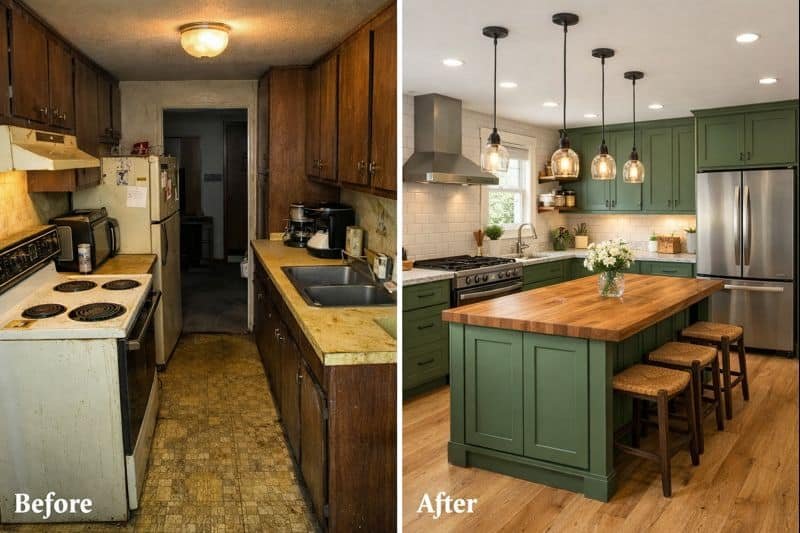
Many Pike County homeowners explore opening the galley to adjacent spaces by removing the wall between kitchen and dining room. This transformation requires careful structural evaluation since some of these walls carry roof loads or second-floor framing. In single-story ranch homes, the wall between kitchen and dining area is frequently non-load-bearing, making removal straightforward with proper permitting. However, in two-story colonials or homes with complex roof structures, a structural engineer’s analysis may reveal that a load-bearing beam replacement is necessary—adding significant cost to the project.
Electrical System Limitations
Perhaps the most critical invisible challenge in Waverly’s older homes is inadequate electrical capacity. Homes built before 1970 typically have 100-amp service panels, and kitchens often operate on a single 15-amp circuit shared with dining room outlets and lighting.
Modern kitchen electrical demands include refrigerator (10-15 amps), microwave (10-12 amps), dishwasher (10-12 amps), garbage disposal (5-8 amps), and countertop small appliances. When you consider that homeowners now routinely use air fryers (12-15 amps), electric kettles, toasters, and coffee makers simultaneously, the math becomes obvious—a single 15-amp circuit cannot handle this load.
Current National Electrical Code (NEC) requirements mandate that kitchens have at minimum two 20-amp small appliance circuits dedicated to countertop receptacles, plus separate circuits for refrigerator, dishwasher, disposal, and microwave. Many older Waverly homes require complete kitchen circuit rewiring to meet modern code, and some need service panel upgrades to 200 amps to support the increased capacity.
Plumbing Considerations in Older Homes
Pike County homes built before 1970 often feature galvanized steel supply lines that have corroded internally over decades, restricting water flow. If your kitchen faucet pressure is noticeably weaker than bathroom fixtures, internal pipe corrosion is likely the culprit.
A comprehensive kitchen remodel provides the opportunity to replace these lines with modern PEX (cross-linked polyethylene) or copper supply lines. PEX has become the standard in Southern Ohio remodeling because it’s flexible, doesn’t corrode, and handles freeze-thaw cycles better than rigid copper—important for homes where kitchen exterior walls may see winter temperature drops if insulation is inadequate.
Drain line considerations are equally important. Many older homes have cast iron drain stacks that have rusted through at the joints. If your kitchen remodel involves relocating the sink—moving it to an island, for example, or repositioning it under a window—drain line routing becomes a major consideration. In single-story homes with basement access, this is relatively straightforward. In homes on crawl spaces or slab foundations, routing new drain lines may require jackhammering concrete or extensive crawl space excavation.
Foundation and Structural Considerations
Waverly’s mix of basement, crawl space, and slab-on-grade foundations affects remodeling approaches differently. Homes with full basements offer easy access for running new electrical, plumbing, and HVAC—contractors can work underneath without disrupting the main floor until connection points. Crawl space homes require significantly more main-floor demolition to access joists and wall cavities, and slab homes present the most challenging infrastructure changes since utilities are often cast into the concrete.
The region’s clay soil composition also creates unique challenges. Pike County sits on heavy clay that expands when wet and contracts when dry, causing seasonal foundation movement. Older homes often show evidence of this movement—cracks in plaster, sticking doors, or sloping floors. Before investing in premium kitchen finishes, it’s wise to address any active foundation settlement issues, as continuing movement will crack tile floors, misalign cabinet doors, and stress countertop seams.
Planning Your Kitchen Remodel
Defining Your Goals and Priorities
Successful kitchen remodeling starts with honest assessment of how you actually use the space. Different households have different priorities, and Southern Ohio’s value-conscious market demands clear thinking about return on investment.
For families with children, durability and safety typically top the list. This means prioritizing surfaces that resist scratches and stains—quartz countertops over marble, luxury vinyl plank flooring over hardwood—and creating open sightlines so parents can monitor young children while cooking. Storage solutions that keep dangerous items (knives, chemicals) secured but keep everyday items accessible become important design elements.
For empty nesters and retirees, aging-in-place considerations often drive decisions. This includes installing pull-out shelving that eliminates bending and reaching into deep base cabinets, positioning the microwave at counter height instead of over the range, and ensuring adequate task lighting to compensate for age-related vision changes. Universal design principles—which make spaces usable for people of all ages and abilities—often provide the best long-term value in the Pike County market.
For households focused on resale value, understanding Waverly’s market becomes critical. Over-improving relative to neighborhood comps rarely returns full investment. A $75,000 luxury kitchen in a $150,000 neighborhood will appeal to very few buyers and likely won’t recoup costs at sale. Conversely, a thoughtfully updated kitchen with quality but not luxury finishes—granite or quartz counters, plywood-box cabinets with soft-close hardware, stainless or black stainless appliances—typically returns 60-80% of investment in Pike County’s market.
Understanding the Work Triangle and Kitchen Zones
The work triangle concept—positioning sink, range, and refrigerator to form a triangle with each leg measuring 4-9 feet—remains valid for kitchen layout planning, though it’s been refined over decades since its 1940s introduction.
In modern kitchen planning, designers think in terms of activity zones: preparation zone (sink area with adjacent counter space for cutting and assembly), cooking zone (range with landing space for hot pots), cleanup zone (sink and dishwasher), and storage zone (refrigerator and pantry). Effective layouts ensure these zones don’t create traffic conflicts and each has adequate workspace.
For Waverly’s typical galley kitchens, the work triangle often becomes a straight line along one wall, which is functionally inefficient. Opening the kitchen to create an L-shaped or U-shaped layout dramatically improves workflow. If structural limitations prevent wall removal, thoughtful appliance repositioning can still improve the workspace—moving the refrigerator to the end of the galley rather than the middle, for example, eliminates the traffic disruption of someone accessing it while another person cooks.
Accessibility and Universal Design
Southern Ohio’s aging population makes universal design principles increasingly relevant for kitchen remodeling. These design strategies make spaces more usable for everyone regardless of age or physical ability, and they often improve functionality even for able-bodied users.
Key universal design elements for kitchens include:
Counter height variation: Standard counter height is 36 inches, but incorporating a 30-34 inch section provides a comfortable work surface for seated users and shorter individuals, while also creating an ideal baking station (lower height makes kneading and rolling dough easier).
Pull-out shelving: Replacing standard lower cabinet shelves with deep pull-out drawers eliminates bending and reaching into dark cabinet depths. This modification benefits everyone—from elderly users with limited mobility to busy parents who need to quickly locate stored items.
D-shaped cabinet hardware: Replacing round knobs with D-shaped or loop pulls makes cabinets easier to open for users with arthritis, limited hand strength, or anyone carrying items in both hands.
Single-lever faucets: These are easier to operate than separate hot/cold handles, and many modern versions include pull-down sprayers that extend reach—helpful for both accessible design and everyday functionality.
Contrasting color schemes: Using darker countertops against lighter cabinets or vice versa creates visual contrast that helps users with vision impairments distinguish work surfaces, and simply makes the space easier to navigate for everyone.
Adequate lighting: Layered lighting with ambient ceiling fixtures, under-cabinet task lights, and accent lighting over key work zones prevents shadows and eye strain while making the kitchen safer for users of all ages.
Kitchen Layouts for Pike County Homes
Galley to L-Shaped Conversion
The most common transformation in Waverly’s ranch-style homes involves converting closed galley kitchens to open L-shaped layouts by removing the wall between kitchen and dining room. This creates a continuous space where the kitchen occupies one wall and wraps around a corner, with the dining area flowing naturally from the open end.
Structural considerations for this conversion require professional evaluation. In single-story ranch homes, the wall between kitchen and dining room often runs parallel to ceiling joists and carries no structural load—making removal straightforward after permits are obtained. However, if the wall runs perpendicular to joists, it may be load-bearing, requiring a properly sized beam installation to carry the roof load. A structural engineer can calculate the required beam size based on span distance and loads.
The functional advantage of L-shaped layouts is the natural work triangle they create. Sink, range, and refrigerator can be positioned along two walls forming an L, with the corner between them serving as the primary work zone. This configuration allows two people to work simultaneously without interfering with each other and creates natural traffic flow around the work area rather than through it.
Adding Kitchen Islands
Kitchen islands are highly desired in modern design, but spatial constraints in many Waverly homes make them impractical. Building codes require minimum 36-inch clearances around islands, and 42-48 inches is preferred for comfortable traffic flow. In a typical 10×14 foot kitchen, a true island rarely fits these requirements.
Peninsula configurations offer a practical alternative. A peninsula extends from the existing counter at a right angle, creating additional workspace and storage without encroaching as far into the room. This approach works particularly well when opening a galley kitchen to the dining area—the peninsula can define the boundary between kitchen workspace and dining space while maintaining the open feel.
For kitchens where even a peninsula doesn’t fit, mobile kitchen carts provide flexible additional workspace. Quality kitchen carts with butcher block or granite tops can be moved out of the way when not needed but rolled into position when extra prep space is required.
U-Shaped Layouts
For homes with kitchen dimensions of 10×12 feet or larger, U-shaped layouts provide maximum storage and counter space by utilizing three walls. This configuration is particularly effective for serious home cooks who need extensive workspace and prefer enclosed kitchens where they can focus on food preparation.
The challenge with U-shaped layouts in smaller kitchens is the corner cabinet problem. Two corner cabinets are created in this configuration, and standard square corners waste significant storage space—the deep back corners are nearly impossible to access. Lazy Susans, blind corner pull-outs, and magic corner mechanisms solve this problem but add cost. Budget-conscious remodels might leave corner base cabinets out entirely, creating a diagonal counter that’s easier to access but sacrifices some storage.
One-Wall Kitchens
In studio-style apartments or very small homes, one-wall kitchens place all appliances and cabinetry along a single wall. While this is the most space-efficient layout, it’s also the least functional for serious cooking since it eliminates any work triangle—everything is in a line.
Optimizing one-wall layouts requires careful appliance sequencing. The most effective arrangement places the refrigerator on one end, the sink in the center, and the range on the opposite end. This creates maximum counter space between the three main work points and prevents the heat from the range from affecting refrigerator efficiency.
Materials and Finishes Guide
Countertop Options for Southern Ohio Conditions
Quartz engineered stone has become the dominant choice in Pike County kitchen remodels over the past decade, and for good reason. Unlike natural stone, quartz is non-porous and never requires sealing, making it truly zero-maintenance. Southern Ohio’s humid conditions don’t affect quartz, and it resists staining from acidic foods like tomato sauce and wine that can etch marble or limestone.
Quality quartz countertops typically cost $60-$100 per square foot installed in the Waverly market, with premium designer colors reaching $100-$140 per square foot. For a standard 10×12 kitchen with 30 square feet of counter space, expect to invest $1,800-$3,000 for quartz countertops including fabrication and installation.
Granite natural stone remains popular for its unique patterns—no two slabs are identical. However, granite requires periodic sealing (typically annually) to prevent staining, and Southern Ohio’s hard water can leave mineral deposits if spills aren’t wiped promptly. Granite pricing parallels quartz at $55-$90 per square foot for standard colors, with exotic stones reaching $120-$200 per square foot.
Laminate countertops have evolved dramatically from the particle-board-core products of decades past. Modern high-definition laminates feature realistic stone and wood patterns and improved edge options that mimic solid surface materials. While they lack the prestige of stone, quality laminates cost $25-$45 per square foot installed and offer excellent durability for budget-conscious remodels.
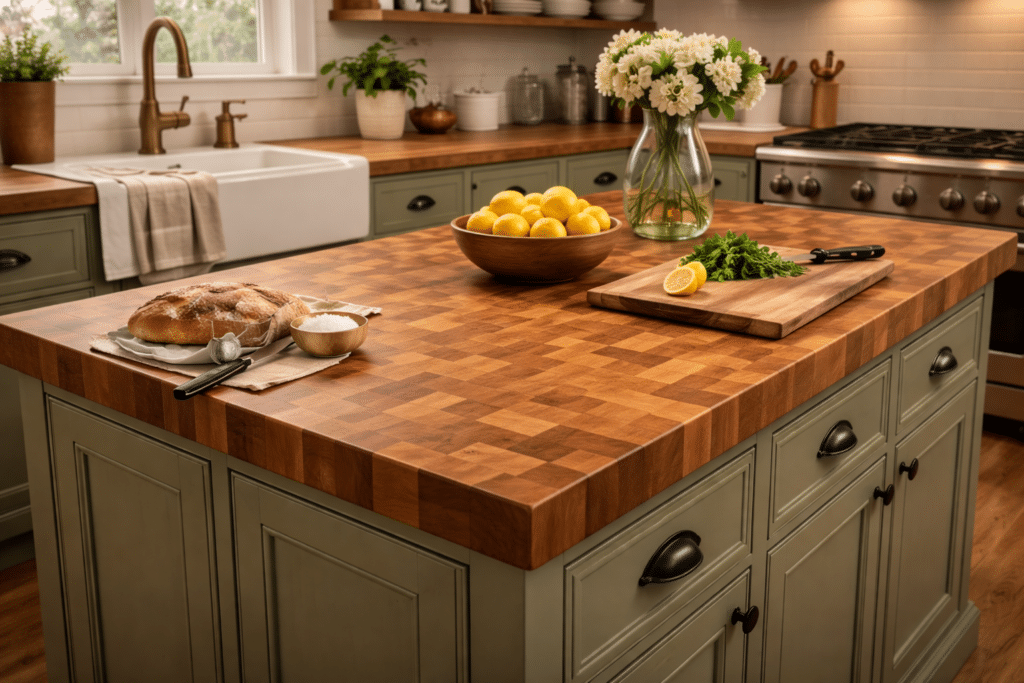
Butcher block wood counters create warmth in traditional farmhouse kitchens, but they require significant maintenance in humid climates. The wood must be oiled monthly to prevent drying and cracking, and standing water will damage the surface. Most designers recommend butcher block only for specific zones—perhaps an island top—rather than primary counter surfaces in Pike County kitchens.
Countertop Care and Maintenance Products
Protecting your countertop investment requires appropriate maintenance, especially in Southern Ohio’s humid conditions. These products help preserve stone and wood surfaces:
Granite Gold Sealer – For granite countertops (and marble or limestone if you’ve chosen those), annual sealing prevents staining from acidic foods and liquids. This water-based sealer dries clear without changing the stone’s appearance and provides protection for 12-18 months in typical kitchen use. Application is straightforward—spray on, spread with included applicator, let sit 15 minutes, buff off excess. The 24-ounce bottle covers approximately 150 square feet, enough for 3-4 applications in an average Waverly kitchen.
Method Daily Granite Cleaner – This pH-neutral cleaner safely removes grease and food residue from granite, quartz, and marble without damaging the stone or stripping sealers. The plant-based formula doesn’t leave streaks, and the spray bottle design makes daily cleaning quick. Unlike harsh all-purpose cleaners that can etch stone or degrade sealers over time, this formula maintains surface integrity.
Howard Butcher Block Conditioner – For wood countertops or butcher block islands, this food-safe mineral oil and wax blend prevents drying and cracking while creating a water-resistant barrier. Southern Ohio’s humidity causes wood to expand in summer and contract in winter, and regular conditioning (monthly for the first year, quarterly thereafter) minimizes this movement.
Bar Keepers Friend Soft Cleanser – This oxalic acid-based cleaner removes hard water stains, rust marks, and stubborn buildup from stainless steel sinks and fixtures—common problems with Pike County’s mineral-rich water. Unlike abrasive powders that can scratch surfaces, the soft cleanser formula works gently while delivering professional cleaning results. Use weekly or as needed to prevent mineral buildup.
Cabinet Construction and Quality Markers
Cabinet selection represents the single largest cost component in most kitchen remodels, typically consuming 30-40% of the total budget. Understanding construction quality helps homeowners make informed decisions.
Box construction determines longevity. Premium cabinets feature plywood boxes with dovetail joinery—plywood is dimensionally stable and moisture-resistant, while dovetail joints won’t separate over time. Mid-grade cabinets use furniture-grade plywood (¾-inch thick for sidewalls) with dado joints—not as robust as dovetails but adequate for most applications. Budget cabinets employ particle board boxes, which sag over time and delaminate if exposed to moisture from leaks.
For Southern Ohio’s humidity conditions, plywood construction is strongly recommended even if it means choosing simpler door styles to fit the budget. Particle board cabinets show their age within 10-15 years, while quality plywood boxes can last 30+ years with simple door and hardware updates.
Door construction and styles range from simple slab (flat panel) through shaker (recessed panel with frame) to ornate raised panel and cathedral styles. Full-overlay doors—where doors cover the entire cabinet frame—create a more modern, seamless look. Partial overlay or inset doors (where doors sit within the frame) are traditional styles more common in period homes.
Hardware quality dramatically affects daily user experience. Soft-close hinges—which slow the door in the final inches to prevent slamming—cost $3-6 per hinge versus $1-2 for standard hinges, but the improved durability and reduced noise are worth the investment. Similarly, soft-close drawer glides cost $15-$30 per drawer versus $5-10 for basic glides, but they prevent the crash-bang that damages drawer boxes over time.
Recommended Cabinet Hardware for Pike County Kitchens
Based on performance in Southern Ohio’s humid conditions, these hardware options deliver excellent durability and value:
Liberty Hardware D-Shaped Cabinet Pulls – These commercial-grade pulls feature solid zinc construction with multiple finish options that resist tarnishing in humid environments. The D-shape design makes them easier to grip than round knobs, benefiting users with arthritis or limited hand strength. Available in 3-inch, 4-inch, and 5-inch center-to-center spacing to fit most cabinet door configurations. Our network professionals install these in 60% of their kitchen remodels because the quality-to-price ratio is exceptional.
Blum Soft-Close Cabinet Hinges – The Blumotion system provides hydraulic soft-close action that works reliably even after years of use. These European-style hinges are the professional standard throughout Pike County because they handle the wood expansion and contraction from humidity changes without binding or failing. The 110-degree opening angle provides excellent access to cabinet interiors.
Undermount Soft-Close Drawer Slides – Full-extension undermount slides allow drawers to open completely, providing access to the entire drawer depth—critical for maximizing storage in Pike County’s smaller kitchens. The soft-close mechanism prevents slamming that can break drawer joints over time. Look for 100-pound weight capacity or higher, especially for heavy cookware and small appliance storage.
Pull-Out Cabinet Organizers – These retrofit organizers convert standard lower cabinets into accessible pull-out storage, eliminating the need to reach into dark cabinet depths. Models with chrome wire construction resist rust in humid conditions better than coated steel. The two-tier designs work particularly well for storing pots and pans, while single-tier versions accommodate small appliances. Installation is straightforward for homeowners with basic tools—drill, screwdriver, and measuring tape.
Flooring for Kitchen Durability
Luxury vinyl plank (LVP) has rapidly gained market share in Southern Ohio kitchen remodels due to its combination of durability, waterproofing, and comfort underfoot. Modern LVP features realistic wood grain textures, scratch-resistant wear layers, and completely waterproof construction—ideal for the kitchen environment where spills are inevitable.
Quality LVP products cost $3-$6 per square foot for materials plus $2-$4 per square foot for professional installation, though many homeowners successfully install floating-floor LVP themselves. For a 150-square-foot kitchen, budget $750-$1,500 for LVP flooring fully installed.
Engineered hardwood offers authentic wood appearance with better dimensional stability than solid hardwood. The construction—a thin hardwood veneer over plywood core—resists expansion and contraction from humidity changes. However, engineered hardwood isn’t waterproof, so standing water from appliance leaks or spills must be cleaned promptly. Expect to pay $6-$12 per square foot installed for quality engineered hardwood.
Ceramic or porcelain tile provides excellent durability and unlimited design options, but the grout lines require periodic maintenance—sealing annually and eventual regrouting as grout deteriorates. Large-format tiles (12×24 inches or larger) minimize grout lines while creating a more contemporary aesthetic. Tile costs vary widely from $3-$15 per square foot for materials plus $5-$10 per square foot for skilled installation.
Solid hardwood is generally not recommended for kitchens in Southern Ohio due to the moisture exposure. Even with polyurethane finish, hardwood can cup or crown from the humidity cycles, and water damage from leaks is difficult to repair without full board replacement.
Backsplash Materials and Design
Backsplashes serve both functional and aesthetic purposes—protecting walls from water and cooking splatter while adding visual interest to the kitchen. The space between countertop and upper cabinets typically measures 18 inches, providing a canvas for design expression.
Ceramic or porcelain tile remains the most popular backsplash choice, offering durability and easy cleaning at reasonable cost. Subway tile (3×6 inch rectangles) has become almost universal, though larger format tiles, mosaics, and decorative patterns provide alternatives. Tile backsplashes cost $8-$25 per square foot installed depending on tile complexity and layout.
Natural stone slabs create seamless backsplashes by continuing the countertop material up the wall. This approach works particularly well behind the range where a single 30-inch-wide stone slab makes a striking focal point. However, full-height stone backsplashes are expensive—essentially doubling the countertop cost for those areas.
Sheet materials like beadboard or shiplap create cottage or farmhouse aesthetics popular in rural Pike County. These materials must be sealed against moisture with polyurethane or specialized cabinet-grade finishes, and the seams require caulking to prevent water intrusion behind the material.
Under-Cabinet Lighting Solutions
Proper task lighting eliminates shadows on countertops and reduces eye strain during food preparation. These lighting systems work particularly well in Pike County kitchens:
LE LED Under Cabinet Lighting Bars – These hardwired LED strips provide 1,100 lumens per 12-inch bar—bright enough for detailed prep work without being harsh. The 3000K warm white color temperature creates an inviting atmosphere while still providing clear visibility. The aluminum housing dissipates heat effectively, important in enclosed cabinets where heat buildup can shorten LED lifespan. These units wire directly into the electrical system during remodeling for a clean, cord-free appearance.
BAZZ LED Puck Lights – For cabinets with unusual layouts or glass-front uppers where linear strips would be visible, puck lights provide focused downward illumination. These low-profile fixtures (1 inch thick) mount easily with screws or adhesive, and the 120-volt versions hardwire for permanent installation. The directional beam angle highlights specific work areas without wasting light.
Philips Hue Lightstrip Plus – For tech-forward households, these smart LED strips integrate with home automation systems and offer color-changing capabilities beyond simple white light. The ability to adjust color temperature throughout the day—brighter and cooler for morning prep, warmer for evening ambiance—adds functionality beyond standard under-cabinet lights. The system requires the Philips Hue Bridge hub, and the initial investment is higher, but the flexibility appeals to homeowners planning to age in place who may need different lighting levels over time.
Litcessory Plug-In Under Cabinet Lighting Kit – For homeowners not planning full electrical remodeling, these plug-in LED bars provide professional-quality task lighting without hardwiring. The linkable design allows multiple bars to connect together from a single outlet, and the included remote control adjusts brightness levels. While the visible power cord isn’t as clean as hardwired options, strategic routing along cabinet edges minimizes visibility.
Don’t get ripped off. See real pricing for bathrooms, kitchens, and HVAC.
Updated for 2026 Market Rates
Electrical and Plumbing Upgrades
Modern Electrical Requirements
The National Electrical Code (NEC) Article 210.52 specifies kitchen electrical requirements that differ substantially from what exists in pre-1970 Waverly homes. Understanding these requirements helps homeowners plan realistic budgets for electrical upgrades.
Small appliance circuits: At least two 20-amp circuits must serve countertop receptacles, and these circuits cannot serve lighting or other rooms. Receptacles must be positioned so no point along the counter is more than 24 inches from an outlet—meaning 4-foot spacing along standard counters.
Individual appliance circuits: Refrigerators, dishwashers, garbage disposals, and microwaves each require dedicated circuits. While not all must be 20-amp (refrigerators can operate on 15-amp circuits), best practice is using 20-amp throughout for future flexibility.
Lighting circuits: Kitchen lighting is served by separate 15 or 20-amp circuits not shared with receptacles, allowing lights to function even if an appliance overload trips the receptacle circuit.
GFCI protection: All countertop receptacles must have ground-fault circuit interrupter protection, either through GFCI receptacles or GFCI circuit breakers. This safety feature prevents electrocution by detecting current leakage and cutting power within milliseconds.
For many Waverly homes, bringing the kitchen to current code requires running 6-8 new circuits from the service panel. In homes where the existing panel has spare breaker spaces, this is straightforward though labor-intensive. In homes with full panels, a sub-panel installation or complete service upgrade to 200 amps may be necessary, adding $1,500-$4,000 to project costs.
Plumbing System Upgrades
Supply line replacement should be considered whenever walls are opened during kitchen remodeling. Galvanized steel pipes—common in pre-1970 construction—corrode internally, restricting water flow. Modern alternatives include copper (the traditional standard), PEX (increasingly popular for flexibility and freeze resistance), and CPVC (chlorinated polyvinyl chloride, acceptable but less flexible than PEX).
PEX has emerged as the preferred choice in Southern Ohio due to its combination of durability, cost-effectiveness, and installation efficiency. The flexible tubing routes easily through wall cavities and floor joists without requiring numerous fittings, and it won’t burst if frozen—relevant for kitchens on exterior walls with marginal insulation. PEX costs approximately $0.50-$1.00 per linear foot versus $2-$4 for copper, and installation is faster.
Drain line considerations become critical if the sink location is changing. The kitchen sink drain must slope 1/4 inch per foot to function properly, and the drain line must connect to the existing waste stack or floor drain. Moving a sink from a wall location to an island requires routing a drain line under the floor—straightforward in homes with basements but challenging in slab-on-grade foundations where trenching through concrete may be necessary.
Hire the Right Contractor the First Time
Use our free research guide and intelligence report to vet any contractor before you sign a contract.
Vent requirements often surprise homeowners. Every drain must be properly vented to prevent slow drainage and gurgling sounds. The kitchen sink drain connects to a vent pipe that rises through the roof, allowing air into the drain system as water exits. If remodeling moves the sink away from the existing vent location, a new vent must be installed or an air admittance valve (AAV) may be permitted—a mechanical device that allows air into the drain without a traditional through-roof vent pipe.
Best Kitchen Faucets for Pike County Hard Water
Southern Ohio’s well water and municipal supply both contain elevated mineral content that causes calcium buildup on fixtures. These faucets resist hard water damage while providing the functionality Pike County homeowners need:
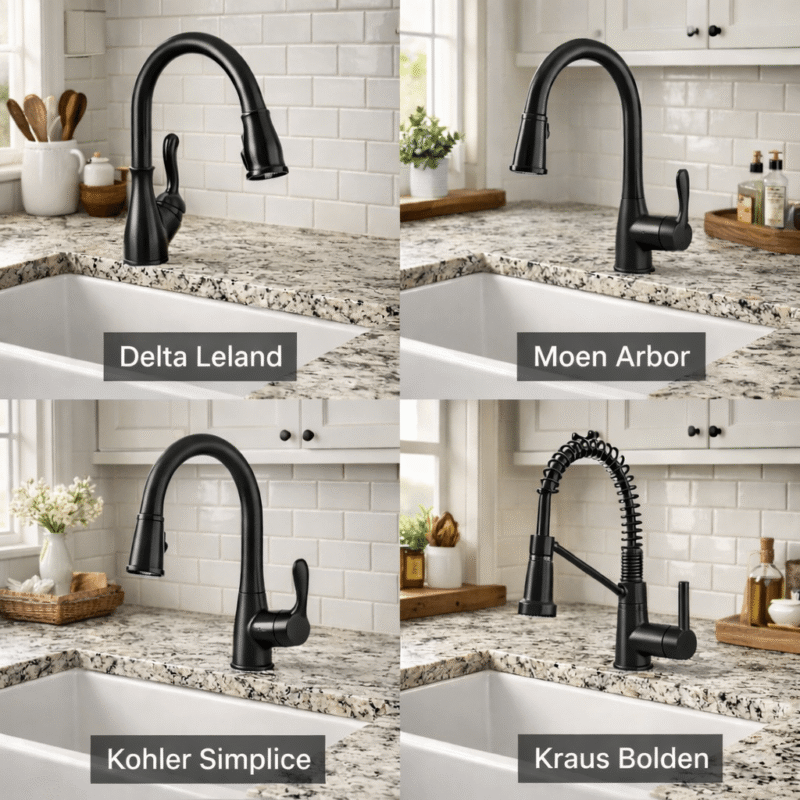
Moen Arbor Motionsense Kitchen Faucet – The touchless activation prevents spreading germs while cooking, and the spot-resistant stainless steel finish hides water spots from hard water. The power clean spray technology provides 50% more spray power than standard pull-down faucets, making it easier to clean stuck-on food. Our network professionals install this model frequently because the Moen lifetime warranty covers both parts and finish—important when hard water can accelerate wear. The high-arc spout provides clearance for large pots, and the single-handle design works well for universal accessibility.
Delta Leland Pull-Down Kitchen Faucet – Delta’s ShieldSpray technology combines a powerful blade of water for tough messes with a powerful spray rinse. The Touch2O technology allows you to start and stop water flow with a simple touch anywhere on the spout or handle—convenient when hands are full or messy. The diamond seal technology reduces leak points by 50% compared to standard faucets, and the Spot Shield stainless finish actively resists water spots and fingerprints. This is the faucet most recommended for Pike County homes on well water because the finish truly performs.
Kraus Bolden Commercial-Style Kitchen Faucet – For homeowners who want professional-grade performance at mid-range pricing, the Bolden delivers. The pre-rinse spring design provides flexibility and reach, while the dual-function spray head toggles between stream and powerful spray. The solid brass construction handles hard water better than chrome-plated zinc models, and the ceramic cartridge resists mineral buildup. Note that the industrial aesthetic won’t suit traditional farmhouse kitchens, but it’s perfect for contemporary or transitional designs.
Kohler Simplice Pull-Down Kitchen Faucet – Kohler’s DockNetik magnetic docking system ensures the spray head retracts securely after use—solving the common problem of spray heads that hang loose over time. The high-arch swing spout rotates 360 degrees, and the three-function spray head provides sweep spray, boosted stream, and regular stream patterns. The MasterClean spray face resists mineral buildup, making it ideal for Pike County water conditions. Available in multiple finishes including matte black and vibrant stainless.
HVAC and Climate Control
Kitchen remodeling often affects heating, cooling, and ventilation systems. Removing walls can eliminate ductwork paths, requiring rerouting. Opening formerly closed kitchens to adjacent spaces may improve airflow—or create cold spots if the HVAC system wasn’t sized for the larger open area.
Range hood venting deserves particular attention. Building codes require mechanical ventilation for cooking appliances, either ducted to the exterior or recirculating through filters. Ducted hoods—which exhaust cooking fumes outside—are significantly more effective than recirculating models but require exterior wall or roof penetrations.
For effective ventilation, range hoods should provide 100 CFM (cubic feet per minute) for every 10,000 BTU of gas burner output, or 100 CFM per linear foot of cooking surface for electric ranges. A 30-inch gas range typically needs 400-600 CFM ventilation, requiring a substantial hood and proper ductwork—not the 250 CFM models often sold at big-box stores.
Permits and Building Codes
Pike County Building Department Requirements
Kitchen remodeling projects in Pike County require permit applications and inspections for any work involving structural changes, electrical systems, plumbing, or mechanical systems. Cosmetic updates like painting, cabinet refacing, and countertop replacement typically don’t require permits, but the line can be unclear.
Within Waverly city limits, the City of Waverly Building Department oversees permits and inspections. Their office operates from the municipal building, and fees are based on project valuation—typically 1-2% of the total project cost with minimum fees of $50-$100. Processing time for straightforward remodels is usually 5-10 business days after a complete application is submitted.
Outside city limits in unincorporated Pike County, the Pike County Building Department handles permitting. Their requirements parallel the city’s but may have slightly different fee structures and inspection scheduling. Rural properties on well and septic systems may require additional approvals if plumbing changes affect the septic system—for example, adding a dishwasher increases wastewater volume.
Structural Work Permits
Any project involving removal or modification of walls requires a structural permit. This includes the common galley-to-open-layout conversion where walls are removed between kitchen and dining areas. The permit application requires drawings showing existing and proposed conditions, with load-bearing walls clearly identified.
For load-bearing wall removal, a structural engineer’s stamp may be required on the plans, certifying that the proposed beam and support system will safely carry the loads. Engineers in Southern Ohio typically charge $500-$1,500 for residential kitchen remodel evaluations and stamped drawings.
Electrical Permits and Inspections
Electrical permits are required for any kitchen remodeling that involves adding new circuits, moving outlets, or upgrading the service panel. The work must be performed by a licensed electrician in accordance with the National Electrical Code as adopted by Ohio (typically the most recent edition minus one cycle).
Inspection occurs at the rough-in stage—after new wiring is installed but before walls are closed—and again at final when fixtures and devices are installed. The inspector verifies proper circuit sizing, correct use of approved materials, adequate grounding, proper GFCI protection, and compliance with receptacle spacing requirements.
Plumbing Permits and Inspections
Plumbing permits cover supply lines, drain lines, and fixture installations that involve changes to the system. Replacing a sink in the same location typically doesn’t require a permit, but moving the sink does. Adding a dishwasher or installing an ice maker line for the refrigerator requires permits in most jurisdictions.
Like electrical work, plumbing is inspected at rough-in and final stages. The rough-in inspection occurs after supply and drain lines are installed but before walls close, verifying proper materials, correct drain slopes, adequate venting, and proper sizing of pipes for the fixtures they serve.
Working Without Permits
Some homeowners and contractors attempt to avoid the permit process to save fees and inspection time. This is inadvisable for several reasons beyond the legal issues.
Home sale complications: If unpermitted work is discovered during a home sale, it can derail the transaction. Lenders often won’t approve mortgages on homes with unpermitted work, and sellers may be forced to bring the work to code at their own expense or reduce the sale price substantially.
Insurance claim denials: If a fire or water damage originates from unpermitted electrical or plumbing work, insurance companies may deny the claim, leaving homeowners financially responsible for all damages.
Code compliance: Without inspections, there’s no verification that work meets minimum safety standards. DIY electrical work or unlicensed “handyman” electrical work frequently contains dangerous errors that create fire and shock hazards.
Cost Factors and Budget Planning
Understanding Kitchen Remodel Cost Ranges in Waverly
Kitchen remodeling costs in Pike County vary dramatically based on scope, materials, and structural complexity. Understanding the general cost tiers helps homeowners set realistic budgets and make informed trade-off decisions.
Cosmetic refresh ($8,000-$15,000): This level includes painting or refacing cabinets, new countertops (laminate or basic granite/quartz), updated backsplash, new sink and faucet, and new lighting fixtures. The existing layout remains unchanged, and no structural or major mechanical work occurs. This approach works well when cabinet boxes are solid and the layout is functional but finishes are dated.
Standard remodel ($15,000-$35,000): This tier includes new mid-grade cabinets (plywood construction with soft-close hardware), quartz or granite countertops, updated flooring (LVP or tile), new appliances (standard efficiency, stainless steel finish), new backsplash, and new lighting. Some minor layout changes may occur—moving an appliance, adding a peninsula—but walls remain in place. Electrical upgrades to current code are included.
Full renovation ($35,000-$65,000): This level involves significant layout changes including wall removal to open the kitchen, structural beam installation if needed, premium cabinets with custom organization features, stone countertops with more complex edge profiles, higher-end appliances, complete electrical system upgrade potentially including service panel replacement, new flooring throughout adjacent spaces, and upgraded lighting with dedicated design.
Luxury remodel ($65,000+): Custom cabinetry, professional-grade appliances, exotic stone countertops, designer plumbing fixtures, extensive structural modifications, complete home HVAC rebalancing, and other high-end finishes characterize this tier. This level is uncommon in Waverly given the regional real estate market, as it’s difficult to recoup the investment.
Cabinet Costs as Budget Driver
Cabinets typically represent 30-40% of total kitchen remodel budgets, making them the single most significant cost driver. Understanding the pricing tiers helps optimize spending.
Stock cabinets ($100-$250 per linear foot): These are pre-manufactured in standard sizes and available immediately from home improvement stores. Box construction is typically particle board with laminate or simple veneer finishes. Hardware is basic. Best suited for budget-conscious remodels where longevity isn’t the primary concern.
Semi-custom cabinets ($200-$500 per linear foot): These offer more door styles, finish options, and custom sizing while maintaining factory efficiency. Box construction ranges from particle board to plywood depending on brand. This is the most popular tier in Waverly remodels, balancing quality and cost.
Custom cabinets ($500-$1,200+ per linear foot): These are built to exact specifications by local or regional cabinet shops. Quality is highest with plywood or solid wood construction, unlimited design options, and superior hardware. Delivery times are longer (8-12 weeks typically). Best for homes where kitchen cabinetry is a defining architectural feature.
A typical Waverly kitchen with 20 linear feet of cabinets would cost $2,000-$5,000 for stock, $4,000-$10,000 for semi-custom, or $10,000-$24,000+ for custom cabinets including installation.
Appliance Selection and Budget Impact
Appliance packages—refrigerator, range/cooktop and oven, dishwasher, and microwave in matching finishes—represent significant budget allocation. Understanding the tier differences helps balance quality and cost.
Builder-grade appliances ($2,500-$4,000 for full suite): Basic models with standard features and efficiency ratings. Typically white or black finishes with manual controls. Adequate for light cooking households but limited features and shorter lifespans (10-12 years average).
Mid-range appliances ($4,000-$7,000 for full suite): Stainless steel or black stainless finishes with improved energy efficiency and features like convection ovens, adjustable refrigerator shelving, and quiet dishwashers. This tier offers the best value for most Waverly households—solid features without luxury premiums.
Premium appliances ($7,000-$15,000+ for full suite): Professional-style ranges with high BTU burners, counter-depth refrigerators for seamless integration, ultra-quiet dishwashers with three racks, and extensive smart home connectivity. Best suited for serious home cooks or households where kitchen appliances are status symbols.
Labor Costs in Southern Ohio
Labor typically represents 40-50% of total project costs in kitchen remodeling, varying by trade and complexity. Understanding typical labor rates helps evaluate contractor proposals.
General contractors in Pike County charge $50-$85 per hour for their time (oversight, project management, some direct labor). They coordinate subcontractors, obtain permits, order materials, and ensure work progresses on schedule.
Specialized trades charge: Electricians $75-$120 per hour, licensed plumbers $80-$125 per hour, cabinet installers $60-$90 per hour, tile setters $50-$80 per hour, and painters $40-$65 per hour. These rates include overhead, insurance, and profit but not materials.
For a $35,000 kitchen remodel in Waverly, expect approximately $18,000 in materials and $17,000 in labor, though this varies by specific work scope.
Hidden Costs and Contingencies
Kitchen remodeling frequently encounters unexpected issues once walls and floors are opened, making contingency budgets essential. Financial advisors recommend setting aside 15-20% of the project budget for contingencies.
Common hidden costs include:
Structural surprises: Rot from old leaks, termite damage, or undersized floor joists requiring reinforcement add $1,500-$5,000+ to budgets.
Outdated plumbing/electrical: Aluminum wiring requiring replacement, old cast iron drains needing rework, or inadequate service panels needing upgrades can add $2,000-$6,000.
Asbestos or lead: Homes built before 1980 may contain asbestos in flooring or lead paint, requiring specialized abatement adding $1,500-$4,000.
Material lead times: Supply chain disruptions can cause backordered materials, extending timelines and potentially increasing labor costs if contractors must demobilize and return.
Timeline and Project Management
Typical Kitchen Remodel Timeline
A standard kitchen remodel in Waverly takes 6-12 weeks from demolition to substantial completion, not including the planning and permitting phases that precede construction. Understanding the typical sequence helps homeowners prepare.
Pre-construction planning (4-8 weeks): Design development, material selection, obtaining contractor proposals, and finalizing decisions occur during this phase. Homeowners who change their minds frequently or struggle with decisions extend this timeline significantly.
Permitting (2-4 weeks): After final plans are drawn, permit applications are submitted to Pike County or the City of Waverly. Processing time varies by completeness of application and department workload. Plan review may require revisions, extending this phase.
Demolition (2-5 days): Removal of cabinets, countertops, flooring, and sometimes walls occurs quickly but creates substantial dust and debris. Proper containment with plastic barriers and negative air machines is essential to prevent dust migration through the house.
Structural work (3-10 days): If walls are being removed, beam installation occurs during this phase. Structural work must be completed and inspected before proceeding to mechanical rough-ins.
Mechanical rough-ins (5-10 days): New electrical circuits, plumbing lines, and HVAC modifications are installed. This work occurs before walls are closed and requires inspections before proceeding.
Drywall and finish work (7-14 days): After passing rough-in inspections, drywall is installed or repaired, taped, mudded, and sanded smooth. Painting occurs after drywall is complete.
Cabinet installation (3-7 days): Cabinets are set level and secure, then adjusted and aligned. Upper cabinets install first, followed by base cabinets.
Countertop templating and installation (7-14 days): After cabinets are installed, stone fabricators create templates, cut the stone, and install countertops. This process takes 1-2 weeks from templating to installation.
Finish work (5-10 days): Backsplash installation, plumbing fixture connection, electrical device installation, appliance installation, flooring, and final trim work occur during this phase.
Final inspections and punch list (2-5 days): Final building inspections occur, and any deficiencies are corrected. Homeowners create punch lists of minor items requiring attention.
Living Without a Kitchen
One of the most challenging aspects of kitchen remodeling is functioning without a full kitchen for 6-12 weeks. Successful families plan alternative cooking arrangements and simplify meal routines during construction.
Temporary kitchen setups in a garage, basement, or dining room should include a microwave, toaster oven or air fryer, electric kettle, small refrigerator or cooler with ice, and basic dishware and utensils. A folding table provides workspace. Paper plates and disposable utensils minimize cleanup when sink access is limited.
Meal planning strategies emphasize simple preparation: breakfast items that don’t require cooking (cereal, yogurt, granola bars), sandwiches for lunch, and microwaveable or toaster oven meals for dinner. Many families increase restaurant meals or use meal delivery services during major kitchen remodeling.
Minimizing Disruption
Kitchen remodeling inevitably disrupts household routines, but thoughtful planning minimizes impacts on daily life. Key strategies include:
Establish clear contractor hours (typically 7:00 AM to 5:00 PM weekdays) with exceptions for specific noisy work scheduled when the household is away.
Create dedicated paths for contractors to access the work area, ideally through garage or exterior door rather than through main living spaces. Protective flooring over carpets and rugs prevents damage.
Plan dust control with plastic sheeting barriers and dedicated exhaust fans venting dust outside. Even with precautions, fine dust infiltrates the house, so plan for extra cleaning during and after the project.
Secure pets and valuables before contractors arrive. With exterior doors opening frequently and unfamiliar people present, pets can escape, and valuable items should be secured in unaffected rooms.
Finding Qualified Contractors
Selecting Kitchen Remodeling Professionals
The success of any kitchen remodel depends heavily on contractor selection and project management. Pike County homeowners should approach contractor selection methodically, prioritizing experience, licensing, and references over lowest price.
General contractors coordinate all aspects of the remodel—they hire and manage subcontractors (electricians, plumbers, tile setters), obtain permits, order materials, and ensure work progresses on schedule. Most kitchen remodels are best managed by a general contractor who takes overall responsibility for quality and completion.
Licensing requirements in Ohio mandate that anyone performing electrical or HVAC work hold appropriate state licenses. Plumbing contractors must be licensed by the state for projects exceeding certain thresholds. General contractors don’t require state licensing but must carry liability insurance and workers’ compensation coverage. Always verify insurance certificates before signing contracts.
Reference checking should include visiting previous projects if possible, speaking directly with past clients about communication style and problem-solving approach, and verifying completion dates against original estimates. Contractors who complete work on schedule and communicate effectively throughout are worth premium pricing.
Evaluating Contractor Proposals
Kitchen remodel proposals vary dramatically in format and detail. Comprehensive proposals break down costs by category (demolition, rough carpentry, electrical, plumbing, cabinetry, countertops, flooring, finish work) and specify materials by brand and model where possible. This transparency allows homeowners to make informed comparisons between contractors and understand where costs concentrate.
Beware of proposals that simply list a total price without itemization. These “lump sum” proposals make it impossible to evaluate whether contractors have accurately estimated work scope or to compare proposals between different contractors.
Payment schedules should align with work progress, not front-load cash to contractors. Typical schedules include 10-15% deposit at contract signing, 25-35% upon demolition and rough-in completion, 35-45% upon substantial completion (cabinets and counters installed, mechanicals functional), and 10-15% upon final completion and inspections. Never pay 100% before work is complete.
Red Flags in Contractor Selection
Several warning signs suggest contractors to avoid:
Pressure for immediate decisions or time-limited pricing indicates contractors who prioritize closing sales over building relationships. Quality contractors understand homeowners need time for decisions.
Requiring large up-front payments (more than 20% deposit) suggests cash flow problems or contractors who abandon projects after collecting deposits.
Unwillingness to provide references or references that are vague or unenthusiastic indicates problem contractors.
No written contract or contracts lacking detailed scope of work, payment terms, warranties, and timeline expectations leave homeowners with no recourse if disputes arise.
Operating without insurance or reluctance to provide insurance certificates exposes homeowners to liability if workers are injured on the property.
Managing the Contractor Relationship
Even with excellent contractors, homeowners play active roles in successful kitchen remodels. Effective strategies include:
Weekly project meetings reviewing progress, upcoming work, and any issues that have arisen keep communication open and allow mid-course adjustments before problems become crises.
Decision timelines should be clear—if homeowners need to select backsplash tile by a certain date to avoid delaying the project, contractors should communicate this explicitly with adequate lead time.
Change orders for work outside the original scope must be documented in writing with price and timeline impacts clearly specified before work begins. Verbal change agreements lead to disputes.
Payment withholding leverage should be maintained until final completion. The 10-15% final payment provides incentive for contractors to complete punch list items promptly.
Connect With Vetted Professionals
Finding qualified kitchen remodeling contractors in the Waverly area requires research and due diligence. Our network includes experienced professionals throughout Pike County who specialize in residential kitchen remodeling and understand the unique challenges of Southern Ohio’s housing stock.
These contractors bring expertise in:
- Structural evaluation and load-bearing wall modifications common in ranch-style home conversions
- Electrical system upgrades from 100 to 200-amp service with modern code-compliant kitchen circuits
- Plumbing reconfiguration including PEX supply line installations and drain line routing
- Custom cabinetry installation and semi-custom cabinet sourcing for optimal value
- Stone fabrication relationships for quartz and granite countertop installation
- Permit coordination with Pike County and Waverly building departments
Our design team will arrange consultations with contractors who match your project scope, budget, and timeline requirements. This vetting process saves homeowners time and reduces risk by connecting them with established professionals who maintain proper licensing, insurance, and proven track records in Pike County kitchen remodeling.
Find a Pro: Connect With Kitchen Remodeling Experts
Ready to transform your Waverly kitchen? Our network includes experienced contractors and design professionals who specialize in Pike County kitchen remodeling—from galley-to-open conversions in 1950s ranch homes to complete renovations in turn-of-century farmhouses.
Get connected with qualified professionals who understand:
- Southern Ohio’s housing stock and regional construction challenges
- Current electrical code requirements and system upgrade procedures
- Permit processes for both Waverly city limits and unincorporated Pike County
- Material selections optimized for humid climate conditions
- Value engineering to maximize return on investment in the local market
Submit your project details and our team will arrange consultations with up to three pre-vetted contractors, allowing you to compare proposals and select the best fit for your kitchen remodeling project.
Frequently Asked Questions
Q: How much does it cost to remodel a kitchen in Waverly, Ohio?
A: Kitchen remodel costs in Pike County typically range from $15,000-$25,000 for a standard refresh (new cabinets, countertops, flooring, and appliances without layout changes) to $45,000-$75,000 for full renovations including structural modifications like wall removal and complete electrical/plumbing system upgrades. Cosmetic updates focusing only on countertops, backsplash, and paint can be completed for $8,000-$15,000. Cabinet selection is the single largest cost driver, representing 30-40% of total budgets. For the best accuracy, obtain itemized proposals from multiple contractors that break down costs by category (demolition, framing, electrical, plumbing, cabinets, countertops, flooring, finish work) so you can identify where investments concentrate and make informed trade-off decisions.
Q: Can I open up my galley kitchen in a 1950s ranch home?
A: Most galley kitchens in Waverly’s ranch-style homes can be opened to adjacent dining areas by removing walls, but structural evaluation is essential before demolition. In single-story ranch construction, walls between kitchen and dining room frequently run parallel to ceiling joists and are non-load-bearing, making removal straightforward after obtaining proper permits. However, if the wall runs perpendicular to joists or sits beneath a beam, it may carry roof loads and require engineered beam installation to transfer that load to adjacent walls or posts. A structural engineer can evaluate your specific home (typical cost $500-$1,500) and provide stamped drawings showing required beam size and support details. The conversion typically costs $3,000-$8,000 including engineering, permit fees, beam materials, and labor, but dramatically improves kitchen functionality by creating open sightlines and better traffic flow.
Q: Do I need permits for kitchen remodeling in Pike County?
A: Permit requirements depend on work scope and location. Within Waverly city limits, the City of Waverly Building Department oversees permitting, while unincorporated Pike County areas fall under the Pike County Building Department. Permits are required for structural changes (wall removal or modification), electrical work (new circuits, panel upgrades, or moving outlets), plumbing modifications (relocating fixtures or adding new ones), and mechanical work (HVAC changes or range hood installations). Cosmetic updates like cabinet refacing, countertop replacement, painting, and backsplash installation typically don’t require permits. Working without required permits creates serious complications—home sales can be delayed or derailed when unpermitted work is discovered, insurance claims may be denied if damage originates from unpermitted work, and bringing unpermitted work to code retroactively costs significantly more than obtaining permits upfront. Permit fees are modest (typically 1-2% of project value) and the inspection process ensures work meets minimum safety standards.
Q: What countertop material works best in Southern Ohio’s humid climate?
A: Quartz engineered stone performs best in Pike County’s humid conditions because it’s non-porous, never requires sealing, and resists moisture-related damage that affects other materials. Southern Ohio’s 70-80% summer humidity levels don’t affect quartz, and it resists staining from acidic foods like tomato sauce, wine, and citrus that can etch natural stone. Quality quartz costs $60-$100 per square foot installed for standard colors, with premium designer colors reaching $100-$140 per square foot. Granite natural stone is also durable but requires annual sealing to prevent staining, and the porous nature means spills should be wiped promptly—especially in humid conditions where moisture can penetrate deeper. Laminate countertops have improved dramatically and offer budget-friendly options ($25-$45 per square foot installed) with modern high-definition patterns that mimic stone, though they lack the prestige and longevity of actual stone. Butcher block wood counters require monthly oiling and careful maintenance in humid climates to prevent warping and are best reserved for specific zones like islands rather than primary counter surfaces.
Q: How long does a kitchen remodel take from start to finish?
A: A typical kitchen remodel in Waverly takes 6-12 weeks from demolition to substantial completion, with additional time needed for planning and permitting on the front end. The pre-construction planning phase (design development, material selection, obtaining contractor proposals) usually requires 4-8 weeks, though homeowners who make decisions quickly can compress this timeline. Permit processing through Pike County or City of Waverly takes 2-4 weeks after complete applications are submitted. The construction sequence includes demolition (2-5 days), structural work if walls are being removed (3-10 days), mechanical rough-ins for electrical and plumbing (5-10 days), drywall and painting (7-14 days), cabinet installation (3-7 days), countertop templating and installation (7-14 days from template to install), and finish work including backsplash, flooring, fixtures, and appliances (5-10 days). Projects involving significant structural changes, complete electrical system upgrades, or complex layouts trend toward the longer end of these ranges, while cosmetic updates with minimal layout changes complete faster. Material lead times can extend schedules—custom cabinets may require 8-12 weeks from order to delivery, and supply chain disruptions occasionally delay specific items.
Affiliate Disclosure: Kore Komfort Solutions participates in the Amazon Associates program and other affiliate programs. When you purchase products through links in this article, we earn a small commission at no additional cost to you. These commissions help us maintain our educational content and continue providing free, comprehensive guides for Ohio Valley homeowners. We recommend only products that our network of contractors and design professionals actually use in Pike County kitchen remodeling projects. Product availability, pricing, and specifications may change. Always verify current details on the retailer’s website before purchasing.
Related Resources
- Bathroom Remodeling In Southern Ohio and Northern Kentucky
- Bathroom Remodeling: Complete Guide to Planning, Costs, and Design
- Complete Guide to Kitchen Remodeling: Planning, Costs, and Design
- Home Improvement in Ashland, KY: Expert Services for Eastern Kentucky Homes
- Kitchen Remodeling in Portsmouth, Ohio: Complete Guide for Scioto County Homeowners
Hire the Right Contractor the First Time
Use our free research guide and intelligence report to vet any contractor before you sign a contract.