Last Updated: January 14, 2026
Article Navigation
Key Takeaways
- Budget Realistically: Most kitchen remodels cost $35,000-$75,000, with 10-15% of your home’s value being a good guideline. Always add 15-20% contingency for unexpected issues.
- Plan Before You Build: Spend 2-4 months in planning phase. Layout changes dramatically increase costs—moving a sink adds $1,500-$3,000 in plumbing alone.
- Cabinetry Is Your Biggest Investment: Cabinets consume 30-40% of budgets. Semi-custom options ($150-$650/linear foot) offer the best value for most homeowners.
- ROI Expectations Matter: Kitchen remodels typically return 50-75% of cost at resale. Minor updates (70-85% ROI) outperform major renovations (50-65% ROI) financially.
- Smart Storage Beats More Storage: Deep drawers, pull-out organizers, and vertical dividers can effectively double usable capacity compared to standard shelving.
Affiliate Disclosure: Kore Komfort Solutions is a participant in the Amazon Services LLC Associates Program and other affiliate programs. We earn from qualifying purchases made through links in this article at no additional cost to you. We only recommend products our network of contractors and design professionals trust for their own projects. Full disclosure.
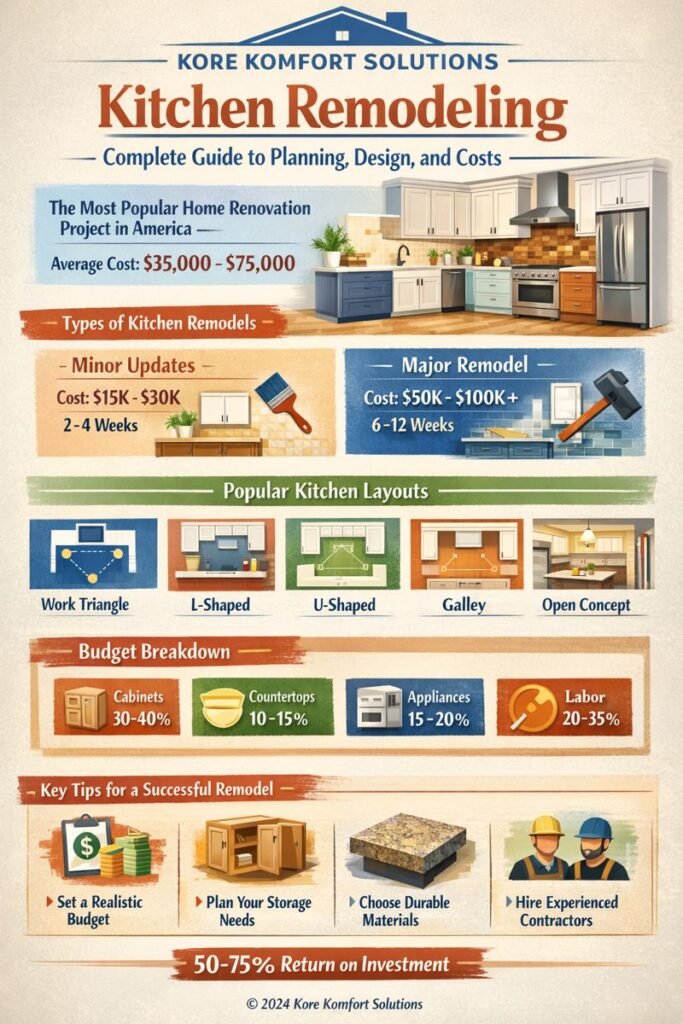
Kitchen remodeling stands as the most popular home improvement project in America, with homeowners investing an average of $35,000 to $75,000 on major renovations. These projects transform the heart of the home while delivering both immediate functional improvements and strong long-term value. Our network of kitchen designers and contractors consistently reports that updated kitchens dramatically enhance daily living quality while addressing common frustrations like inadequate storage, poor workflow, and outdated appliances.
This comprehensive guide explores everything homeowners need to know about kitchen remodeling. We’ll examine project types, typical costs, design principles, and practical planning strategies based on insights from our partner contractors and design professionals across the country. Whether you’re refreshing dated cabinets or completely reimagining your cooking space, this guide provides the essential information for successful kitchen transformations.
Understanding Kitchen Remodeling Scope
Kitchen remodeling projects range from simple cosmetic updates to complete gut renovations. Understanding these differences helps homeowners plan appropriately and set realistic expectations when working with contractors.
Minor Kitchen Updates vs. Major Remodels
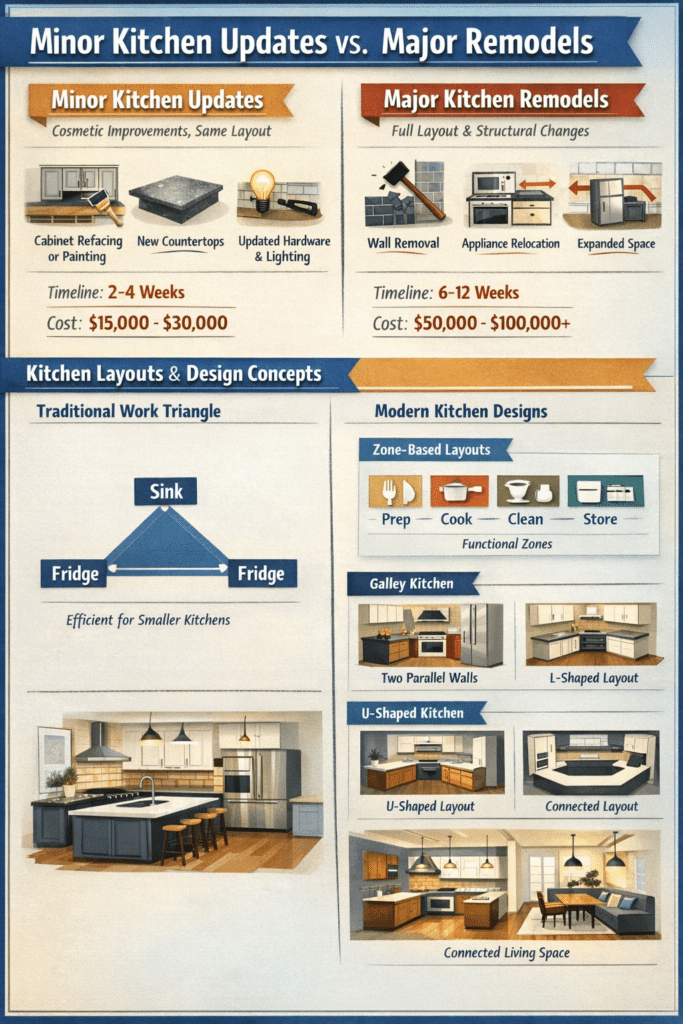
Minor kitchen updates involve refreshing visible elements without changing the room’s layout or moving major appliances. These projects include cabinet refacing or painting, new countertops, updated hardware, modern lighting fixtures, and fresh backsplashes. Our contractor partners typically complete minor updates within two to four weeks at costs ranging from $15,000 to $30,000.
In contrast, major kitchen remodels involve comprehensive changes including layout modifications, appliance relocation, and structural alterations. These projects might remove walls to create open concepts, relocate sinks or ranges, expand the footprint, or completely reconfigure workflow patterns. Our network reports that major remodels typically cost $50,000 to $100,000+ and require six to twelve weeks to complete.
The distinction matters because layout changes trigger substantial additional costs. Moving a sink requires rerouting plumbing through floors or walls, often costing $1,500 to $3,000 just for plumbing work. Similarly, relocating gas ranges involves licensed gas line installation. Removing load-bearing walls requires structural engineering, temporary supports, and beam installation, adding $5,000 to $15,000 to project costs.
Kitchen Work Triangle and Modern Layouts
Traditional design centered on the work triangle connecting the sink, stove, and refrigerator. This concept aimed to minimize steps between the three most-used areas. While the work triangle remains relevant for smaller kitchens, modern designs often embrace more flexible zone-based layouts that our design partners recommend for contemporary homes.
Zone-based layouts organize kitchens into distinct functional areas: food storage, prep, cooking, cleaning, and serving. This approach works particularly well for larger kitchens and spaces accommodating multiple cooks. Zone-based designs create logical workflows while providing adequate counter space between major appliances.
Galley kitchens position work areas along two parallel walls. This efficient layout maximizes functionality in narrow spaces while maintaining short distances between work zones. Our contractors recommend galley kitchens for smaller homes and apartments where space efficiency is paramount.
L-shaped kitchens arrange cabinets and appliances along two perpendicular walls. This configuration provides good workflow while leaving space for dining areas or islands. L-shaped layouts suit medium-sized kitchens in most home styles.
U-shaped kitchens surround cooks with cabinetry and appliances on three walls. These layouts offer maximum counter and storage space while creating highly efficient work triangles. U-shaped kitchens work best in square or rectangular rooms with adequate width to prevent cramped conditions.
Open-concept kitchens integrate cooking areas with living and dining spaces. These designs have dominated modern home design for the past two decades. Our design team emphasizes that open concepts require careful planning to manage noise, cooking odors, and visual clutter while maintaining functionality.
Planning Your Kitchen Remodel
Successful kitchen remodeling begins with thorough planning. The planning phase determines whether projects stay on budget and deliver results that meet expectations. Our network of contractors consistently reports that homeowners who invest adequate time in planning achieve better outcomes with fewer mid-project changes and budget overruns.
Defining Goals and Priorities
Start by identifying specific problems your remodel should solve. Are you addressing inadequate storage, poor lighting, insufficient counter space, or outdated appliances? Perhaps you need better traffic flow or want to accommodate multiple cooks. Clearly defined problems guide design decisions and help prioritize spending when working with contractors.
Consider how you actually use your kitchen. Do you cook elaborate meals daily or primarily reheat prepared foods? Do you entertain frequently or cook mainly for your household? Do children use the kitchen for homework? Understanding usage patterns ensures designs support actual needs rather than aspirational habits.
Think about your timeline for staying in your home. If you’re planning to sell within two years, our design partners recommend focusing on updates that appeal to broad buyer preferences and offer strong resale returns. Conversely, if you’re staying long-term, prioritize features that improve your daily experience, even if they offer limited resale value.
Create a list of must-haves versus nice-to-haves. Must-haves include non-negotiable elements like adequate refrigeration or essential storage. Nice-to-haves encompass desirable features like professional ranges or wine refrigerators that you’ll include if budget permits.
Establishing a Realistic Budget
Budget planning requires understanding both what you can afford and what kitchen remodels typically cost in your area. Start by examining your available funds, financing options, and monthly cash flow to determine a realistic total budget.
As a general guideline, plan to spend 10% to 15% of your home’s value on a major kitchen remodel. For a $300,000 home, this suggests a $30,000 to $45,000 budget. Spending significantly more risks over-improving relative to your neighborhood, making it difficult to recoup costs if you sell.
Always include a contingency fund of 15% to 20% of your project budget for unexpected issues. Our contractor network reports that kitchen remodels frequently reveal hidden problems like water damage, outdated electrical systems that don’t meet current codes, or structural issues requiring correction. For example, a $50,000 kitchen budget should include $7,500 to $10,000 for contingencies.
Research typical kitchen remodeling costs in your area before finalizing budgets. Regional variations can be substantial, with identical projects costing 40% to 50% more in high-cost markets compared to lower-cost areas. Local contractor quotes provide the most accurate pricing information for your specific market.
Layout Considerations and Space Planning
Kitchen layouts significantly impact both functionality and cost. Our design professionals emphasize that keeping existing plumbing and gas locations minimizes expenses, as moving these utilities requires extensive behind-the-wall work. However, layout changes often deliver the most dramatic improvements in functionality.
When planning layouts, maintain adequate clearances and dimensions. Walkways should measure at least 36 inches wide, with 42 to 48 inches preferred in work areas. Islands need 36 to 42 inches of clearance on all sides for comfortable movement. Counter space between major appliances should measure at least 15 inches, with 18 to 24 inches preferred.
Landing space matters for functionality. Refrigerators need at least 15 inches of counter space on the handle side for setting down items. Ranges benefit from 12 to 18 inches of counter space on both sides. Sinks should have 18 to 24 inches of counter space on at least one side for dish stacking and food prep.
Storage planning extends beyond cabinet quantity to consider what you’re storing. Assess your cookware, small appliances, pantry goods, and serving pieces. Our network recommends planning specific storage solutions including deep drawers for pots, pull-out organizers for spices, appliance garages for countertop items, and pantry systems for dry goods.
Kitchen Remodeling Costs
Understanding typical kitchen remodeling costs helps homeowners budget appropriately and make informed decisions about where to allocate resources. Pricing varies significantly by region, material choices, and project scope.
Cost Breakdown by Category
Cabinetry represents 30% to 40% of total kitchen remodeling budgets. This encompasses both base and wall cabinets, hardware, and installation. Stock cabinets cost $100 to $300 per linear foot, semi-custom cabinets run $150 to $650 per linear foot, while custom cabinetry can exceed $1,000 per linear foot.
Countertops account for 10% to 15% of budgets. Material choices dramatically affect costs. Laminate counters cost $20 to $50 per square foot installed. Solid surface materials run $50 to $100 per square foot. Granite costs $50 to $200 per square foot. Quartz ranges from $60 to $150 per square foot. Marble can exceed $200 per square foot.
Appliances consume 15% to 20% of kitchen remodeling budgets. Basic appliance packages cost $2,000 to $5,000. Mid-range packages run $5,000 to $10,000. High-end professional-style appliances can exceed $15,000 to $30,000 for complete suites. Our network partners often recommend quality mid-range appliances that offer excellent performance without luxury premiums.
Labor represents 20% to 35% of total costs for most kitchen remodels. This includes demolition, carpentry, plumbing, electrical work, and finishing. Labor costs vary significantly by region and project complexity.
Flooring typically accounts for 5% to 10% of budgets. Vinyl flooring costs $3 to $8 per square foot installed. Ceramic or porcelain tile runs $8 to $20 per square foot. Hardwood flooring costs $12 to $25 per square foot. Natural stone can exceed $25 per square foot.
Lighting, plumbing fixtures, and backsplashes combine for 5% to 10% of budgets. These finishing touches significantly impact aesthetics while offering opportunities for both budget savings and statement-making investments.
Budget Categories for Different Project Scopes
Budget kitchen updates costing $15,000 to $30,000 typically include cabinet refacing or painting, laminate or basic solid-surface countertops, standard appliances, vinyl or basic tile flooring, and simple backsplashes. These updates use stock materials and maintain existing layouts. Budget updates suit rental properties or situations requiring functional improvements without premium finishes.
Mid-range kitchen remodels costing $35,000 to $65,000 feature semi-custom cabinets, quartz or granite countertops, quality appliances, ceramic or porcelain tile floors, and attractive backsplashes. Our contractor network reports that mid-range remodels balance quality with value, providing durable, attractive results without premium price tags. These projects suit most family kitchens and represent the sweet spot for balancing investment with return.
High-end kitchen renovations costing $75,000 to $150,000+ include custom cabinetry, premium countertop materials, professional-grade appliances, high-quality flooring, and designer finishes throughout. Luxury remodels might expand kitchen footprints, add butler’s pantries, or incorporate specialty features like wine refrigerators and warming drawers. These projects typically focus on luxury homes and serious cooking enthusiasts.
Cost Factors That Increase Budgets
Several factors can substantially increase kitchen remodeling costs beyond baseline estimates. Our contractor partners identify these as the most common budget drivers:
Structural changes like removing walls, adding windows, or expanding footprints require engineering, permits, and extensive construction work. Wall removal costs $500 to $3,000 for non-load-bearing walls. Load-bearing wall removal runs $3,000 to $10,000 including structural support installation.
Plumbing and electrical upgrades involve more than just relocating fixtures. Older homes often require panel upgrades to support modern appliance loads, adding $1,500 to $3,000. Bringing electrical systems to current code can add thousands more. Similarly, old galvanized plumbing might need replacement, costing $2,000 to $8,000 depending on extent.
Premium materials and finishes like custom cabinetry, exotic stone countertops, and professional appliances can double or triple material costs compared to standard selections. However, our design team notes that premium materials often provide superior durability and aesthetics that justify their costs for homeowners prioritizing quality and longevity.
Unexpected issues discovered during demolition frequently add costs. Water damage requiring structural repairs, mold remediation, outdated systems needing upgrades, and code violations requiring correction can each add thousands to project budgets. This explains why adequate contingency funds are essential.
Don’t get ripped off. See real pricing for bathrooms, kitchens, and HVAC.
Updated for 2026 Market Rates
Key Design Elements
Several critical design elements determine both the functionality and aesthetic success of kitchen remodels. Our network of designers and contractors emphasize these as the most impactful decisions homeowners make.
Cabinetry Selection and Configuration
Cabinetry selection represents the single most impactful design decision in kitchen remodeling. Cabinet style, quality, and configuration dramatically affect both aesthetics and functionality.
Stock cabinets come in standard sizes and limited style options. These cabinets offer the most affordable option while still providing decent quality from major manufacturers. Stock cabinets work well for budget-conscious remodels and standard layouts.
Semi-custom cabinets offer more size options, finish choices, and organizational features than stock options. These cabinets accommodate most layout needs while providing better quality and more design flexibility. Our contractor network consistently recommends semi-custom cabinets as representing the best value for most kitchen remodels.
Custom cabinets are built specifically for your kitchen with unlimited design options, specialized storage solutions, and premium construction. Custom cabinetry allows for unique layouts, specialized storage, and exact dimensional fit. The investment makes sense for luxury kitchens and unusual spaces.
Cabinet door styles define aesthetics. Shaker-style doors with simple recessed panels suit both traditional and contemporary kitchens. Flat-panel doors create modern, minimalist looks. Raised-panel doors convey traditional elegance. Glass-front doors display dishware while breaking up solid cabinet runs.
Storage organization matters as much as cabinet quantity. Deep drawers work better than shelves for pots and pans. Pull-out organizers maximize corner cabinet access. Vertical dividers keep baking sheets and cutting boards organized. Drawer organizers for utensils and spices prevent cluttered chaos.
For homeowners looking to maximize cabinet organization, our design team recommends products like the Rev-A-Shelf Pull-Out Cabinet Organizers which transform hard-to-reach corners into accessible storage. Similarly, adjustable drawer dividers allow customization as storage needs change over time.
Countertop Materials and Selection
Countertop materials significantly impact aesthetics, functionality, and maintenance requirements. Each material offers distinct advantages and limitations based on our contractor partners’ extensive installation experience.
Quartz has become the most popular countertop material, offering the appearance of natural stone with superior durability and minimal maintenance. Quartz resists staining, never requires sealing, and provides consistent coloring without natural stone’s variations. These engineered surfaces cost $60 to $150 per square foot installed.
Granite remains popular for its natural beauty, durability, and heat resistance. Each slab offers unique patterns and coloring. However, granite requires periodic sealing and can stain if spills aren’t cleaned promptly. Granite costs $50 to $200 per square foot depending on variety and origin.
Marble delivers unmatched elegance and classic beauty. However, marble is softer and more porous than granite or quartz, making it prone to staining, etching, and scratching. Our design partners note that marble works better for low-traffic areas or homeowners willing to embrace patina. Costs range from $75 to $250 per square foot.
Solid surface materials like Corian offer seamless installations, integrated sinks, and repairable surfaces. These materials resist staining and provide consistent coloring. However, solid surfaces can scratch and don’t offer natural stone’s depth and character. Costs run $50 to $100 per square foot.
Butcher block provides warm, natural beauty and excellent prep surfaces for serious cooks. These wood counters require regular oiling and careful maintenance to prevent water damage and staining. Butcher block costs $50 to $150 per square foot installed.
For maintaining granite and marble countertops, our network recommends quality stone sealers applied annually. For butcher block care, food-safe mineral oil keeps wood protected and beautiful.
Appliance Selection and Placement
Appliance selection balances aesthetics, functionality, and budget. Modern appliances offer dramatic improvements in energy efficiency, performance, and features compared to models over ten years old.
Refrigerators anchor design and functionality. Standard-depth refrigerators (30 to 36 inches deep) cost $800 to $3,000 and protrude beyond standard 24-inch-deep cabinets. Counter-depth models ($2,000 to $6,000) align with cabinetry for streamlined looks but sacrifice capacity. Built-in refrigerators ($5,000 to $15,000+) integrate seamlessly but require significant investment.
Ranges and cooktops determine cooking capabilities. Freestanding ranges ($600 to $3,000) offer all-in-one convenience. Slide-in ranges ($1,000 to $5,000) provide built-in looks without custom cabinetry. Separate cooktops ($800 to $4,000) and wall ovens ($1,500 to $5,000) offer design flexibility but require more space and investment.
Professional-style ranges ($3,000 to $15,000+) appeal to serious cooks with their power and features. However, our contractor partners emphasize that these ranges often require upgraded ventilation ($1,000 to $5,000+), gas line upgrades, and fire suppression systems, substantially increasing total costs.
Dishwashers ($400 to $2,000) have become standard features. Panel-ready models integrate with cabinetry for seamless looks. Drawer-style dishwashers offer flexibility but cost more. Multiple dishwashers make sense for large households and frequent entertainers.
Ventilation matters more than many homeowners realize. Range hoods should provide airflow of at least 100 CFM per linear foot of cooking surface. Professional ranges require 400+ CFM hoods. Our network consistently recommends ducted ventilation over recirculating models for removing heat, moisture, and cooking odors.
For homeowners seeking professional performance without full commercial costs, our partners often recommend quality 30-inch ranges with convection ovens that deliver excellent results for most cooking needs.
Lighting Design
Kitchen lighting requires layered approaches combining ambient, task, and accent lighting. Proper lighting enhances functionality while creating attractive ambiance.
Ambient lighting provides overall illumination throughout the kitchen. Recessed can lights, flush-mount ceiling fixtures, or pendant lights create base lighting levels. Our design team emphasizes planning for adequate overall light without relying solely on under-cabinet fixtures for ambient illumination.
Task lighting supports specific activities at work surfaces. Under-cabinet lighting illuminates countertops for food prep. Pendant lights over islands provide focused light for cooking and dining. Interior cabinet lighting makes finding items easier.
Accent lighting highlights architectural features and creates visual interest. Toe-kick lighting adds drama while improving nighttime navigation. Above-cabinet lighting emphasizes ceiling height. Display cabinet lighting showcases collections or glassware.
LED lighting has revolutionized kitchen illumination. LEDs use 75% less energy than incandescent bulbs while lasting 25 times longer. Modern LEDs offer excellent color rendering and dimming capabilities. The long-term savings and convenience justify higher upfront costs.
Dimmer controls add versatility, allowing bright lighting for food prep while creating relaxed ambiance for dining and entertaining. Our contractors recommend installing dimmers on all lighting circuits for maximum flexibility.
For under-cabinet lighting, our network frequently specifies linkable LED light bars that provide even illumination without dark spots. Smart dimmer switches allow precise lighting control from anywhere in the room.
Flooring Options
Flooring choices significantly impact kitchen aesthetics, comfort, and maintenance. Kitchen floors must withstand heavy traffic, moisture, and dropped items while remaining easy to clean.
Porcelain and ceramic tile dominate kitchen flooring due to water resistance, durability, and design versatility. Porcelain offers superior density and durability. Ceramic costs less but remains suitable for most kitchens. Both materials offer extensive design options at $8 to $25 per square foot installed.
Large-format tiles (12 by 24 inches or larger) create contemporary looks with fewer grout lines requiring maintenance. However, these tiles require flatter substrates and more precise installation than smaller tiles. Small mosaic tiles provide excellent traction but involve more grout to maintain.
Luxury vinyl plank (LVP) has emerged as a popular tile alternative offering wood aesthetics with superior water resistance. Quality LVP costs $5 to $12 per square foot installed and installs more quickly than tile. Our contractor network reports that LVP works well for kitchen floors, though it lacks tile’s premium feel and long-term durability.
Hire the Right Contractor the First Time
Use our free research guide and intelligence report to vet any contractor before you sign a contract.
Hardwood flooring delivers classic beauty and warmth. However, wood requires more careful maintenance in kitchens where water and spills are common. Engineered hardwood offers better moisture resistance than solid wood. Hardwood costs $12 to $25 per square foot installed.
Natural stone including slate and limestone provides distinctive character and durability. However, stone requires sealing and careful maintenance. Stone costs $15 to $50+ per square foot installed depending on variety.
Working with Kitchen Remodeling Contractors
Contractor selection significantly impacts project success. Investing time in thorough vetting pays dividends through quality work and stress reduction throughout the remodeling process.
Finding and Evaluating Contractors
Start contractor searches by gathering recommendations from friends, neighbors, and family who’ve completed similar projects. Personal referrals from trusted sources provide valuable insights into contractors’ reliability, communication, and work quality.
Online reviews supplement personal recommendations but require careful evaluation. Look for patterns across multiple reviews rather than focusing on individual experiences. Contractors with consistent feedback about specific strengths or weaknesses reveal more than scattered reviews.
Verify contractors hold appropriate licenses and insurance. Licensing requirements vary by state and municipality, so confirm local requirements. At minimum, contractors should carry general liability insurance and workers’ compensation coverage. Request certificates of insurance and verify coverage directly with insurance companies.
Check references from recent projects similar to yours. Ask references about timeline adherence, budget management, communication quality, how contractors handled problems, and whether they would hire them again. If possible, view completed projects to assess work quality directly.
Getting Accurate Bids
Obtain at least three bids for kitchen remodeling projects. Multiple bids provide market pricing information while revealing how different contractors approach your project.
Provide identical information to all bidding contractors. Share the same scope descriptions, any drawings or plans, material preferences, and timeline expectations. Inconsistent information leads to bids that aren’t truly comparable.
Quality bids include detailed breakdowns of labor and material costs, specific material specifications, project timelines, payment schedules, and warranty information. Be wary of bids providing only lump-sum totals without detail, as these make comparing value difficult.
Don’t automatically accept the lowest bid. Extremely low bids may indicate contractors who misunderstand project scope, plan to use inferior materials, or intend to cut corners. Focus on value—the relationship between cost and quality—rather than price alone.
Ask contractors to explain significant price differences between their bids and competitors. Legitimate reasons include higher-quality materials, more experienced crews, superior warranty coverage, or more thorough site protection. If contractors can’t explain price differences, their bids may lack proper project understanding.
Managing the Project
Establish regular communication schedules with contractors. Daily check-ins work well for projects requiring frequent decisions, while weekly updates suit straightforward remodels. Consistent communication prevents misunderstandings and keeps projects on track.
Make material and design decisions promptly when contractors need input. Delays in selecting cabinets, countertops, or other elements can halt progress and extend timelines. If you struggle with decisions, review options in advance and prepare selections before contractors need them.
Document projects through photos at each stage. Before photos establish baseline conditions, progress photos track work quality, and completion photos provide records of finished work. Documentation proves valuable if disputes arise or you need records for insurance or future sales.
Address concerns immediately rather than allowing problems to accumulate. Our contractor network emphasizes that minor issues caught early are easily corrected, while problems ignored until completion become expensive to fix. Good contractors appreciate prompt feedback that helps them deliver results meeting your expectations.
Return on Investment
Understanding the financial returns kitchen remodeling generates helps prioritize improvements and set appropriate budgets based on your specific goals and timeline.
Typical ROI for Kitchen Remodels
Kitchen remodeling projects typically recoup 50% to 75% of their cost when homeowners sell within a few years of completion. Our contractor network reports that minor kitchen remodels generally return higher percentages (70% to 85%) than major renovations (50% to 65%), as buyers often don’t pay full premiums for high-end finishes.
These averages mask significant regional variations. Strong housing markets with high demand typically generate better returns than markets with flat or declining prices. Additionally, homes in move-in ready condition provide value beyond pure financial returns by attracting more buyers and potentially reducing time on market.
The primary value most homeowners receive from kitchen remodeling comes from improved functionality and daily enjoyment rather than purely financial returns. Updated kitchens eliminate frustrations from inadequate storage, poor workflow, or outdated appliances. These quality-of-life improvements justify investments even when financial returns fall below 100%.
Maximizing Resale Value
Certain kitchen improvements deliver stronger resale returns than others. Our design partners recommend focusing on these elements when remodeling kitchens in homes you plan to sell within several years:
Neutral finishes in timeless styles appeal to broad buyer preferences. Avoid highly distinctive or trendy finishes that might not match buyers’ tastes. White, gray, and natural wood cabinets outperform bold colors in resale situations. Classic subway tile backsplashes provide broader appeal than distinctive patterns.
Quality materials in appropriate ranges for your neighborhood provide better returns than either cheap finishes or over-the-top luxury. Match material quality to neighborhood norms. Granite or quartz counters make sense in most markets. Exotic marble might be over-improvement unless your neighborhood supports luxury finishes.
Adequate storage and counter space rank among buyers’ top kitchen priorities. Pantries, deep drawers, organizational features, and generous counter space add functional value buyers appreciate and will pay for.
Modern, energy-efficient appliances attract buyers while avoiding the premium pricing of ultra-luxury brands. Stainless steel appliances remain the preferred finish. Energy Star ratings appeal to cost-conscious buyers.
Avoid over-improving relative to your neighborhood. Installing $80,000 worth of custom cabinetry and professional appliances in a $200,000 home represents over-improvement that won’t return its cost. Match kitchen quality and finishes to neighborhood norms for optimal returns.
Common Kitchen Remodeling Mistakes
Learning from common mistakes helps homeowners avoid expensive problems and disappointment with results. Our contractor network consistently identifies these pitfalls across thousands of kitchen projects.
Inadequate Planning and Research
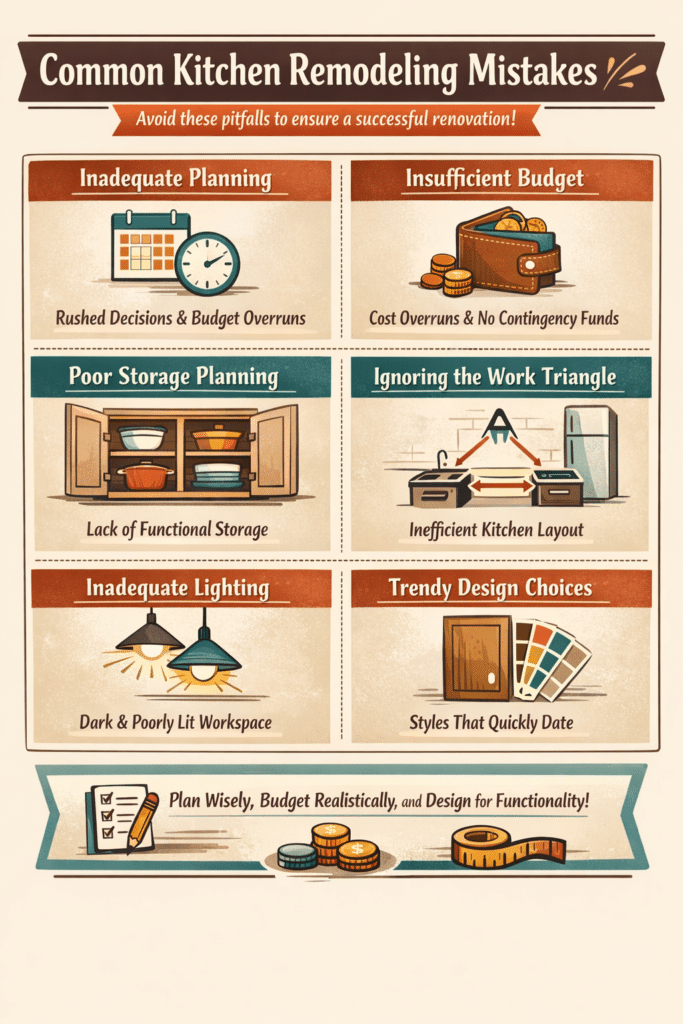
Rushing into kitchen remodeling without thorough planning causes most project failures. Homeowners who skip planning phases, fail to research costs, or underestimate complexity find themselves with budget overruns, extended timelines, or results that don’t meet needs.
Our design team recommends investing adequate time in planning before starting work. For kitchen remodels, spend two to four months planning, gathering bids, selecting materials, and making design decisions. This preparation time prevents hasty decisions made under pressure during construction.
Insufficient Budget and Contingency Funds
Underestimating kitchen remodeling costs leads to stressful mid-project budget crises. Homeowners who set unrealistic budgets based on wishful thinking rather than market research find themselves unable to complete projects as planned or forced to accept inferior solutions due to funding shortfalls.
Research actual kitchen remodeling costs in your market before setting budgets. Obtain multiple contractor bids even if you plan to handle work yourself, as these bids provide realistic cost baselines. Add 20% contingency funds for unexpected issues, as kitchen remodels frequently reveal hidden problems requiring correction.
Poor Storage Planning
Failing to plan adequate storage during kitchen remodeling creates ongoing frustration. Homeowners who focus solely on aesthetics while neglecting practical storage needs find themselves with beautiful kitchens that don’t function well for daily use.
Carefully assess storage requirements during planning phases. Consider where you’ll keep cookware, small appliances, pantry goods, serving pieces, and everyday dishes. Our network recommends planning specific storage solutions including deep drawers, pull-out organizers, pantry systems, and appliance garages before finalizing cabinet layouts.
Ignoring the Work Triangle
Neglecting workflow planning creates inefficient kitchens regardless of how attractive they look. Kitchens with poor distances between sink, stove, and refrigerator force unnecessary steps and create frustration during meal preparation.
Plan layouts that maintain reasonable work triangle distances. The total distance between all three points should measure 12 to 26 feet. No single leg should exceed 9 feet. Ensure clear pathways between work zones without traffic cutting through the triangle.
Inadequate Lighting
Inadequate lighting represents one of the most common kitchen design mistakes. Kitchens relying solely on overhead ambient lighting leave work surfaces in shadow, making food prep difficult and potentially dangerous.
Our design partners emphasize prioritizing task lighting during kitchen remodeling. Install under-cabinet lighting to illuminate countertops. Add pendant lights over islands. Plan for adequate overall ambient lighting. Include dimmer controls for versatility. Proper lighting dramatically improves kitchen functionality while creating attractive ambiance.
Trendy Design Choices
Following design trends too closely creates spaces that quickly feel dated. Color schemes, cabinet styles, or hardware choices that feel current today may appear tired within five years. Homeowners who prioritize trendiness over timeless design find themselves wanting to remodel again sooner than necessary.
Choose classic designs for permanent elements like cabinets, countertops, and layouts. Save trendy expressions for easily changed elements like paint colors, accessories, and hardware. Neutral cabinets, simple door styles, and classic materials maintain appeal across decades while trendy choices age quickly.
Kitchen Remodeling Timeline
Understanding realistic timelines helps manage expectations and plan around remodeling disruption. Our contractor network provides these estimates based on thousands of completed projects.
Typical Project Timelines
Minor kitchen updates maintaining existing layouts typically require two to four weeks from start to completion. These projects include cabinet refacing, new countertops, hardware updates, and cosmetic changes without moving appliances or making structural modifications.
Mid-range kitchen remodels involving layout changes or appliance relocation typically take six to eight weeks. Additional time accommodates the complexity of moving utilities, rerouting plumbing, and addressing structural modifications.
Major kitchen remodels creating open concepts or expanding footprints often require eight to twelve weeks or longer. Structural work, custom cabinetry lead times, and comprehensive scope contribute to extended timelines.
Several factors can extend kitchen remodeling timelines beyond initial estimates. Custom cabinets might require eight to twelve weeks for manufacturing and delivery. Permit approval processes add days to weeks depending on jurisdictions. Unexpected issues like structural problems or code violations require additional time for proper correction.
Living Without Your Kitchen
Plan how you’ll manage meals and daily routines during kitchen remodeling. The disruption significantly impacts daily life, particularly for families who cook regularly.
Setting up a temporary kitchen in another room provides basic functionality. Include a microwave, cooler or mini-refrigerator, coffee maker, and basic supplies. Our network recommends compact refrigerators and countertop microwaves for temporary setups. Stock disposable plates and utensils to minimize cleanup needs. Designate a temporary dining area.
Eating out or using prepared meals works for short projects but becomes expensive and unhealthy for extended remodels. Budget for increased food costs during construction.
Using outdoor cooking including grills expands options during warm weather. However, this approach has limitations during cold months or bad weather.
Communicate clearly with contractors about their daily schedules so you can plan accordingly. Understanding when workers arrive, take breaks, and leave helps you coordinate access during active work periods.
Frequently Asked Questions
How long does a typical kitchen remodel take from start to finish?
Kitchen remodels typically take six to eight weeks for standard projects maintaining basic layouts while replacing cabinets, countertops, and appliances. Minor cosmetic updates might complete in two to four weeks. Extensive remodels involving layout changes, structural modifications, or custom cabinetry often require eight to twelve weeks or longer.
Factors affecting timelines include custom cabinet lead times (often eight to twelve weeks), material availability, permit approval processes, and unexpected issues discovered during demolition. Our contractor partners recommend planning for projects to take about 25% longer than initial estimates to manage expectations. Avoid scheduling kitchen remodels immediately before holidays or planned events when you’ll need full access.
Can I remodel a kitchen for under $25,000?
Kitchen remodels under $25,000 are possible when maintaining existing layouts, using stock cabinets, choosing affordable countertop materials, and keeping current appliances or selecting builder-grade replacements. This budget typically accommodates cabinet refacing or stock replacements, laminate or basic solid-surface countertops, simple backsplashes, and vinyl flooring.
However, $25,000 budgets require careful material selection and might not cover layout changes, semi-custom cabinetry, premium countertop materials, or high-end appliances. Small kitchens fit $25,000 budgets more readily than large spaces. DIY work on appropriate tasks like demolition, painting, and possibly tile installation can stretch budgets further. Nevertheless, our network reports that most complete kitchen remodels with professional labor cost $35,000 to $65,000 for mid-range finishes and quality.
Should I choose custom, semi-custom, or stock cabinets?
Cabinet selection depends on budget, timeline, and design needs. Stock cabinets ($100-$300 per linear foot) work well for standard layouts and tight budgets. These cabinets come in limited sizes and styles but offer decent quality from major manufacturers. Stock cabinets are readily available and typically deliver within two to four weeks.
Semi-custom cabinets ($150-$650 per linear foot) provide the best value for most kitchen remodels according to our contractor network. These offer more size options, finish choices, and organizational features than stock cabinets while costing significantly less than custom options. Semi-custom cabinets accommodate most layouts and deliver within six to eight weeks.
Custom cabinets ($500-$1,000+ per linear foot) make sense for unusual spaces, specific design visions, or luxury kitchens. Custom cabinetry allows unlimited design options, exact dimensional fit, and specialized storage solutions. However, custom cabinets require twelve or more weeks for fabrication and cost significantly more than other options.
What are the most important things to splurge on in a kitchen remodel?
Our design partners recommend prioritizing spending on elements affecting long-term functionality and durability rather than purely aesthetic features. Quality cabinetry justifies higher costs through superior construction, better hardware, and organizational features that enhance daily use for decades. Solid wood construction and full-extension drawer slides outlast particle board and basic hardware.
Durable countertop materials like quartz or quality granite provide lasting beauty and functionality. These surfaces resist staining, stand up to daily use, and maintain appearance for decades. Adequate ventilation prevents moisture damage and removes cooking odors effectively. Professional-grade range hoods with proper CFM ratings justify their costs.
Quality installation matters as much as material selection. Professional cabinet installation, proper countertop fabrication and installation, and skilled tile work ensure projects last without callbacks. Conversely, consider budget options for easily changed elements like hardware, light fixtures, and paint colors. You can always upgrade these decorative elements later while core infrastructure investments prove expensive to redo.
How do I maximize storage in a small kitchen?
Maximize storage through smart cabinet configuration rather than just adding more cabinets. Deep drawers store pots, pans, and small appliances more efficiently than shelves. Pull-out organizers make corner cabinets fully accessible rather than wasting space in dark corners. Vertical dividers keep baking sheets and cutting boards organized.
Wall cabinets extending to ceilings capture otherwise wasted space while making kitchens feel taller. Use upper cabinet space for items used less frequently. Toe-kick drawers utilize the space beneath base cabinets for flat items like cookie sheets or placemats. Appliance garages hide countertop small appliances while keeping them accessible.
Organizational inserts maximize drawer and cabinet efficiency. Our network recommends products like pull-out spice racks, pot lid holders, and waste basket pullouts. Consider specialized storage solutions like pull-out pantries and tray dividers during the design phase rather than trying to retrofit organization later.
Related Kitchen Remodeling Resources
Explore these helpful guides and tools to support your kitchen remodeling project:
- Kitchen Remodeling Cost Calculator – Estimate your project costs based on your specific needs
- Home Remodeling Guide: Planning, Costs, and Essential Considerations – Comprehensive overview for all remodeling projects
- Kitchen Layout Ideas for Small Spaces – Maximize every square foot in compact kitchens
- Kitchen Flooring Options and Costs in Southern Ohio – Complete 2026 flooring guide
Local Kitchen Remodeling Services
Full Affiliate Disclosure
Kore Komfort Solutions LLC participates in the Amazon Services LLC Associates Program and other affiliate advertising programs. These programs allow us to earn advertising fees by linking to Amazon.com and other partner retailers.
When you click on affiliate links in this article and make a purchase, we may receive a commission at no additional cost to you. This commission helps support our educational content and allows us to continue providing comprehensive home improvement guides.
We maintain strict editorial independence in our recommendations. Our network of contractors and design professionals only recommends products they trust and use in their own projects. All product suggestions are based on quality, durability, and value—never on commission rates.
Whether you purchase through our links or directly from retailers, the price you pay remains the same. We appreciate your support when you choose to use our affiliate links, as it enables us to keep producing valuable content for homeowners.
For questions about our affiliate relationships or product recommendations, please contact us directly.
Hire the Right Contractor the First Time
Use our free research guide and intelligence report to vet any contractor before you sign a contract.