Last Updated: January 14, 2026
Article Navigation
Key Takeaways
- Similar Pricing: Both materials cost $60-$120/sq ft installed for mid-range options. Material quality matters more than choosing granite vs quartz.
- Heat Tolerance Differs: Granite withstands direct hot pot contact (1,000°F+). Quartz requires trivets above 300°F to prevent resin damage.
- Maintenance Gap: Granite needs annual sealing ($15-$30 DIY). Quartz never requires sealing, offering true low-maintenance performance.
- Stain Resistance: Quartz’s non-porous surface naturally resists stains. Sealed granite performs well but requires maintained sealer.
- Both Last 20+ Years: Equal scratch resistance and durability. Choose based on heat tolerance needs and maintenance willingness.
Affiliate Disclosure: Kore Komfort Solutions is a participant in the Amazon Services LLC Associates Program and other affiliate programs. We earn from qualifying purchases made through links in this article at no additional cost to you. We only recommend products our network of contractors and fabricators trust for their own projects. Full disclosure.
Choosing between granite vs quartz countertops represents one of the most important decisions in kitchen remodeling. Both materials dominate modern renovations, offering excellent durability and attractive aesthetics at similar price points. Our network of fabricators and designers reports that homeowners consistently ask which material delivers better performance, lower maintenance, and superior value.
This comprehensive comparison helps you understand the real differences between granite vs quartz countertops. We’ll examine performance characteristics, maintenance requirements, cost factors, and climate considerations based on insights from our partner contractors and stone fabricators across the country. Whether you prioritize heat resistance, low maintenance, or natural aesthetics, this guide provides the essential information for informed countertop decisions.
Understanding Granite Countertops
Granite countertops have dominated kitchen remodeling for decades. This natural stone offers unique beauty and proven durability that continues to appeal to homeowners seeking authentic materials.
What Is Granite?
Granite forms deep underground through volcanic activity. Molten rock cools slowly over millions of years, creating crystalline structures with distinctive patterns and colors that make each slab truly one-of-a-kind.
Granite composition includes primarily quartz, feldspar, and mica minerals. These components create the characteristic speckled appearance and natural variation that defines granite countertops. No two slabs match exactly, ensuring your countertops remain unique—a quality that appeals to homeowners seeking distinctive character in their kitchens.
How Granite Countertops Are Made
Granite extraction involves quarrying large blocks from mountainsides around the world. Workers cut these blocks into slabs typically measuring 2-3 centimeters thick for residential countertops.
Fabricators polish slabs to desired finishes. Polished finishes create glossy, reflective surfaces that showcase granite’s natural depth. Honed finishes produce matte, softer appearances suited to contemporary designs. Leathered finishes offer textured, tactile surfaces with modern appeal.
The fabrication process typically requires 2-3 weeks from template to installation. Fabricators template your kitchen, cut slabs to specification, polish edges, and professionally install countertops—the same timeline whether choosing granite vs quartz countertops.
Granite Appearance and Aesthetics
Granite offers virtually unlimited color and pattern options. Colors range from white and cream through gray, brown, black, red, blue, and green. Patterns vary from subtle and uniform to bold and dramatic, allowing coordination with any design aesthetic.
Popular Granite Styles:
Santa Cecilia features light gold backgrounds with burgundy and brown speckles, creating warm, inviting surfaces. Uba Tuba displays dark green-black bases with gold and brown flecks for dramatic contrast. Kashmir White presents white backgrounds with gray and burgundy movement suited to both traditional and contemporary spaces.
Giallo Ornamental offers cream-beige tones with brown and gray patterns that coordinate beautifully with wood cabinets. Black Pearl delivers deep black with silver and gold sparkles for high-contrast modern kitchens. New Venetian Gold combines gold-brown bases with burgundy accents creating rich, luxurious surfaces.
Granite complements both traditional and contemporary kitchen designs. Our design partners note that the natural material suits historic homes while working equally well in modern spaces when paired with appropriate cabinet styles and finishes.
Understanding Quartz Countertops
Quartz countertops—also called engineered stone—combine natural materials with manufacturing precision. This creates surfaces that address many natural stone limitations while offering design flexibility impossible in nature.
What Is Quartz Engineered Stone?
Quartz countertops contain 90-95% ground natural quartz crystals, combined with 5-10% polymer resins and pigments. This engineered composition creates non-porous surfaces that require no sealing and resist staining naturally—a significant advantage over natural stone.
Manufacturing allows precise control over appearance. Patterns can convincingly simulate natural stones like marble, granite, or concrete, or create contemporary designs impossible in nature. This versatility appeals to homeowners seeking specific aesthetics or exact color matching across large installations.
How Quartz Countertops Are Made
Manufacturers combine quartz crystals, resins, and pigments under intense heat and pressure. This process creates slabs with consistent strength and appearance throughout, eliminating the natural variations that can complicate large installations with natural stone.
Fabricators handle quartz identically to granite—templating kitchens, cutting slabs, finishing edges, and installing countertops. Installation timelines match granite at 2-3 weeks from template to completion, simplifying project scheduling when comparing granite vs quartz countertops.
Quartz Appearance and Aesthetics
Quartz offers extensive design possibilities that extend beyond natural stone limitations. Some patterns convincingly simulate natural stones, while others embrace contemporary aesthetics with solid colors or unique patterns.
Popular Quartz Styles:
Carrara-style quartz features white backgrounds with delicate gray veining that mimics Italian marble without the maintenance concerns. Concrete-look quartz presents industrial gray surfaces resembling polished concrete for urban contemporary kitchens.
Solid color quartz offers pure whites, grays, or blacks for minimalist spaces where clean lines dominate. Granite-look quartz provides speckled patterns similar to natural granite with superior stain resistance. Dramatic veining patterns create bold focal points impossible to find consistently in natural stone.
Our network of designers reports that quartz suits diverse preferences. Homeowners seeking specific colors or patterns find more consistent options with engineered quartz than natural granite, particularly for large installations requiring multiple slabs with matching appearance.
Granite vs Quartz Countertops: Durability Comparison
Durability affects long-term satisfaction and maintenance costs. Understanding how granite vs quartz countertops perform helps predict ownership experiences and guides material selection.
Scratch Resistance
Both materials resist scratching extremely well under normal kitchen use. Cutting boards, pots, pans, and utensils won’t scratch either surface under typical conditions, making both excellent choices for busy kitchens.
Granite edges this category slightly, rating 6-7 on the Mohs hardness scale—one of the hardest natural surfaces. Quartz rates similarly at 7 on the Mohs scale, though the resin binders slightly reduce overall hardness compared to pure quartz crystals. In practical terms, these differences prove negligible for residential kitchens.
Neither granite vs quartz countertops requires special precautions beyond normal cutting board use for food preparation. Both materials maintain their appearance for decades without visible scratching from daily activities.
Heat Resistance
Heat tolerance differs significantly between granite vs quartz countertops. This proves particularly relevant for homeowners who cook frequently or use high-heat cooking methods.
Granite Heat Performance:
Granite withstands extreme heat naturally. The stone formed under intense volcanic conditions, creating exceptional heat resistance that tolerates temperatures exceeding 1,000°F without burning, scorching, or discoloring.
Our contractor network reports that placing hot pots directly on granite typically causes no damage. However, sudden temperature changes may cause cracking—placing frozen items directly on hot granite or vice versa creates thermal shock that risks damage. Normal kitchen use poses minimal concerns.
Quartz Heat Performance:
Quartz shows less heat tolerance due to polymer resins binding quartz crystals. These resins can burn, scorch, or discolor when exposed to extreme heat, creating permanent damage that cannot be repaired.
Placing very hot pots directly on quartz may damage surfaces. Temperatures exceeding 300°F risk resin damage creating permanent marks or discoloration. Our network consistently recommends using trivets or hot pads for cookware fresh from stovetops or ovens.
This represents the most significant functional difference when comparing granite vs quartz countertops. Homeowners who frequently place hot cookware on counters benefit from granite’s superior heat tolerance. Those comfortable using trivets consistently find this limitation manageable given quartz’s other advantages.
For protecting quartz surfaces, our fabricator partners recommend silicone trivets that withstand high heat while protecting countertops. Cork trivet sets offer natural aesthetics that complement stone countertops beautifully.
Stain Resistance
Stain resistance differs substantially between materials, particularly impacting kitchens where cooking and entertaining occur frequently.
Granite Staining:
Granite’s porous nature allows liquids to penetrate unsealed surfaces. Wine, coffee, oils, and acidic substances can stain granite if left standing on unsealed stone. However, proper sealing dramatically improves stain resistance.
Quality sealers create barriers preventing liquid penetration for 1-2 years before reapplication becomes necessary. Sealing frequency depends on granite type—denser granites like absolute black require less frequent sealing, while more porous varieties need annual attention.
Quartz Staining:
Quartz’s non-porous composition naturally resists staining without any sealer. Liquids cannot penetrate surfaces, preventing most staining concerns that affect natural stone. Wine, coffee, oils, and other common kitchen substances wipe away easily without leaving marks.
However, some substances may discolor quartz. Highly concentrated dyes, permanent markers, or certain harsh chemicals can affect resin binders. Our network emphasizes prompt cleanup of any spills for optimal long-term appearance with both materials.
For granite maintenance, our fabricators recommend premium granite sealers that provide long-lasting protection.
Impact and Chip Resistance
Both materials show good impact resistance, though differences exist in damage patterns and repair options.
Granite Chipping:
Granite can chip along edges or corners from sharp impacts. Dropping heavy pots or appliances on edges risks damage, particularly around undermount sink cutouts where material thickness reduces vulnerability.
However, damaged granite can sometimes be repaired by professional stone specialists who fill chips with color-matched epoxy. While repairs remain visible upon close inspection, they restore functionality and prevent further damage.
Quartz Chipping:
Quartz edges exhibit similar vulnerability to sharp impacts as granite. The material shows comparable performance in this regard, requiring reasonable care to avoid edge impacts.
However, quartz repairs prove more challenging. The engineered composition makes invisible repairs nearly impossible compared to natural stone. Our network emphasizes that both granite vs quartz countertops benefit from reasonable care avoiding impacts on edges and corners.
Don’t get ripped off. See real pricing for bathrooms, kitchens, and HVAC.
Updated for 2026 Market Rates
Granite vs Quartz Countertops: Maintenance Requirements
Maintenance affects long-term ownership costs and convenience. Understanding requirements helps evaluate true granite vs quartz countertops expenses beyond initial installation.
Daily Cleaning
Both materials clean easily with mild soap and water. Regular wiping with damp cloths maintains appearance and hygiene without special products or procedures.
However, avoid harsh cleaners on both surfaces. Acidic cleaners, bleach, or abrasive products can damage sealers on granite or dull quartz surfaces. Our network recommends pH-balanced cleaners designed specifically for natural stone or quartz, which clean effectively without risking damage.
For daily maintenance, quartz-specific cleaners maintain engineered surfaces safely. Microfiber cleaning cloths prevent scratching while effectively removing residue from both granite and quartz.
Sealing Requirements
Sealing represents the most significant maintenance difference between granite vs quartz countertops, affecting both time investment and ongoing costs.
Granite Sealing:
Granite requires periodic sealing to maintain stain resistance. Sealing frequency varies by granite density and sealer quality, but most granite needs annual sealing for optimal protection.
Some dense granites extend sealing intervals to 2-3 years. Lighter, more porous granites may require semi-annual sealing for adequate protection. Testing granite helps determine sealing needs—place water drops on surfaces and observe. If water beads up, sealer remains effective. If water soaks in darkening the stone, resealing is necessary.
Sealing proves straightforward. Apply sealer, let penetrate for specified time (typically 15-20 minutes), wipe excess, and allow curing. Total time investment: 30-60 minutes annually. Quality sealers cost $15-30 per bottle, treating typical kitchens multiple times. Professional sealing costs $150-300 if preferred.
Quartz Sealing:
Quartz never requires sealing. The non-porous engineered surface maintains stain resistance permanently without maintenance, eliminating ongoing sealing time and costs.
This appeals to busy homeowners seeking truly low-maintenance surfaces. Our network reports that elimination of sealing requirements represents quartz’s primary advantage for time-conscious homeowners.
Long-Term Maintenance
Granite Long-Term:
Granite may require professional polishing every 10-15 years as daily use gradually dulls polished finishes. However, this happens slowly and many homeowners find the gradual patina appealing rather than problematic.
Minor chips or damage can be professionally repaired by specialized stone companies. Technicians fill chips with color-matched epoxy and restore appearance, though repairs remain visible upon close inspection.
Quartz Long-Term:
Quartz may need professional buffing if surfaces become dull, though resin binders maintain shine longer than natural stone typically. The engineered composition resists daily wear effectively.
However, damage to quartz proves harder to repair invisibly. Chips or burns may require section replacement rather than simple repairs, making prevention more important with engineered surfaces.
Granite vs Quartz Countertops: Cost Comparison
Pricing significantly influences material selection. Understanding true costs—including installation and long-term maintenance—helps budget accurately for granite vs quartz countertops.
Material Costs
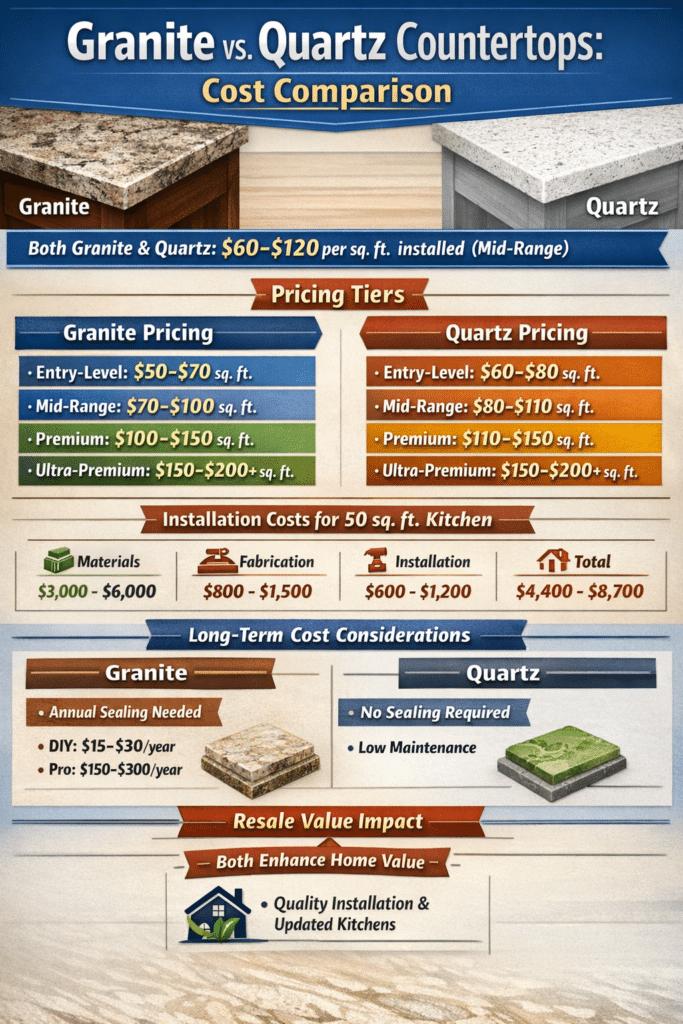
Granite and quartz overlap substantially in pricing. Both materials cost $60-$120 per square foot installed for mid-range options, making initial cost a minimal factor when choosing between them.
Granite Pricing Tiers:
Entry-level granite costs $50-$70 per square foot installed, offering limited colors and smaller slab selections. Mid-range granite runs $70-$100 per square foot installed, providing good variety and popular colors that suit most kitchens.
Premium granite reaches $100-$150 per square foot installed for unique colors and exotic patterns. Ultra-premium granite exceeds $150-$200+ per square foot installed for rare stones and dramatic patterns that create statement kitchens.
Quartz Pricing Tiers:
Entry-level quartz costs $60-$80 per square foot installed for basic patterns and standard colors. Mid-range quartz runs $80-$110 per square foot installed, offering diverse patterns and popular brands.
Premium quartz reaches $110-$150 per square foot installed for unique designs and thicker slabs. Ultra-premium quartz exceeds $150-$200+ per square foot installed for designer collections and special finishes.
Our contractor network emphasizes that material selection within granite or quartz affects costs more than choosing between them. Budget granite costs less than premium quartz, and vice versa. Choose based on desired aesthetics and specific slab appeal rather than assuming one material costs significantly more.
Installation Costs
Installation costs remain similar for granite vs quartz countertops. Both require professional fabrication and installation, with costs representing 30-40% of total project budgets.
For a typical 50 square foot kitchen:
Materials: $3,000-$6,000
Fabrication: $800-$1,500
Installation: $600-$1,200
Total: $4,400-$8,700
Complex layouts, multiple seams, or specialty edge profiles increase costs equally for both materials. Simple edges and minimal seams control expenses while maintaining clean, professional appearance.
Long-Term Cost Considerations
Granite Long-Term Costs:
Periodic sealing adds minor ongoing expenses. Annual sealing costs $15-$30 DIY or $150-$300 professionally. Over 20 years, expect $300-$600 for DIY sealing or $3,000-$6,000 for professional sealing.
Our network notes this represents modest additional investment compared to initial installation costs. Many homeowners handle sealing themselves as simple annual maintenance.
Quartz Long-Term Costs:
Quartz eliminates sealing expenses entirely. The material requires only routine cleaning without periodic treatments, reducing lifetime costs despite similar initial pricing.
However, if damage occurs, quartz repairs cost more than granite. Section replacement may become necessary rather than simple chip repairs, though both materials benefit from reasonable care preventing damage.
Resale Value Impact
Both granite vs quartz countertops enhance resale value similarly. Modern buyers expect quality stone countertops in updated kitchens, with neither material commanding premium pricing over the other.
Home values reflect overall kitchen quality rather than specific countertop material. What matters for resale: professional installation, design cohesion with cabinets, maintenance condition, and neutral color appeal.
Choose based on performance preferences and maintenance willingness rather than resale concerns. Both materials satisfy buyer expectations when part of quality kitchen renovations.
Climate and Environmental Performance
Climate affects countertop performance in ways many homeowners don’t initially consider. Understanding how materials respond to environmental conditions helps predict long-term satisfaction.
Humidity Effects
Humidity affects materials differently, particularly in regions experiencing significant seasonal moisture variations.
Granite in Humidity:
Properly sealed granite handles humidity well. Quality sealers prevent moisture penetration, maintaining performance regardless of ambient moisture levels.
However, inadequate sealing allows moisture absorption. This can temporarily darken granite until moisture evaporates, though it causes no permanent damage. Regular sealing prevents these cosmetic concerns.
Quartz in Humidity:
Quartz’s non-porous nature makes it immune to humidity effects. Moisture cannot penetrate surfaces regardless of conditions, eliminating concerns about seasonal moisture variations.
Our network notes that quartz proves slightly more forgiving in humid climates, particularly for homeowners who might postpone sealing maintenance on granite surfaces.
Temperature Fluctuations
Granite Temperature Performance:
Granite tolerates temperature fluctuations naturally. The stone formed under extreme conditions, creating inherent stability that handles seasonal temperature swings without concern.
However, extreme temperature differentials can theoretically cause stress. This proves more theoretical than practical in residential kitchens where temperature variations remain moderate.
Quartz Temperature Performance:
Quartz handles normal temperature ranges well. Kitchen temperature variations pose no concerns for engineered surfaces under typical residential conditions.
However, direct sunlight exposure may affect some quartz colors. UV exposure can cause slight yellowing in lighter colors over years, particularly near south-facing windows. Our design partners recommend considering window locations when selecting quartz colors for sun-exposed kitchens.
Environmental and Health Considerations
Environmental Impact:
Granite requires quarrying natural resources, creating environmental disturbance to formations that took millions of years to create. Additionally, transporting heavy granite slabs consumes significant energy, particularly for stone quarried internationally.
However, granite represents natural material requiring minimal processing beyond cutting and polishing, consuming less manufacturing energy than engineered products.
Quartz uses natural quartz crystals but requires manufacturing that consumes energy binding crystals with resins. However, quartz doesn’t deplete finite stone deposits—quartz crystals represent earth’s most abundant mineral, making supply essentially unlimited.
Indoor Air Quality:
Both granite vs quartz countertops meet indoor air quality standards for residential use. Some granite contains trace radon (naturally-occurring radioactive gas), but EPA studies confirm granite countertops pose negligible health risks with emissions far below outdoor air levels.
Quality quartz manufacturers use low-VOC resins meeting strict standards. Installed quartz releases negligible volatile organic compounds in homes, posing no air quality concerns.
Food Safety:
Both materials meet food safety standards for direct food contact. Sealed granite provides safe food preparation surfaces with sealers creating non-porous barriers preventing bacterial growth.
Quartz’s non-porous nature naturally resists bacterial growth, with studies showing quartz inhibits bacterial colonization effectively. Both materials provide safe food preparation surfaces when properly maintained.
Hire the Right Contractor the First Time
Use our free research guide and intelligence report to vet any contractor before you sign a contract.
Aesthetic Considerations
Design compatibility affects long-term satisfaction. Understanding how granite vs quartz countertops suit different styles helps ensure cohesive kitchens that age well.
Traditional Kitchen Styles
Traditional kitchens often prefer granite for its natural material authenticity. The organic patterns complement raised-panel cabinets, ornate details, and classic design elements common in craftsman, colonial, and Victorian homes.
Granite colors like Santa Cecilia, Kashmir White, or Giallo Ornamental pair beautifully with oak or maple cabinets popular in traditional spaces. Our design partners note that granite’s natural variations enhance rather than compete with traditional architectural details.
Contemporary Kitchen Styles
Contemporary kitchens work well with either material, though quartz offers advantages for modern aesthetics. Uniform patterns create clean, minimalist looks that suit flat-panel cabinets and streamlined designs.
Quartz concrete-look or solid color patterns deliver contemporary character with precision impossible in natural stone. These engineered designs create specific aesthetics that complement modern appliances and hardware finishes.
Transitional Kitchen Styles
Transitional kitchens—blending traditional and contemporary elements—work equally well with granite vs quartz countertops. Neutral granites like Kashmir White pair with Shaker cabinets and contemporary hardware. Simple quartz patterns complement traditional cabinets with modern appliances.
Our network reports that transitional spaces offer complete flexibility, allowing material selection based on other preferences like heat tolerance and maintenance requirements rather than aesthetic limitations.
Cabinet and Flooring Coordination
With White Cabinets:
Both granite vs quartz countertops work beautifully with white cabinets. Gray-veined quartz creates sophisticated contrast while maintaining brightness. Speckled granite adds warmth and texture that prevents spaces from feeling sterile.
With Dark Cabinets:
Light countertops prevent overwhelming darkness in kitchens with espresso or charcoal cabinets. White or light gray quartz brightens spaces effectively. Light granite with warm brown tones adds depth while maintaining adequate brightness.
With Wood Tone Cabinets:
Natural granite complements wood grains naturally. Warm granite tones harmonize with oak or cherry, creating cohesive organic aesthetics. Cool-toned quartz creates intentional contrast with honey-toned woods for contemporary-traditional blends.
Installation Considerations
Installation affects final results and project timelines. Understanding processes helps set realistic expectations for granite vs quartz countertops.
Measuring and Templating
Professional fabricators create precise templates of kitchens, measuring all countertop areas, marking sink and cooktop locations, and noting special details like electrical outlets or decorative edges.
Templating requires existing cabinets be installed and level. This ensures templates reflect actual conditions rather than plans, preventing fit issues during installation. Both granite vs quartz countertops require identical templating processes.
Fabrication Time
Fabrication timelines match between materials, typically requiring 2-3 weeks from template to installation. However, exotic granite colors may require longer lead times if material must be ordered from quarries. Similarly, special-order quartz colors extend timelines beyond stock offerings.
Our network recommends selecting materials early in renovation processes. Countertop lead times often determine overall project completion dates, particularly when coordinating with cabinet installation and appliance delivery.
Seam Placement
Seam placement requires careful planning for both materials. Granite’s natural patterns help hide seams as fabricators match veining across joints, making connections less obvious. However, seams remain visible upon close inspection regardless of fabricator skill.
Quartz seams also remain visible, though uniform patterns sometimes show seams more prominently than granite’s varied patterns. Minimize seam numbers through careful layout planning regardless of material selection.
Edge Profile Options
Both materials accommodate various edge profiles that affect final appearance and cost:
Eased edge: Slightly rounded corner, simple and affordable
Beveled edge: Angled corner creating subtle detail
Bullnose: Fully rounded edge providing smooth, safe profile
Ogee: S-curved decorative edge suited to traditional kitchens
Waterfall: Contemporary detail wrapping countertop over cabinet ends
Complex edges increase costs $10-$30 per linear foot for both granite vs quartz countertops. Simple edges control expenses while maintaining clean, professional appearance.
Quick Comparison: Granite vs Quartz at a Glance
| Feature | Granite | Quartz |
|---|---|---|
| Heat Resistance | ✅ Excellent (1,000°F+) | ⚠️ Limited (300°F max) |
| Stain Resistance | ⚠️ Needs sealing | ✅ Naturally resistant |
| Maintenance | Annual sealing required | ✅ No sealing needed |
| Cost (Mid-Range) | $70-$100/sq ft | $80-$110/sq ft |
| Appearance | Unique natural patterns | Uniform engineered looks |
| Scratch Resistance | ✅ Excellent (6-7 Mohs) | ✅ Excellent (7 Mohs) |
| Lifespan | ✅ 20+ years | ✅ 20+ years |
| Best For | Heat tolerance, natural aesthetics | Low maintenance, uniform color |
Making Your Decision: Granite vs Quartz Countertops
Choosing between granite vs quartz countertops depends on your priorities and lifestyle. Consider these factors when making final decisions based on insights from our network of fabricators and designers.
Choose Granite If You:
Granite suits homeowners who value natural materials and appreciate authentic stone’s unique character. If you frequently place hot pots on counters without trivets, granite’s exceptional heat resistance (tolerating 1,000°F+) prevents damage from cooking activities.
If you don’t mind annual sealing as routine maintenance (30-60 minutes yearly), granite’s modest upkeep requirements remain manageable. Homeowners who enjoy natural stone’s organic beauty and varied patterns find granite delivers the authentic aesthetics they seek.
Traditional kitchens benefit from granite’s ability to match historic home architectural character. Additionally, granite offers professional repair options when chips occur, with specialists able to fill damage invisibly enough for most homeowners’ standards.
Choose Quartz If You:
Quartz suits homeowners who prioritize low maintenance and want surfaces never requiring sealing. If you prefer consistent patterns and value uniform appearance throughout installations, quartz’s engineered precision delivers what natural stone cannot.
Homeowners seeking superior stain resistance without maintenance benefit from quartz’s non-porous composition that naturally resists staining. Busy lifestyles appreciate reduced maintenance requirements beyond simple daily cleaning.
If you need specific colors for precise design coordination, quartz offers exact color matching impossible with natural stone variations. Contemporary kitchens benefit from quartz’s engineered precision and modern aesthetic options.
When Either Works Equally Well:
Both granite vs quartz countertops work when you have mid-range budgets, as both cost similarly in middle price ranges. If you want durable surfaces resisting scratching and normal wear, both materials deliver 20+ years of reliable service.
Homeowners needing easy cleaning appreciate that both clean with simple soap and water. Transitional design styles suit both materials equally, allowing selection based on other factors. If you seek resale value enhancement, both materials improve home values comparably.
Frequently Asked Questions About Granite vs Quartz Countertops
Which is more durable—granite or quartz countertops?
Both granite vs quartz countertops offer excellent durability for modern kitchens. They resist scratching equally well under normal use, with both rating high on the Mohs hardness scale (6-7 for granite, 7 for quartz).
However, durability differences exist in specific areas. Granite withstands heat better, tolerating direct contact with hot pots without damage up to 1,000°F+. Quartz requires trivets protecting surfaces from extreme heat exceeding 300°F to prevent resin damage.
Quartz resists staining better through its non-porous composition that naturally prevents liquid penetration. Granite requires annual sealing to maintain stain resistance, with unsealed granite vulnerable to wine, coffee, or oil absorption.
Both materials can chip along edges from sharp impacts. Our network reports that granite repairs prove easier than quartz repairs, though both benefit from reasonable care avoiding edge impacts. Overall, both provide 20+ years of reliable service. Choose based on which specific durability characteristics matter most for your cooking habits and maintenance preferences.
Do granite countertops need to be sealed?
Yes, granite requires periodic sealing to maintain stain resistance. Granite’s porous natural composition allows liquids to penetrate unsealed surfaces, creating permanent staining from wine, coffee, oils, or acidic substances.
Quality sealers create protective barriers preventing liquid absorption. This maintains stain resistance and makes daily cleaning easier by preventing spills from soaking into stone.
Sealing frequency depends on granite density and sealer quality. Most granite needs annual sealing for optimal protection. Dense granites like absolute black may extend to 2-3 years between applications. Lighter, more porous granites may require semi-annual sealing.
Test whether granite needs sealing by placing water drops on surfaces. If water beads up, sealer remains effective. If water soaks in darkening the stone, resealing is necessary. Sealing proves straightforward—apply sealer, let penetrate 15-20 minutes, wipe excess, allow overnight curing. Quality sealers cost $15-30 per bottle treating typical kitchens multiple times. Professional sealing costs $150-300 if preferred.
Which costs more—granite or quartz?
Granite vs quartz countertops cost similarly in most markets. Both range $60-$120 per square foot installed for mid-range options, making initial cost a minimal factor when choosing between materials.
However, pricing varies more within each material category than between materials. Entry-level granite costs $50-70 per square foot while premium granite reaches $150-200+ per square foot. Similarly, basic quartz costs $60-80 while designer quartz exceeds $150 per square foot.
Material selection within granite or quartz affects costs more than choosing between them. Budget-conscious homeowners find affordable options in both categories. Those seeking premium materials pay similar amounts for high-end granite or quartz.
Long-term costs differ slightly. Granite requires annual sealing costing $15-30 DIY or $150-300 professionally. Over 20 years, this adds $300-6,000 depending on DIY versus professional approach. Quartz eliminates sealing costs entirely but may cost more for repairs if damage occurs.
Our network recommends choosing based on performance preferences rather than assuming one material costs significantly more than the other.
Can you put hot pans on quartz countertops?
No, avoid placing very hot pots directly on quartz countertops. The polymer resins binding quartz crystals can burn, scorch, or discolor when exposed to extreme heat exceeding 300°F, creating permanent damage that cannot be repaired.
Always use trivets or hot pads protecting quartz from cookware fresh from stovetops or ovens. This simple precaution prevents permanent damage to surfaces and maintains appearance for decades.
Brief contact with warm items causes no issues. Normal dish temperatures from microwaves or moderate oven use (under 200°F) pose no risk to quartz surfaces. However, pots from high-heat cooking or fresh from 400°F+ ovens require protection.
In contrast, granite tolerates direct hot pot contact naturally. The stone formed under extreme volcanic conditions, creating exceptional heat resistance that handles temperatures exceeding 1,000°F without damage.
If you frequently place hot cookware directly on counters as part of your cooking routine, granite offers better heat tolerance. If you’re comfortable using trivets consistently, quartz’s superior stain resistance and zero-maintenance sealing may outweigh heat considerations. Many homeowners choose quartz despite heat precautions, finding trivets a minor inconvenience compared to quartz’s low-maintenance benefits.
Which is better for resale value—granite or quartz?
Both granite vs quartz countertops enhance resale value equally in modern real estate markets. Contemporary homebuyers expect quality stone countertops in updated kitchens, with neither material commanding premium pricing over the other.
Home values reflect overall kitchen quality, condition, and design rather than specific countertop material choice. What matters more for resale: overall kitchen condition with updated appliances and cabinets, quality installation with professional fabrication and minimal seams, design cohesion with countertops coordinating with cabinet styles, maintenance condition showing well-cared-for surfaces, and neutral appeal with colors and patterns suiting broad buyer preferences.
Our network reports that both materials satisfy buyer expectations when part of quality kitchen renovations. Neither creates appraisal disadvantage compared to the other in comparable installations.
Choose granite vs quartz countertops based on your preferences and maintenance willingness rather than resale concerns. Both materials meet buyer standards for modern kitchens. Focus on selecting colors and patterns with broad appeal if resale timing is near-term. Neutral whites, grays, and beiges in either material attract the widest buyer demographic across most markets.
Related Countertop Resources
Explore these helpful guides and tools to support your countertop selection:
- Kitchen Remodeling Cost Calculator – Estimate your complete project costs
- Kitchen Countertop Materials Comparison – Compare all countertop options
- Kitchen Cabinet Buying Guide – Coordinate cabinets with countertops
- Kitchen Remodeling Guide: Planning, Costs, and Design – Complete renovation overview
Regional Kitchen Remodeling Services
Full Affiliate Disclosure
Kore Komfort Solutions LLC participates in the Amazon Services LLC Associates Program and other affiliate advertising programs. These programs allow us to earn advertising fees by linking to Amazon.com and other partner retailers.
When you click on affiliate links in this article and make a purchase, we may receive a commission at no additional cost to you. This commission helps support our educational content and allows us to continue providing comprehensive home improvement guides.
We maintain strict editorial independence in our recommendations. Our network of contractors, fabricators, and design professionals only recommends products they trust and use in their own projects. All product suggestions are based on quality, durability, and value—never on commission rates.
Whether you purchase through our links or directly from retailers, the price you pay remains the same. We appreciate your support when you choose to use our affiliate links, as it enables us to keep producing valuable content for homeowners.
For questions about our affiliate relationships or product recommendations, please contact us directly.
Hire the Right Contractor the First Time
Use our free research guide and intelligence report to vet any contractor before you sign a contract.